
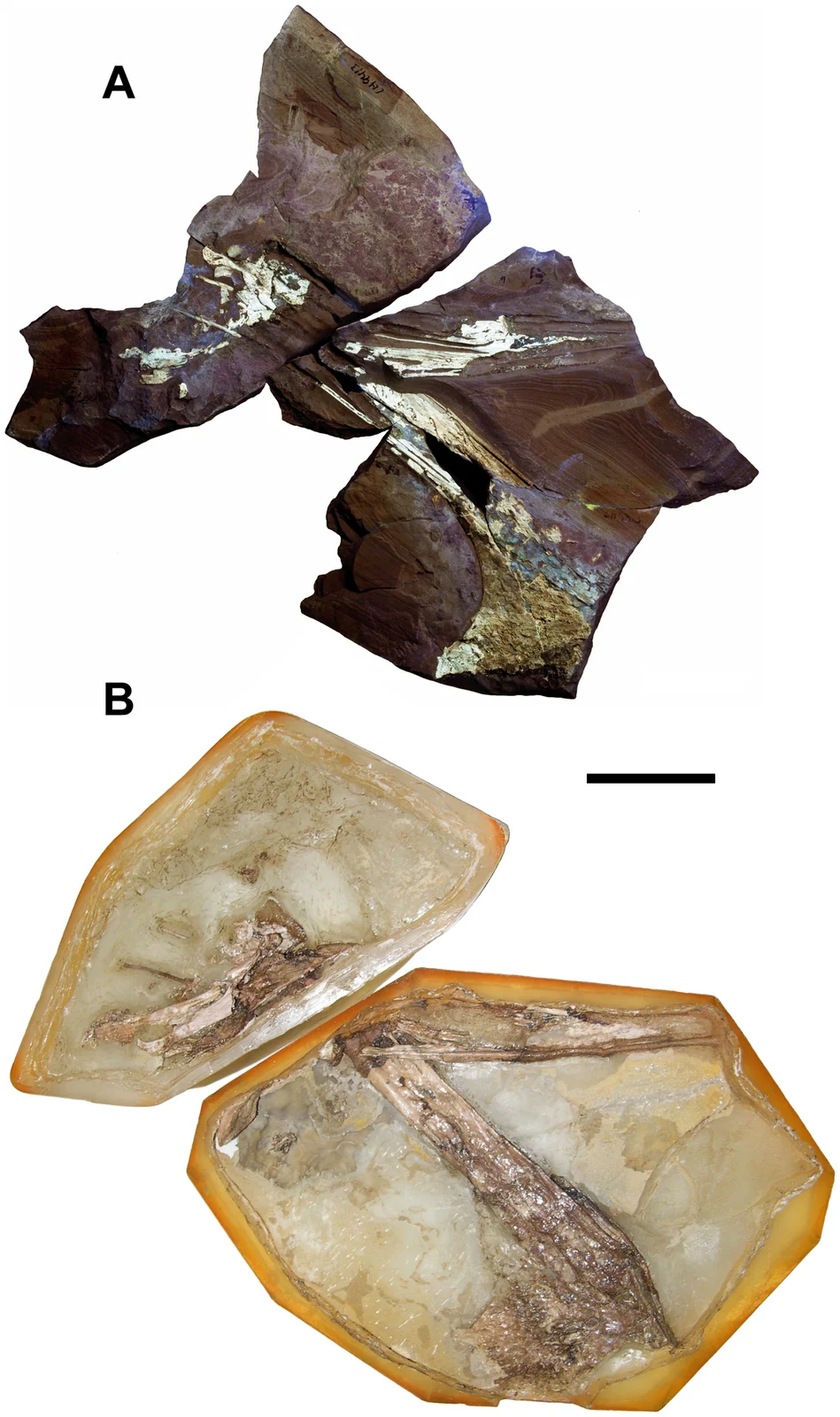
Holotype MCCM-LH 9413: ultraviolet slab above; acid-prepared counterslab below.
Whole fossil plate. Compressed for display.
Overview
Named in 2012, Europejara is represented by crushed skull and jaws MCCM-LH 9413 from Barremian limestone at Las Hoyas. Its backward-curved lower-jaw crest distinguishes it from other tapejarids; missing and compressed bones limit reconstruction.
The original analysis placed it within Tapejarinae but poorly resolved its relationships inside that clade. Anatomical comparisons with other tapejarids are evidence of shared and differing characters, not proof of a direct ancestral sequence.
Fruit or seed eating and seed dispersal were tapejarine hypotheses based on jaw shape and co-occurring early flowering plants. The paper acknowledged absent direct dietary evidence and insufficient quantitative support for that interaction.
Origins & earliest records
Biological origin undated.
Evidence & interpretation
Fossils.
Selected bibliography
Documented works and useful reading. This is not a list of every appearance.
- 01
A New Crested Pterosaur…
Selected evidence.
Family, evolution & connections
Taxonomic classification
A hierarchy of classified groups, not a chain of direct ancestors.
Source note: GBIF ranks; intermediate clades omitted.
- kingdomAnimalia
- phylumChordata
- genusEuropejara
- speciesEuropejara olcadesorum
References
Sources supporting this profile. Linked pages have their own scope and editorial standards.
- Primary researchA New Crested Pterosaur…Research access: 2026-10-07
- Institutional taxonomyGBIF taxonomic matchResearch access: 2026-10-07
Image credits
Scientific specimen plateHolotype MCCM-LH 9413: ultraviolet slab above; acid-prepared counterslab below.
Whole fossil plate. Compressed for display.