
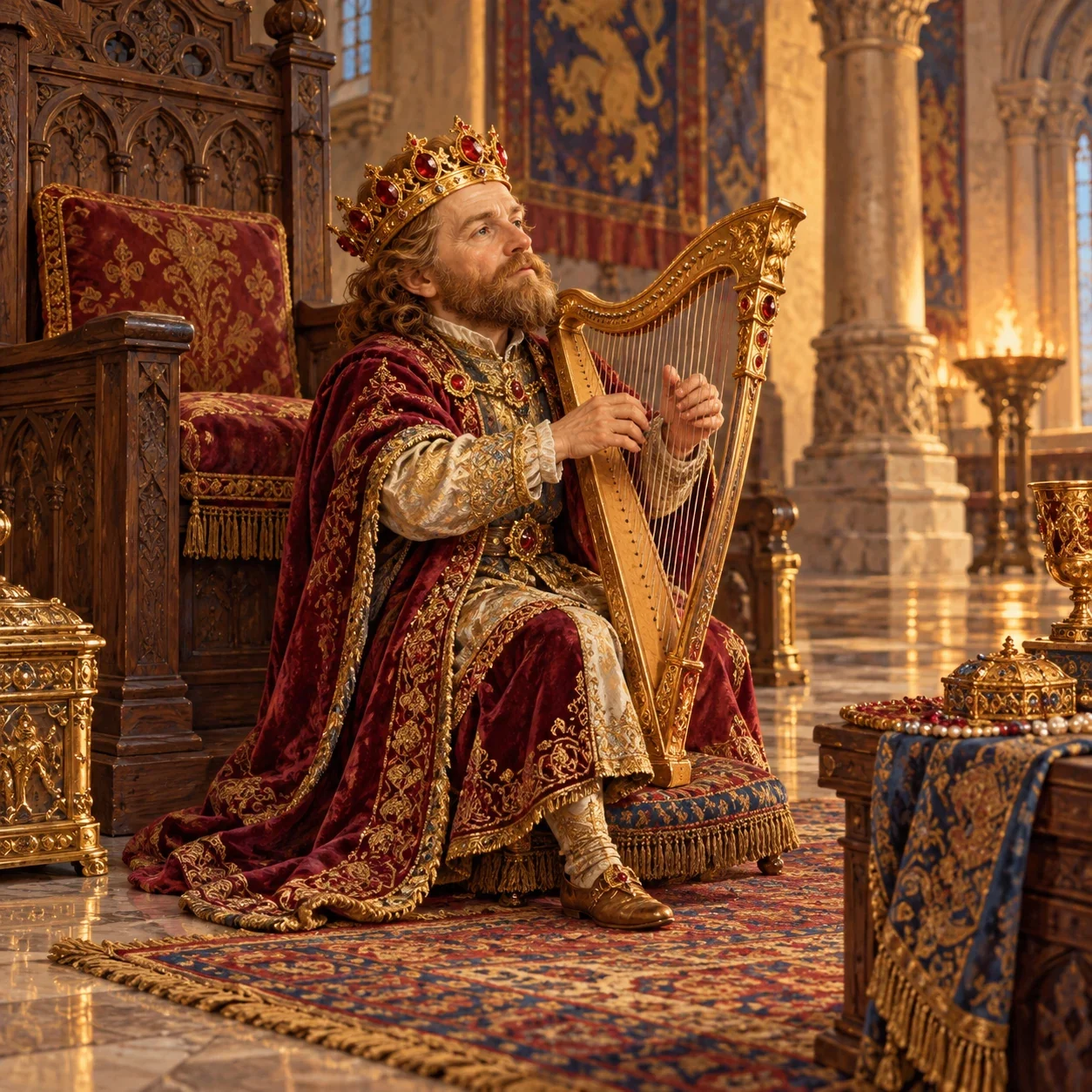
AI-generated interpretation of Elberich playing the harp at Otnit’s court. Crown, red precious stones and harp follow the selected episode; a mature face, beard, clothing, scale and palace design are artistic choices. The initial meeting presents him as infantlike; this imagined later portrait is not an authenticated anatomy or a depiction of a modern fantasy character.
AI-generated interpretation of Elberich playing the harp at Otnit’s court. Crown, red precious stones and harp follow the selected episode; a mature face, beard, clothing, scale and palace design are artistic choices. The initial meeting presents him as infantlike; this imagined later portrait is not an authenticated anatomy or a depiction of a modern fantasy character.
Overview
Keightley’s account introduces Elberich as a dwarf who assists the Lombard ruler Otnit, also called Ortnit. Otnit seeks the daughter of a Syrian ruler after hearing her praised in council. His mother gives him a ring and directs him to an adventure near a linden and a spring. The route brings him to an apparently abandoned, richly dressed infant beneath the tree. The figure is Elberich, visible because of the ring. A struggle follows, and the apparently vulnerable stranger proves a powerful, knowledgeable opponent rather than an ordinary lost child.
Elberich offers extraordinary armour as ransom: a valuable sword, mail, leg armour, helmet and shield, described through an extended catalogue of material and protective qualities. He then persuades Otnit to lend him the ring. Once it changes hands, he disappears from the young ruler’s sight and mocks his predicament. Eventually he returns it and says that he is Otnit’s father. This is a revelation within the romance, not an independently established genealogy. He promises help in gaining the desired bride, provided Otnit treats his mother well. The ring controls this encounter’s visibility; it does not prove that every dwarf needs the same object or follows the same rule.
When Otnit’s fleet reaches the eastern port named Sunders, Elberich has already travelled unseen on the mast. He supplies a stone that enables its bearer to speak all languages and helps his son enter by posing as a merchant. Otnit subsequently proposes killing the inhabitants by night. The dwarf condemns and prevents that treachery, although he later assists the military conquest of the city. His role combines moral restraint with participation in the expedition’s violence, rather than making him simply a harmless donor of magical equipment.
Elberich negotiates unsuccessfully with the ruler at Muntabur, guides Otnit’s army while invisible and disables the city’s defences. He also humiliates the opposing ruler by pulling his beard and hair where guards cannot strike the hidden assailant. Otnit presents the unseen standard-bearer to his soldiers as a divine guide. The literary opposition between Christians and their adversaries, including the text’s distorted description of the latter’s gods, belongs to this medieval romance and its later retelling. It is not an account of actual religious practice or a reliable geography of the eastern Mediterranean.
The princess accepts marriage amid persuasion, her father’s danger and her mother’s consent. Elberich leads her from the city, insists that she be baptized before intercourse, and joins Elias in the baptism before the voyage home. Later she mistakes the envoy she encountered for Otnit’s deity. He explains that the figure was Elberich and asks the dwarf to show himself. Elberich appears at court with a splendid crown, then plays a harp to the assembled company. He leaves further riches and advises compensation for families bereaved by the expedition before vanishing from the story.
This profile follows the complete Elberich episode as Keightley presents it, not a complete reading of the underlying Otnit poem. Keightley closes by asserting that this dwarf supplied a model for Oberon, and his note proposes a chain linking the names Elberich, Albrich, Auberon and Oberon through Grimm. Those statements remain the compiler’s historical argument, not a demonstrated influence on any particular modern fantasy design. The selected account supplies its own substantial identity: an elusive father, armour-giver, linguistically resourceful guide, coercive war-helper and musician whose final advice addresses the human cost of his son’s venture.
Origins & earliest records
Thomas Keightley, The Fairy Mythology, revised and enlarged edition, London: George Bell & Sons, 1892. Complete Elberich/Otnit account, pp208–213; notes251–255.
Records & interpretation
Complete selected account, quoted verses, ending and all attached notes read. Underlying medieval poem not independently collated. Compiler’s proposed Oberon derivation and uncertain place-name identifications are attributed.
Selected bibliography
Documented works and useful reading. This is not a list of every appearance.
- 01
The Fairy Mythology — Complete Elberich/Otnit account, pp208–213; notes251–255
Complete selected historical English account; does not claim full upstream poem or saga collation.
Family & connections
A source-supported family tree or inspiration record has not yet been compiled for this profile. Related reading below indicates a connection in subject matter, not a proven lineage or creative influence.
References
Sources supporting this profile. Linked pages have their own scope and editorial standards.
- Historical English compilation and literary retellingKeightley1892 — Complete Elberich/Otnit account, pp208–213; notes251–255Research access: 2026-10-27
Image credits
AI-generated illustrationAI-generated interpretation of Elberich playing the harp at Otnit’s court. Crown, red precious stones and harp follow the selected episode; a mature face, beard, clothing, scale and palace design are artistic choices. The initial meeting presents him as infantlike; this imagined later portrait is not an authenticated anatomy or a depiction of a modern fantasy character.
AI-generated interpretation of Elberich playing the harp at Otnit’s court. Crown, red precious stones and harp follow the selected episode; a mature face, beard, clothing, scale and palace design are artistic choices. The initial meeting presents him as infantlike; this imagined later portrait is not an authenticated anatomy or a depiction of a modern fantasy character.