
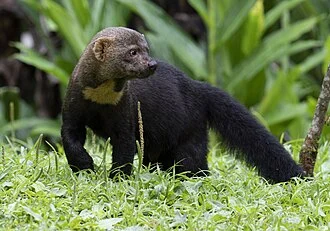
A dark tayra with a pale throat patch standing among green plants.
A male tayra photographed in the wild in Brazil, according to the source caption.
Overview
The tayra has a long neck, robust head and bushy tail. Its generally dark brown body contrasts with a paler head and often a pale diamond-shaped throat patch.
Habitats include tropical forests, secondary vegetation and plantations. Tayras move on the ground and in trees, sheltering in hollow trees or other animals' burrows and eating prey and fruit.
Soley and Alvarado-Díaz (2011) combined field observation, camera traps and radio telemetry to document tayras storing unripe climacteric fruits, which continued ripening after harvest, for later consumption. The authors proposed that caching secures fruit before competitors find it attractive; this adaptive explanation is a hypothesis, not proof of human-like planning.
Origins & earliest records
Naming and evolutionary origin are not established here.
Evidence & interpretation
Institutional account and original field-study abstract.
Selected bibliography
Documented works and useful reading. This is not a list of every appearance.
- 01
Prospective thinking in a mustelid? Eira barbara (Carnivora) cache unripe fruits to consume them once ripened
Selected bibliography; field study of fruit caching.
Family, evolution & connections
Taxonomic classification
A hierarchy of classified groups, not a chain of direct ancestors.
Source note: Cited ranks; subspecies not reviewed.
- OrderCarnivora
- FamilyMustelidae
- SpeciesEira barbara
References
Sources supporting this profile. Linked pages have their own scope and editorial standards.
- Institutional species accountEira barbara — Animal Diversity Web, University of MichiganResearch access: 2026-10-07
- Scientific article abstractSoley and Alvarado-Díaz: fruit-caching study (2011)Research access: 2026-10-07
Image credits
Attributed biological photographA dark tayra with a pale throat patch standing among green plants.
A male tayra photographed in the wild in Brazil, according to the source caption.