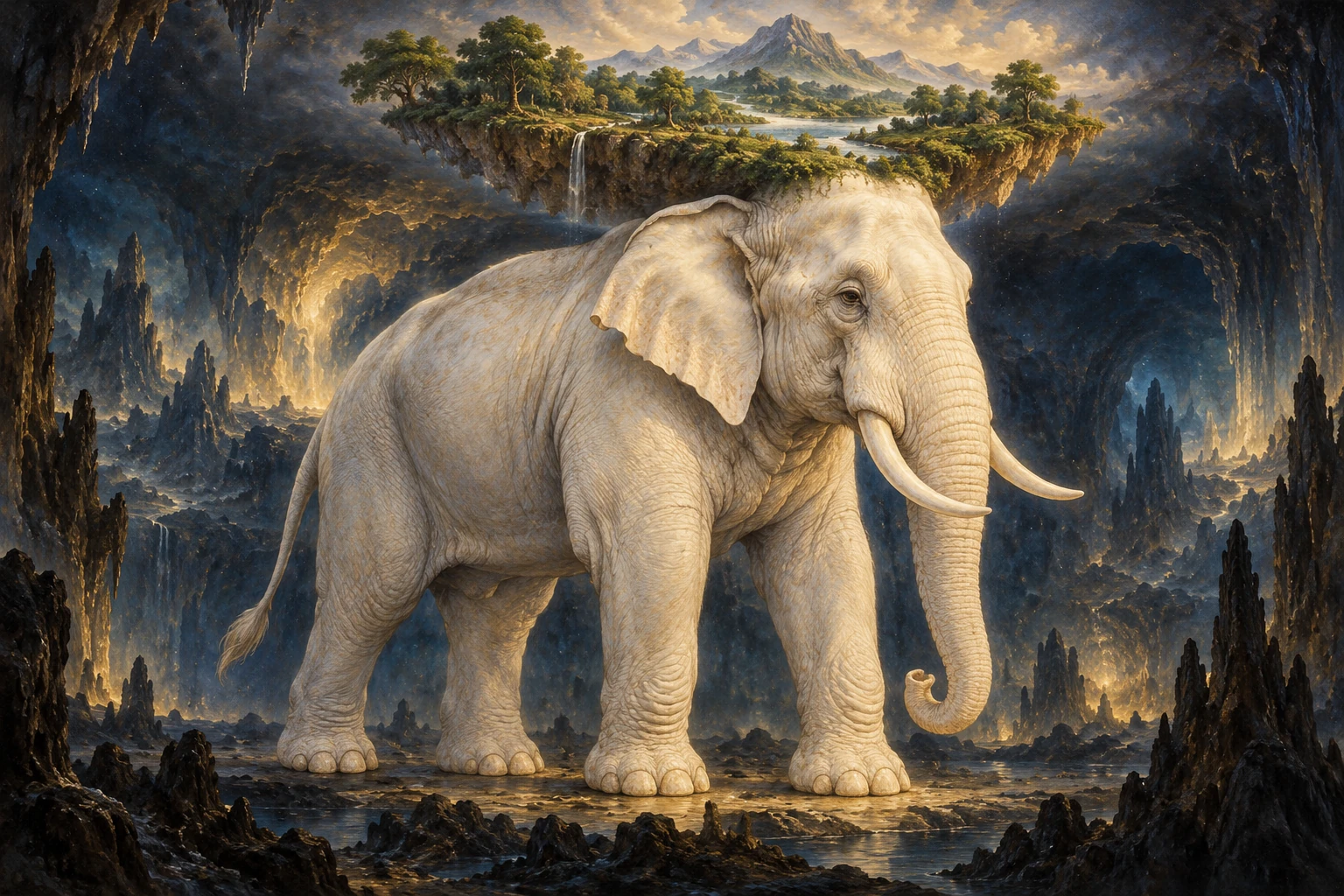
AI-generated interpretation of Bhadra, one of the four earth-supporting elephants in Griffith’s Ramayana. The account specifies his white colour and support of the earth on his head. Anatomy, cavern, land shape, trees, mountains and lighting are imagined; this is neither a traditional icon nor a map or reconstruction, and it does not depict Discworld.
One named guardian illustrates the four-elephant account. The selected cantos do not place a turtle underneath them.
Overview
Griffith’s rendering places the elephants within the story of King Sagar’s interrupted sacrifice. Indra, disguised as a demon, steals the sacrificial horse. Sagar sends his sixty thousand sons to search and orders them to dig through the earth. Their excavation kills many creatures, provoking a complaint to the divine father. The elephants are encountered during this destructive search, rather than introduced as a separate general catalogue of Hindu cosmology.
In the east the princes encounter Vírúpáksha, an immense immortal elephant carrying the earth, its hills and wooded plains upon his head. The narrative explains earthquakes through his movement: when distressed and seeking rest, he shakes that head and the earth trembles. The sons walk respectfully around him before continuing. In the south they meet Mahápadma, also supporting the earth on his head; in the west they greet mountain-sized Saumanas. Their northern encounter is with Bhadra, expressly described as white and marked with auspicious signs. Each receives reverential circling and greetings.
The account then follows the princes northeast, where they discover the horse near Kapil. They mistake him for the thief and rush at him. Kapil reduces them to ashes. The elephants do not punish the searchers or explain away their actions; their appearances punctuate a journey whose violent conclusion occurs elsewhere. Griffith’s text identifies Kapil here with Vásudeva, a name his note explains as Vishnu. The translator’s additional volcanic speculation is an interpretive note, not part of the elephants’ described behaviour.
Sagar subsequently sends his grandson Anśumán down the same route. He approaches each elephant respectfully and asks about his uncles and the stolen horse. Each responds favourably, predicting his successful return with the animal. After finding the ashes, Anśumán meets Garuḍ, who explains the need for Gangá’s purifying water. The prince returns with the horse so that Sagar can complete the sacrifice, although bringing the river down remains unresolved at this point. The elephants thus act both as supports of the earth and as speaking guardians within the journey.
This entry follows three complete cantos of one nineteenth-century English verse translation. Its four named elephants should not be silently replaced by other directional-elephant lists, assigned extra tusks or merged with Airavata. No turtle beneath the elephants is specified in these selected cantos. Their underground positions and reverential encounters belong to the epic narrative; this account does not describe a physical model of the planet or a uniform belief held by all Hindu communities.
Origins & earliest records
The Ramayan of Valmiki, translated into English verse by Ralph T. H. Griffith, title-page dates 1870–1874; Book I, cantos XL–XLII.
Records & interpretation
Root read all three selected cantos and eleven associated translator notes from an exact retained Gutenberg transcription. Sanskrit witnesses and other directional-elephant traditions were not collated. The selected account distinguishes earth-bearing heads in the verse from the backs mentioned in Gorresio’s comparative footnote.
Selected bibliography
Documented works and useful reading. This is not a list of every appearance.
- 01
The Ramayan of Valmiki, Book I, XL The Cleaving of the Earth; XLI Kapil; XLII Sagar’s Sacrifice
Three complete selected cantos and all eleven attached notes; edition dates from the transcription’s title page.
Family, evolution & connections
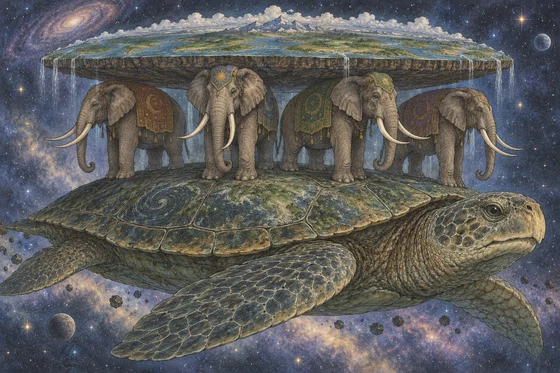
World elephant (Discworld)
In Griffith’s Ramayana, Sagar’s sons meet four immense elephants in successive directions beneath the earth. The verse describes earth-bearing heads; Bhadra is white, and the elephants later speak encouragement to Anśumán. This is a source-specific world-supporting animal motif for comparison with Discworld. These cantos do not put the elephants on a turtle or establish that Pratchett consulted this translation.
References
Sources supporting this profile. Linked pages have their own scope and editorial standards.
- Hindu epic in historical English translationGriffith, The Ramayan of Valmiki (1870–1874), Book I, cantos XL–XLII and notes 183–193Research access: 2026-10-25
Image credits
Modern interpretation of an epic narrativeAI-generated interpretation of Bhadra, one of the four earth-supporting elephants in Griffith’s Ramayana. The account specifies his white colour and support of the earth on his head. Anatomy, cavern, land shape, trees, mountains and lighting are imagined; this is neither a traditional icon nor a map or reconstruction, and it does not depict Discworld.
One named guardian illustrates the four-elephant account. The selected cantos do not place a turtle underneath them.