
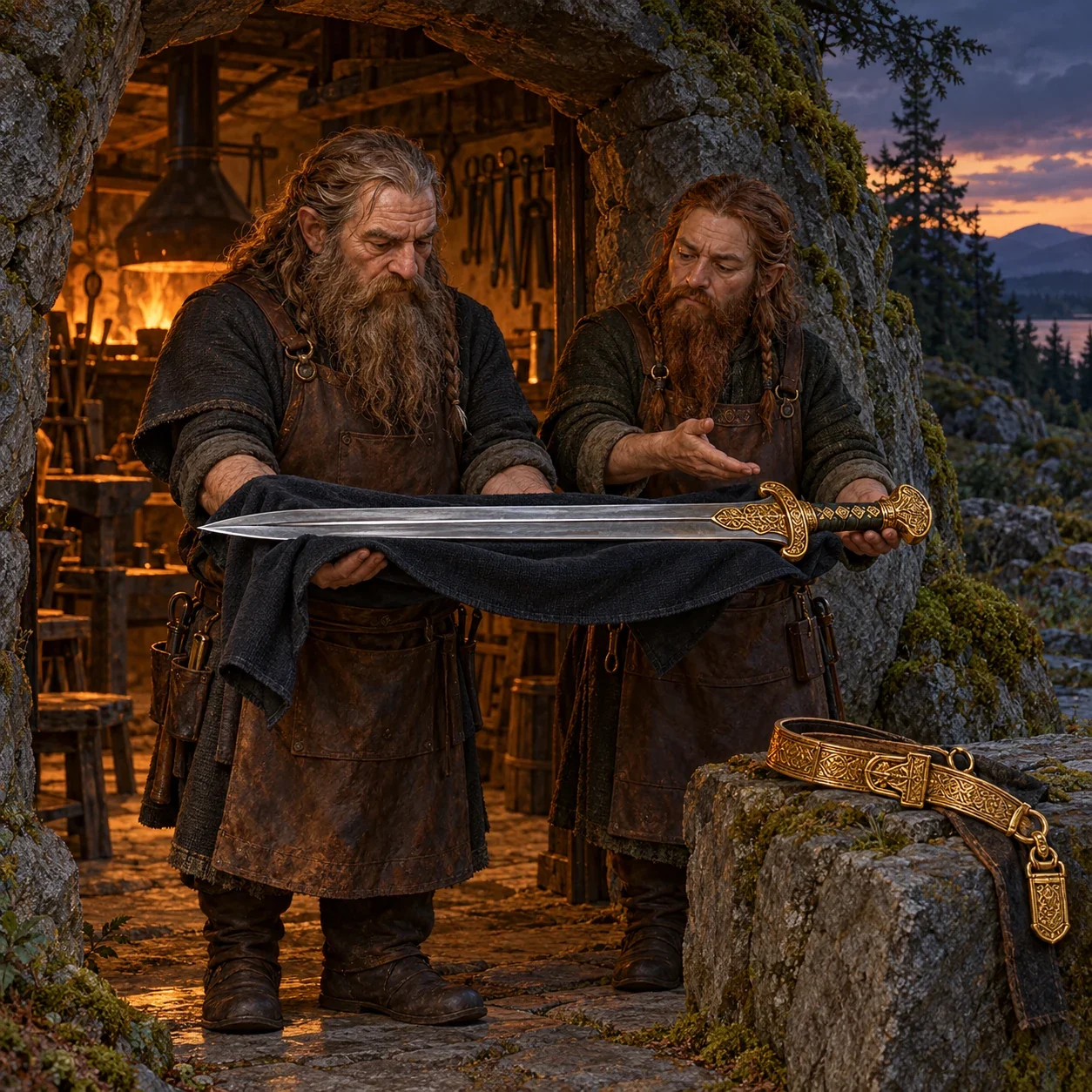
AI-generated interpretation of Dyren and Dualin presenting Tirfing at a hill doorway. The paired makers, completed sword, gold hilt and gold belt follow the account. Faces, ages, beards, stature, clothing, tools and the visible workshop are imagined, not a universal dwarf anatomy or a reconstruction of an actual historical forge.
AI-generated interpretation of Dyren and Dualin presenting Tirfing at a hill doorway. The paired makers, completed sword, gold hilt and gold belt follow the account. Faces, ages, beards, stature, clothing, tools and the visible workshop are imagined, not a universal dwarf anatomy or a reconstruction of an actual historical forge.
Overview
Dyren and Dualin are the two named dwarfs in Keightley’s account of the sword Tirfing. Their encounter begins when King Suaforlami, hunting in Gardarike, becomes lost near sunset. He sees them outside a hill and blocks their return to the rock with his sword. When they offer a ransom for their lives, he asks their names and recognizes exceptionally skilled makers. He demands a sword with a gold hilt and belt, incapable of missing its blow or rusting, able to cut iron and stone like cloth, and victorious in combat. The exchange begins under threat, rather than with a freely offered gift.
The dwarfs deliver the weapon at the appointed time. From the doorway, Dualin announces additional conditions: drawing it will always bring a human death, three great atrocities will be committed with it, and it will kill its first royal owner. Suaforlami lashes out at the dwarf, driving the new blade into solid stone. Keightley does not say that this blow kills either maker. The pair leave the foreground of the narrative, but their cursed work governs what follows. Their shared role is therefore preserved in one account, without manufacturing separate biographies or treating the weapon itself as a biological creature.
Suaforlami later falls to the berserker Andgrim, who takes the sword. Andgrim’s sons subsequently die in a contest involving Hialmar, Oddur and Ingaborg, and Angantyr is buried with Tirfing. His daughter Hervor grows up, adopts a male name and joins sea-raiders. She reaches the burial island alone and calls upon her dead father for the sword amid the tombs’ fire. He reluctantly gives it up. Keightley’s note explains the sepulchral flames as a reported northern belief surrounding heroic or treasure-bearing graves, not as a physically verified phenomenon.
The curse acts through more than deliberate battlefield killing. At Gudmund’s court, a servant draws the blade while Hervor is playing a board game, and she abruptly kills him with it. Later she gives Tirfing to her son Heidreker as he leaves home. Admiring it, he draws it and kills his mild-mannered brother Angantyr. Further episodes include the deaths of his father-in-law and his foster-son, the latter after an encounter with a boar has already prompted him to unsheathe the weapon. The account associates such killings with the sword’s demand for blood; it does not make that supernatural explanation a factual account of human violence.
After Heidreker’s murder, his Scottish slaves carry the sword away, but his succeeding son Angantyr recovers it. The closing battle brings victory over the Huns together with the death of Angantyr’s own brother Laudur. Keightley does not supply a simple numbered adjudication of exactly which three acts fulfil the original warning. His retelling instead follows the repeated family losses surrounding a weapon commissioned as unfailingly advantageous. The selected witness retains spellings such as Dyren, Dualin and Suaforlami; no uninspected edition’s names or genealogical details are silently substituted.
Keightley cites Hervarar Saga generally rather than providing a modern critical chapter apparatus. His following discussion offers etymologies and nineteenth-century theories about dwarfs, including comparisons with historical peoples and personified natural powers. Those conjectures are separate from the named pair’s actions and are not adopted as accounts of real populations or medical conditions. The secure scope here is the complete historical English Tirfing narrative, its ending and attached notes, without claiming to have read every medieval version or established the original form of the story.
Origins & earliest records
Thomas Keightley, The Fairy Mythology, revised and enlarged edition, London: George Bell & Sons, 1892. The Dwarf-Sword Tirfing, pp72–75, complete narrative and following commentary; notes117–121.
Records & interpretation
Complete selected narrative through Laudur’s death, following dwarf commentary and attached notes117–121 read. Multiline note121 includes its verse and final continuation. Underlying saga versions not independently collated.
Selected bibliography
Documented works and useful reading. This is not a list of every appearance.
- 01
The Fairy Mythology — The Dwarf-Sword Tirfing, pp72–75, complete narrative and following commentary; notes117–121
Complete selected historical English account; does not claim full upstream poem or saga collation.
Family & connections
A source-supported family tree or inspiration record has not yet been compiled for this profile. Related reading below indicates a connection in subject matter, not a proven lineage or creative influence.
References
Sources supporting this profile. Linked pages have their own scope and editorial standards.
- Historical English compilation and literary retellingKeightley1892 — The Dwarf-Sword Tirfing, pp72–75, complete narrative and following commentary; notes117–121Research access: 2026-10-27
Image credits
AI-generated illustrationAI-generated interpretation of Dyren and Dualin presenting Tirfing at a hill doorway. The paired makers, completed sword, gold hilt and gold belt follow the account. Faces, ages, beards, stature, clothing, tools and the visible workshop are imagined, not a universal dwarf anatomy or a reconstruction of an actual historical forge.
AI-generated interpretation of Dyren and Dualin presenting Tirfing at a hill doorway. The paired makers, completed sword, gold hilt and gold belt follow the account. Faces, ages, beards, stature, clothing, tools and the visible workshop are imagined, not a universal dwarf anatomy or a reconstruction of an actual historical forge.