
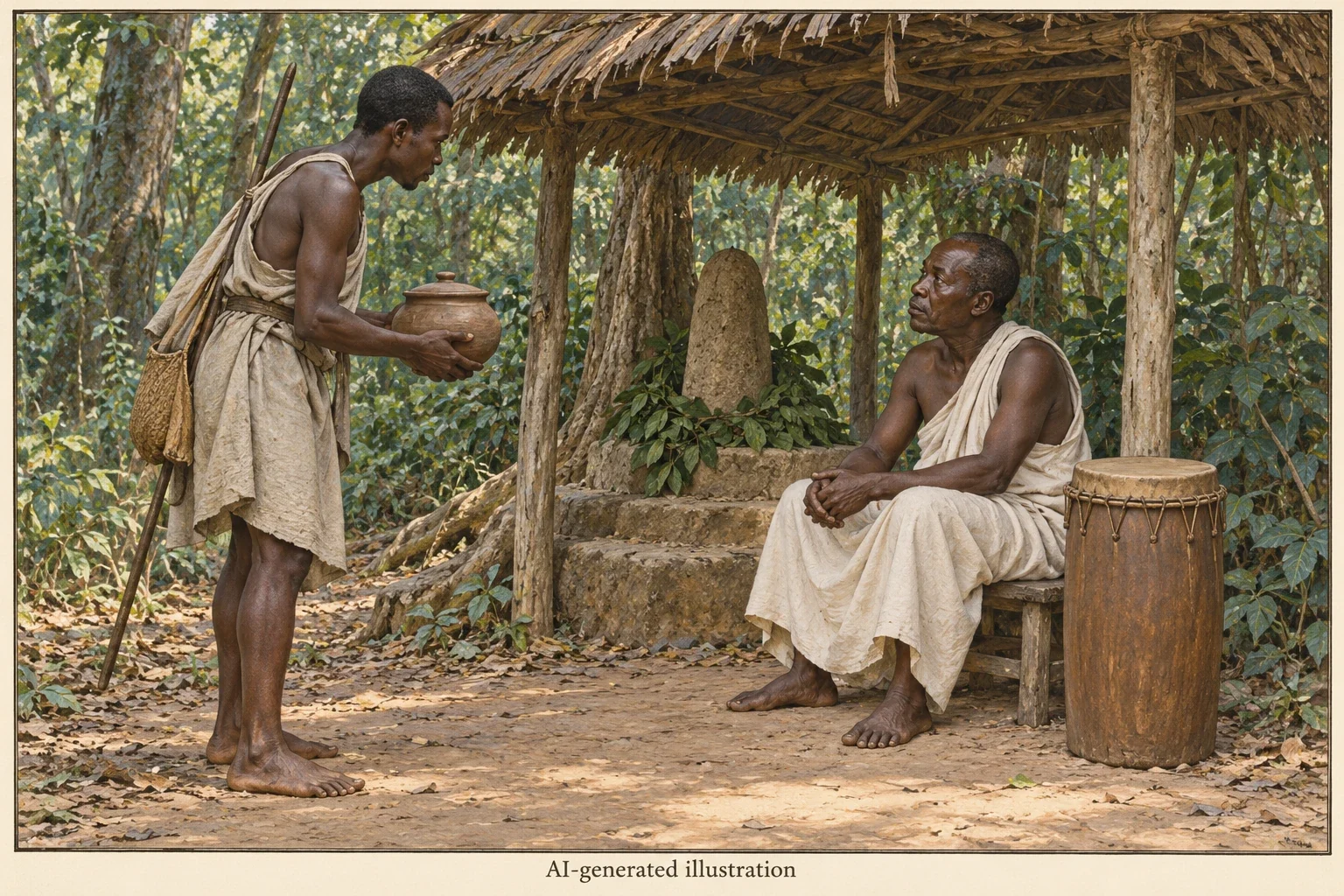
An imagined hunter with an offering pot consults a medium beside a closed drum.
Hunters consult Dungu through a medium in Roscoe’s Bunyoro-attributed account. Human appearance, garment and scenery are illustrative choices, not authenticated divine anatomy or historical costume.
Overview
Roscoe explicitly calls Dungu a Bunyoro god and identifies his medium, Lusoke of Kikoma, as a Munyoro. A footnote distinguishes Bunyoro, the historical country, from Banyoro, the people. The principal temple lies in a forest on the Bulemezi–Bunyoro border, with a second temple at Busenya in Budu. The priest bears the title Lwekika. This attribution places a Bunyoro deity and medium within the author’s broader Baganda collection without turning the two community identities into synonyms.
Before hunting, people bring beer and ask where game may be found. The account describes protective amulets, cords for nets and preparations applied to weapons, all with powers attributed to them. Successful hunters return a portion of captured game and firewood for cooking it. A special drum contains a prepared object made from portions of hunted animals and birds, hunting preparations, miniature weapons, cords and trapping materials. Roscoe says the object is fixed upright inside with a mixture of animal dung and sacrificial blood.
When the medium is to speak under divine possession, he smokes a pipe and the drum is beaten. Kalisa, another named deity, is described as Dungu’s servant whose task is to herd wild animals. The subsection provides ritual offices, relationships and objects rather than a visible body for Dungu. Its claims about protective or hunting efficacy remain attributed to the collected account. The preface credits Apolo Kagwa with access to elders and religious authorities, but the individual narrator of this subsection is not identified.
Origins & earliest records
John Roscoe, The Baganda (London: Macmillan,1911), Chapter IX, pp.311–312.
Records & interpretation
Complete Dungu subsection, including the Bunyoro/Munyoro/Banyoro footnote, both temple locations, hunting consultations, prepared drum, possession and Kalisa. Complete selected continuous subsection and preface ix–xii read from retained original English OCR. No whole-book or contemporary-community consensus claim.
Selected bibliography
Documented works and useful reading. This is not a list of every appearance.
- 01
The Baganda: An Account of Their Native Customs and Beliefs
Chapter IX, pp.311–312, complete selected subsection; preface ix–xii for method and mediation.
Family & connections
A source-supported family tree or inspiration record has not yet been compiled for this profile. Related reading below indicates a connection in subject matter, not a proven lineage or creative influence.
References
Sources supporting this profile. Linked pages have their own scope and editorial standards.
- Historical missionary-mediated ethnographic collectionRoscoe1911 — Dungu of Bunyoro in Roscoe’s Hunting AccountResearch access: 2026-10-17
Image credits
Original imagined narrative scene; physical appearance, costume and setting are illustrative choices. No authenticated divine anatomy, historical costume or current ritual documentation.An imagined hunter with an offering pot consults a medium beside a closed drum.
Hunters consult Dungu through a medium in Roscoe’s Bunyoro-attributed account. Human appearance, garment and scenery are illustrative choices, not authenticated divine anatomy or historical costume.