
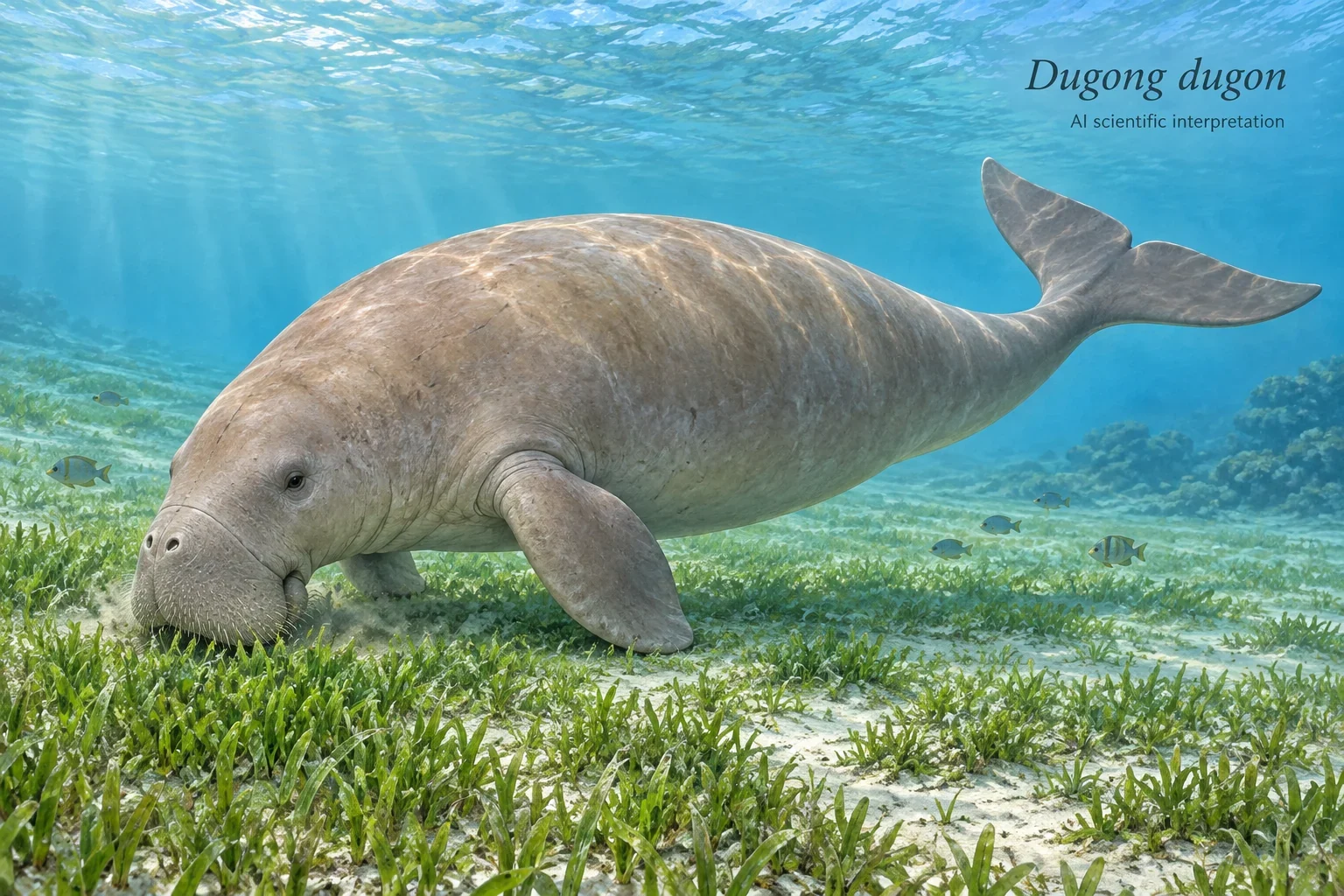
AI scientific interpretation of Dugong dugon.
AI scientific interpretation of an imagined Dugong dugon.
Overview
The Reef Authority describes a rounded head, small eyes, fleshy bristled snout and closable nostrils above it. Front flippers help balance and turn; a whale-like fluked tail drives swimming. Feeding uproots seagrass and leaves trails. Sheltered shallow coastal meadows provide its principal feeding habitat.
D’Souza and colleagues studied a remnant population in India’s Andaman and Nicobar archipelago. During seven years, recorded animals travelled alone or in pairs and used eight seagrass meadows. Consumption averaged about fifteen percent of meadow production, but varied markedly among sites.
Exclosure experiments found higher shoot densities where grazing was excluded. The authors interpreted repeated meadow use as compatible with vegetation recovery at the observed grazing intensity. This local result does not imply that every dugong population is sedentary or that grazing has identical effects everywhere.
Origins & earliest records
Marine-authority diagnosis complements field surveys and grazing exclosures.
Evidence & interpretation
Local habitat persistence is distinguished from universal movement claims.
Selected bibliography
Documented works and useful reading. This is not a list of every appearance.
- 01
- 02
Family, evolution & connections
Taxonomic classification
A hierarchy of classified groups, not a chain of direct ancestors.
Source note: The authority identifies manatees as closest living aquatic relatives and a relationship to elephants.
- ClassMammalia
References
Sources supporting this profile. Linked pages have their own scope and editorial standards.
- Government marine accountDugongResearch access: 2026-10-11
- Primary field ecologySeagrass Herbivory Levels Sustain Site-Fidelity in a Remnant Dugong PopulationResearch access: 2026-10-11
Image credits
AI-generated interpretationAI scientific interpretation of Dugong dugon.
AI scientific interpretation of an imagined Dugong dugon.