
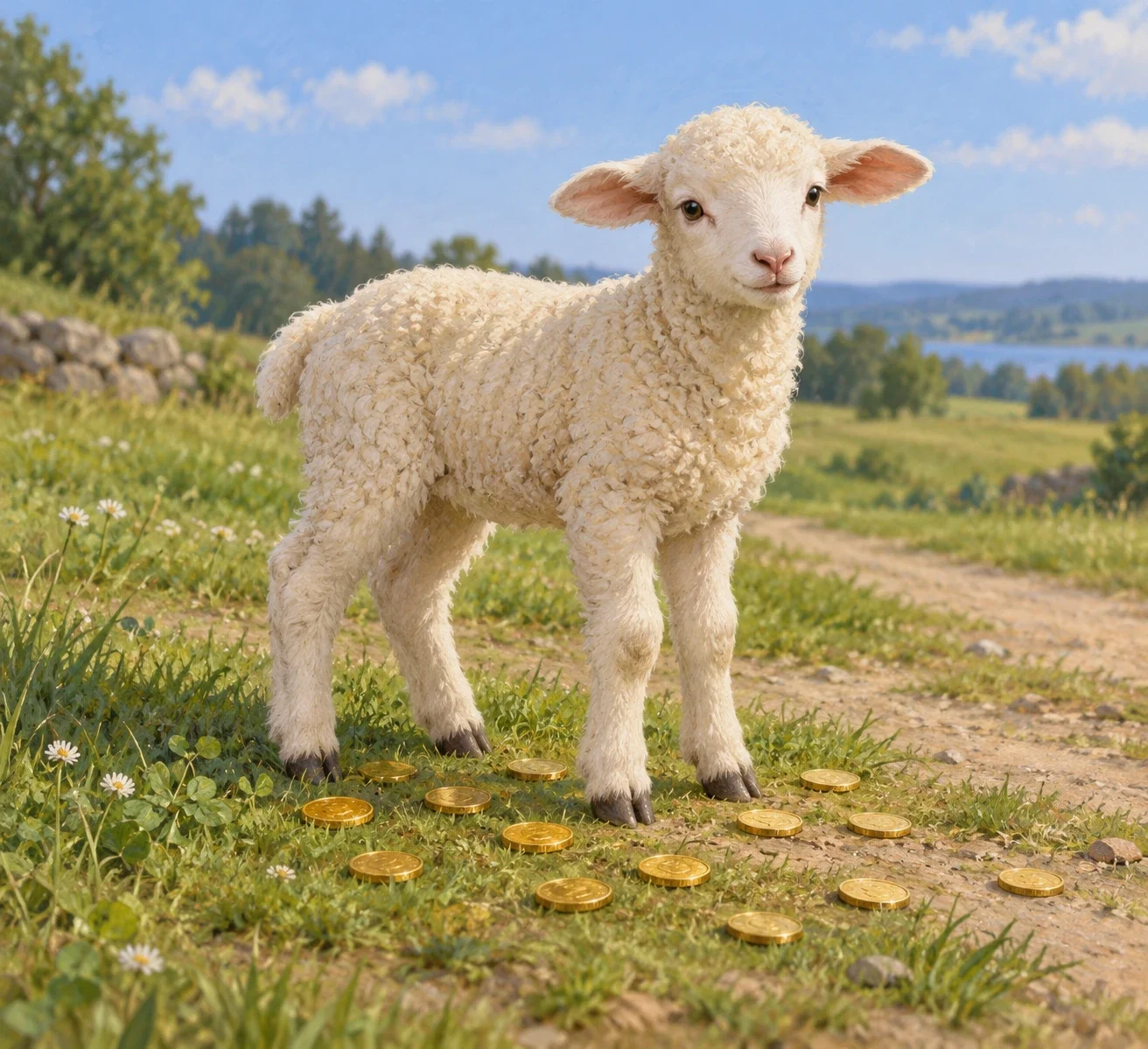
AI narrative interpretation of Ducat-Scattering Lamb in Wratislaw’s Sixty Folk-Tales (1889).
AI interpretation of Wratislaw’s Kashubian story. Pale wool, breed-like details, exact size, coin designs and setting are invented; this is not an authenticated ducat reconstruction.
Overview
A cobbler gives the proceeds of his home and possessions to the church after hearing a promise of recompense, but becomes hungry while waiting for the promised return. He sets out to look for God and meets an old shepherd tending lambs. The shepherd feeds him, hears his story and gives him one lamb. At the call “Lamb, shake yourself!” it scatters ducats. The narrator describes it as an ordinary lamb, and the first successful trial leaves the coins around its feet.
The shepherd warns the cobbler not to enter his old acquaintance’s tavern, but he accepts her invitation and leaves the lamb with her. His warning not to utter the command reveals the secret. She tests it, makes him drunk and substitutes a similar lamb from her own flock. The substitute remains still when the cobbler tries the command at home; the magical lamb has not lost its power.
The same woman later steals a self-spreading tablecloth by another substitution. The shepherd’s final gift is an ornate cudgel whose command brings two strong men to administer a beating. After testing this gift on himself, the cobbler uses it to force the return of both the actual lamb and the tablecloth. He goes home with all three gifts, and his household’s abundance is finally shared with poor people.
Wratislaw labels the tale Kashubian and compares its pattern with Grimm’s table, ass and stick story. That comparison does not make the lamb an ass, or establish that every similar tale has the same creature. This profile follows this particular complete English translation; the lamb’s color, breed, precise size and mechanism for scattering coins are not specified.
Origins & earliest records
Tale XVI, “Cudgel, Bestir Yourself!,” printed pp. 101–106, in A. H. Wratislaw’s Sixty Folk-Tales from Exclusively Slavonic Sources (London: Elliot Stock, 1889).
Records & interpretation
Complete tale XVI, pp. 101–106, including inline notes 6–7; complete Kashubian introduction, preface and edition/contents read. English translation selected through Erben’s 1865 reading-book; no independently consulted Kashubian-language witness or named teller asserted. The contents credits Dr. Florian Cenova under the original title Kjiku resze se; no earlier publication or direct teller is independently identified here.
Selected bibliography
Documented works and useful reading. This is not a list of every appearance.
- 01
Sixty Folk-Tales from Exclusively Slavonic Sources
Complete tale XVI, pp. 101–106, including inline notes 6–7; complete Kashubian introduction, preface and edition/contents read. English translation selected through Erben’s 1865 reading-book; no independently consulted Kashubian-language witness or named teller asserted. The contents credits Dr. Florian Cenova under the original title Kjiku resze se; no earlier publication or direct teller is independently identified here.
Family & connections
A source-supported family tree or inspiration record has not yet been compiled for this profile. Related reading below indicates a connection in subject matter, not a proven lineage or creative influence.
References
Sources supporting this profile. Linked pages have their own scope and editorial standards.
- Primary historical translationWratislaw: complete original historical English taleResearch access: 2026-10-21
Image credits
AI-generatedAI narrative interpretation of Ducat-Scattering Lamb in Wratislaw’s Sixty Folk-Tales (1889).
AI interpretation of Wratislaw’s Kashubian story. Pale wool, breed-like details, exact size, coin designs and setting are invented; this is not an authenticated ducat reconstruction.