
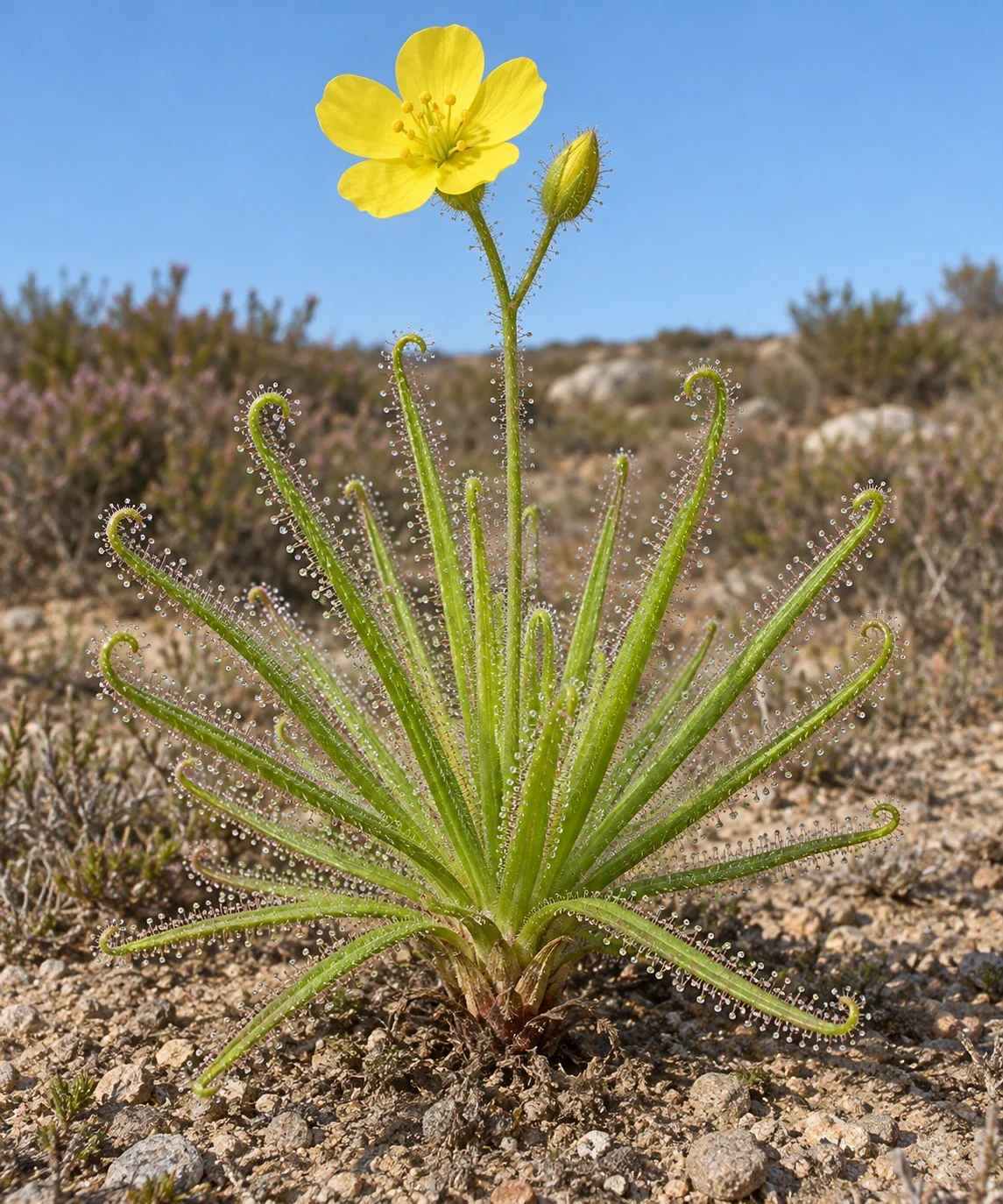
Modern AI interpretation of sticky Drosophyllum rosette.
Modern AI botanical interpretation; fine sticky glands and floral tissues are schematic.
Overview
Drosophyllum lusitanicum forms dense rosettes of linear leaves covered in stalked, mucilage-producing glands. Unlike many bog carnivores, it grows in dry Mediterranean heathlands. Its large yellow flowers have five petals and are carried above the leaf traps.
Bertol and colleagues compared living plants with plant-shaped artificial traps coated in odourless glue. Living leaves caught more insects, especially small flies. Scent or visual attraction was proposed, but the experiment did not isolate one universal lure compound.
Salces-Castellano and colleagues found that removing flowers did not reduce prey capture in their experiment. Hand-pollination and access by insect visitors increased seed production compared with untouched bagged flowers capable only of spontaneous selfing. Thus successful self-pollination does not make floral visitors irrelevant, nor does a conspicuous flower automatically act as a prey lure.
Origins & earliest records
Its experiments test prey attraction and reproduction without resolving an evolutionary origin.
Evidence & interpretation
Retained scientific and institutional passages.
Selected bibliography
Documented works and useful reading. This is not a list of every appearance.
- 01
- 02
Family & connections
A source-supported family tree or inspiration record has not yet been compiled for this profile. Related reading below indicates a connection in subject matter, not a proven lineage or creative influence.
Look for a taxonomic record and classified relativesReferences
Sources supporting this profile. Linked pages have their own scope and editorial standards.
- Primary artificial-mimic comparisonPrey attraction experimentResearch access: 2026-10-12
- Primary flower-removal and pollination experimentsShowy-flower experimentResearch access: 2026-10-12
Image credits
Modern scientific interpretationModern AI interpretation of sticky Drosophyllum rosette.
Modern AI botanical interpretation; fine sticky glands and floral tissues are schematic.