
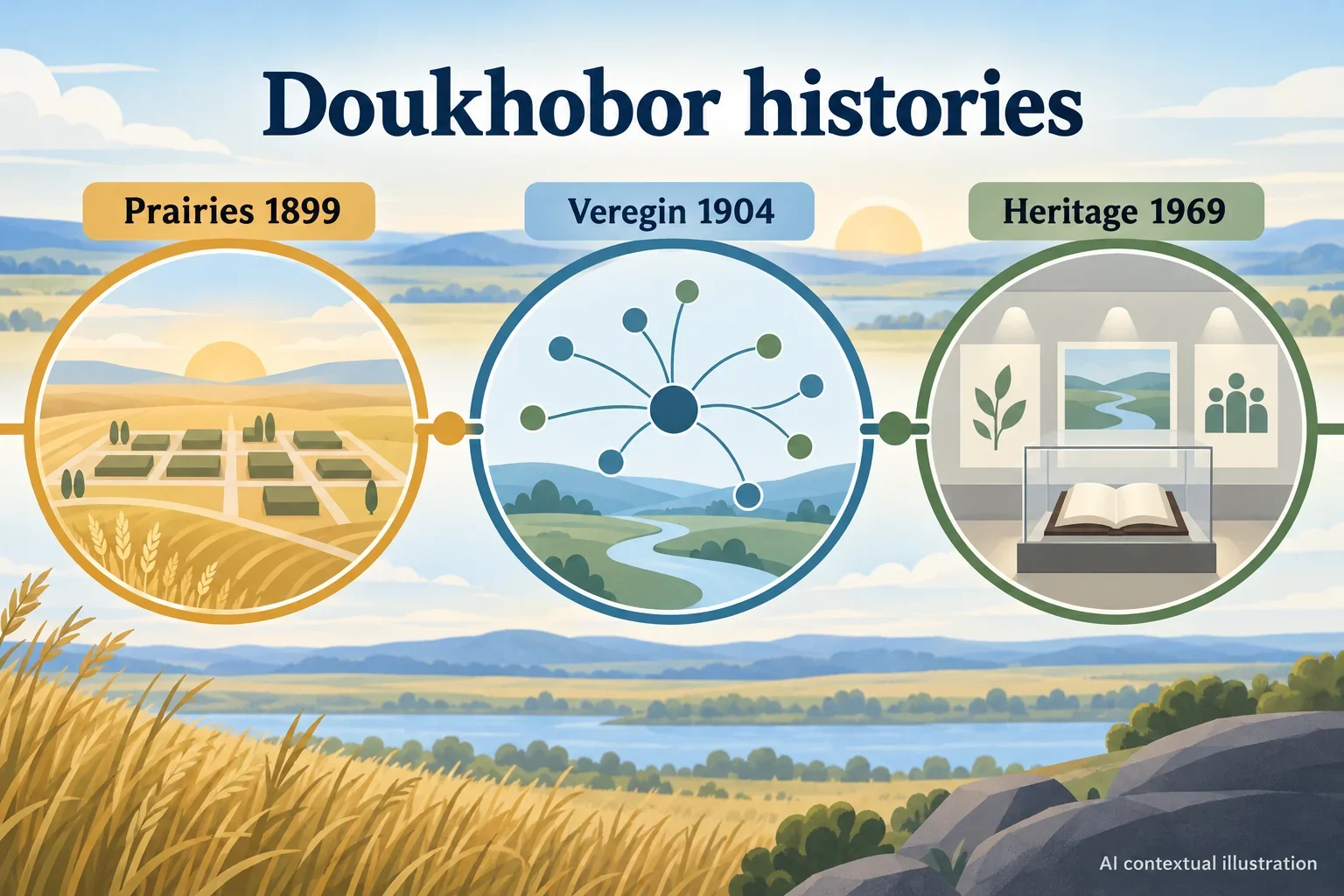
AI diagram of Doukhobor settlement milestones and heritage stewardship
AI contextual illustration. Diagram glyphs and scenery imagined; not ethnographic evidence.
Overview
Parks Canada describes Veregin’s 1904 settlement as an administrative, distribution and spiritual centre. It served as the Christian Community of Universal Brotherhood headquarters from 1917 to 1931, then developed heritage functions in the 1980s. A historic site represents selected communal experience, not every Doukhobor branch.
The Discovery Centre’s timeline records 1899 migration and prairie village settlement. It also describes Doukhobor and non-Doukhobor residents organizing heritage preservation in 1969, followed by museum construction. These are institutional accounts of migration and public memory; museum reconstruction does not reproduce all historical community life.
History & identity
Selected Canadian settlement and heritage histories.
Sources & representation
Selected public institutional passages retained.
Selected bibliography
Documented works and useful reading. This is not a list of every appearance.
- 01
- 02
Language & cultural connections
Source-supported language and cultural connections have not yet been compiled for this profile.
References
Sources supporting this profile. Linked pages have their own scope and editorial standards.
- Federal heritage-site interpretationDoukhobors at Veregin National Historic SiteResearch access: 2026-10-12
- Community museum indexed timelineDoukhobor HistoryResearch access: 2026-10-12
Image credits
AI contextual interpretationAI diagram of Doukhobor settlement milestones and heritage stewardship
AI contextual illustration. Diagram glyphs and scenery imagined; not ethnographic evidence.