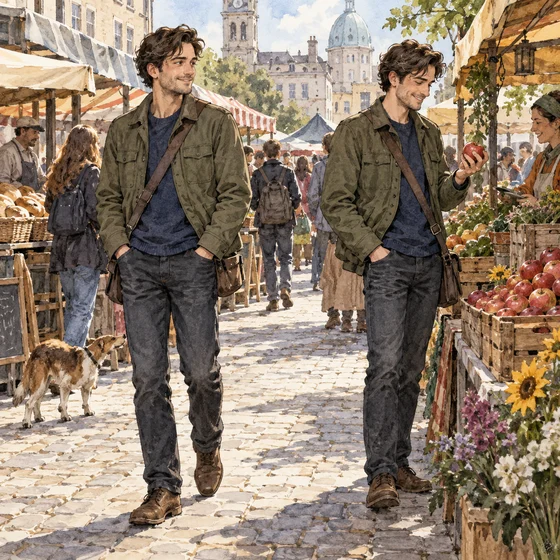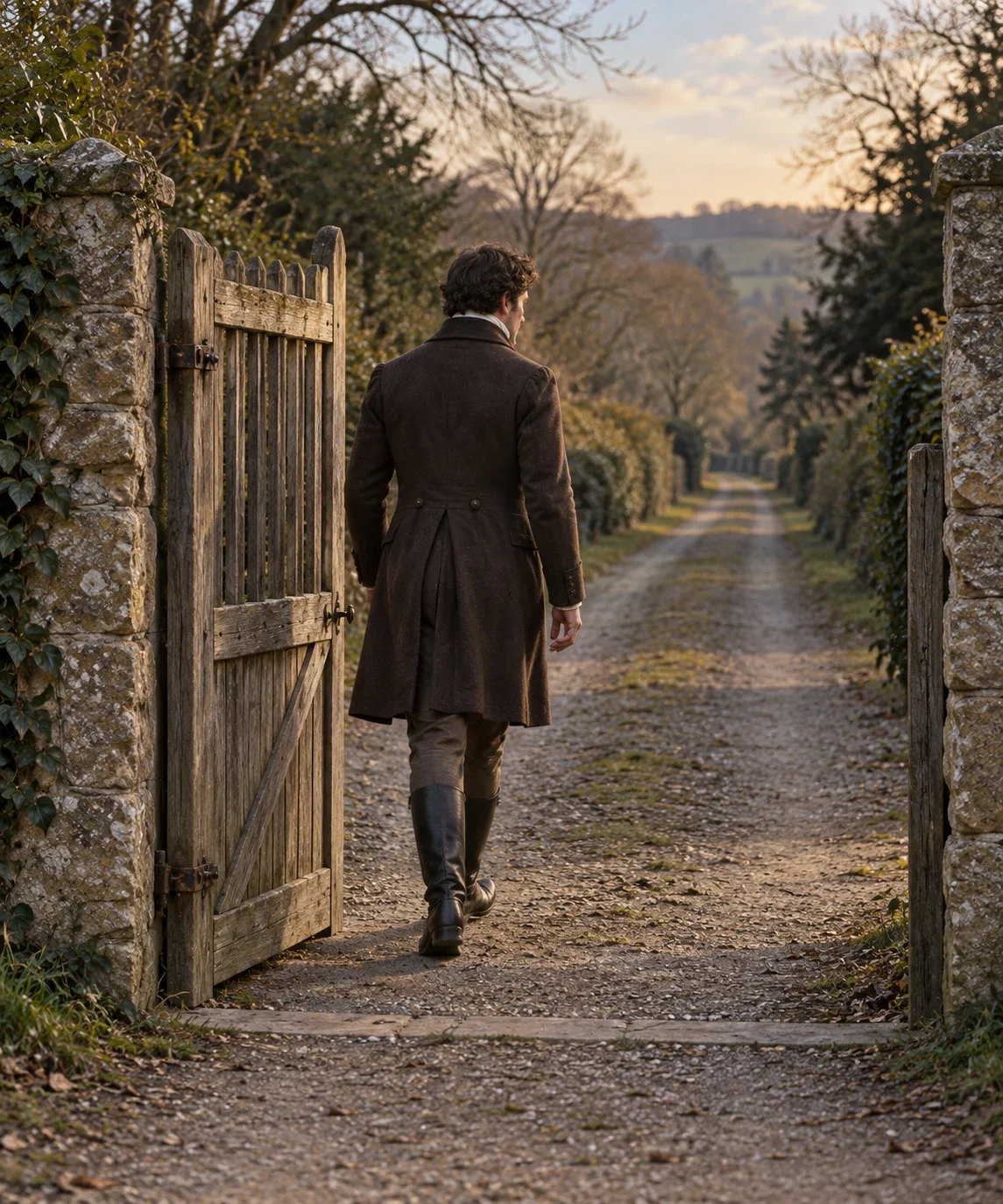
AI-generated interpretation of the reported likeness at the gate; face, clothing, exact place and lighting imagined. No authenticated portrait or sighting.
Interpretation of an anonymized historical report, not a verified sighting or authenticated portrait. Ordinary coat, boots, face, gate, lane and light are imagined; no transparent-body effect or modern game design implied.
Overview
Catherine Crowe’s chapter on Doppelgängers, or Doubles includes a reported encounter in which a man meets the apparent likeness of an acquaintance whose body is said to be elsewhere. The inspected witness is the 1850 New York edition of The Night-Side of Nature. Crowe attributes this particular story to Macnish, rather than presenting it as her own observation. The men appear only as Mr H and Mr C; the selected account supplies no complete names, exact place or date that would independently identify the occurrence.
Mr H is walking along a street when he thinks he sees Mr C ahead of him. He calls, receives no answer and quickens his pace. The other figure also moves faster, making it impossible for him to catch up. At a gate the apparent acquaintance passes through and shuts it forcefully in his pursuer’s face. Mr H immediately opens it and finds nobody in the long lane beyond. He then visits Mr C’s house and is told that his acquaintance has been confined to bed for several days. The narrative thus separates the walking likeness from the man whose appearance it has.
A week or two later, the men meet at a mutual friend’s house. Mr H jokingly treats the encounter as a wraith sighting and a prediction of death; Mr C and the company laugh. The account then says that Mr C dies after a sudden throat illness and that Mr H also dies soon afterwards. These are outcomes asserted in the transmitted story, not independently checked medical or death records. The passage provides no measured interval for the second death and does not describe the likeness changing into a different person.
Crowe and her named source do not interpret the report alike. She quotes Macnish’s description of it as hallucination, but argues that its resemblance to other accounts warrants another explanation. She treats the moving figure and gate as evidence of will and mechanical power while the body remains elsewhere. Her suggestions that Mr C was asleep and that the encounter anticipated a later meeting of spirits are speculation within her discussion. A later definition in the same chapter calls a double the appearance of a person outside the body. This selected witness therefore concerns an apparition and an omen interpretation, without establishing the physical impersonation, biological species or creator-source route of a modern fantasy shapeshifter.
Origins & earliest records
Catherine Crowe, The Night-Side of Nature; Or, Ghosts and Ghost-Seers, inspected 1850 New York J. S. Redfield / Boston B. B. Mussey edition. Chapter VIII opening case attributed to Macnish; original Macnish publication not independently located or read.
Records & interpretation
Complete opening three paragraphs of chapter VIII, including the entire Mr H / Mr C encounter and Crowe’s immediate commentary, and the complete later paragraph defining doubles were read. Whole book and every other chapter VIII case not claimed read.
Selected bibliography
Documented works and useful reading. This is not a list of every appearance.
- 01
The Night-Side of Nature; Or, Ghosts and Ghost-Seers
Inspected New York J. S. Redfield / Boston B. B. Mussey imprint. Chapter VIII, Doppelgängers, or Doubles: complete opening case/commentary and later complete definition paragraph. Edition date not equated with exact case date.
Family, evolution & connections
Doppler (The Witcher)
Crowe’s selected report describes a living man’s apparent likeness keeping ahead of a pursuer, passing through a gate and disappearing, while the man himself is said to be elsewhere. She discusses it as a double or wraith and treats its reported later deaths as significant. This is a comparison of double motifs, not a creator-source route or a claim of identical bodies or powers.
References
Sources supporting this profile. Linked pages have their own scope and editorial standards.
- Historical English compilation and discussionCrowe 1850, chapter VIII: complete selected gate encounter and definitionResearch access: 2026-10-24
Image credits
AI-generated historical interpretationAI-generated interpretation of the reported likeness at the gate; face, clothing, exact place and lighting imagined. No authenticated portrait or sighting.
Interpretation of an anonymized historical report, not a verified sighting or authenticated portrait. Ordinary coat, boots, face, gate, lane and light are imagined; no transparent-body effect or modern game design implied.