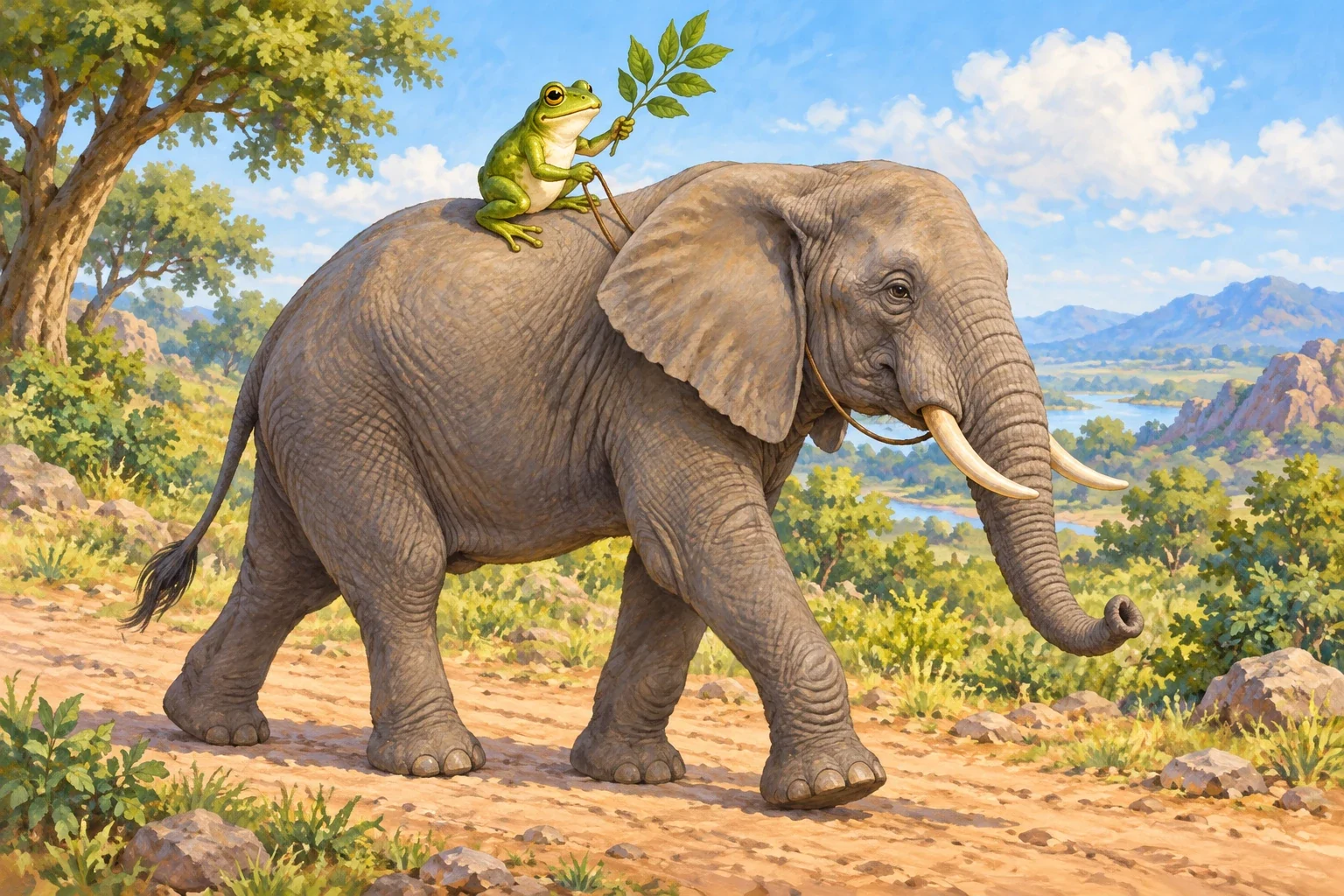
AI-generated interpretation of Dizundu’s elephant-riding trick in Chatelain’s Loanda tale.
Frog, elephant, twig and cords interpret tale XXVIII. Species, colouring, scale, landscape and harness details are imagined.
Overview
Dizundu is the frog in Chatelain’s short courtship fable XXVIII, paired with Elephant, Nzamba. Both are visiting the same house while courting. The frog tells Elephant’s sweetheart that Elephant is his horse. When Elephant comes that night, the girls repeat the assertion. He confronts Frog, who denies having said it, and the two set out together to settle the matter at the house. The scene concerns speech, reputation and a staged appearance; Elephant is not transformed into another animal.
On the road, Frog addresses his companion as grandfather and complains that he lacks the strength to walk. Elephant calls him grandson and lets him ride on his back. Frog next says that he may fall and asks to obtain small cords to secure himself at Elephant’s mouth. With permission granted, he arranges them. He then asks for a green twig, supposedly to brush mosquitoes away from his carrier. As they approach the house, the girls come out shouting that Elephant really is Frog’s horse. The small rider has made his own denial look false and his original boast look true, using concessions that Elephant accepted one at a time.
The tale stops at that public recognition. It does not describe a whipping, injury, marriage, revenge or a permanent master-and-servant relationship. The green twig and cords help create the appearance of horse riding without adding actual equine anatomy. The kinship forms of address establish their conversation; they do not independently prove a literal shared family. Chatelain’s note explains that their courting at one house does not mean that they seek the same woman, since several women are present. The story therefore should not be recast as a contest for one uniquely identified bride.
The Kimbundu text prints Dizundu and shortened Zundu forms, while the facing English uses Mr. Frog. The notes attribute the tale’s dialect and origin to Loanda and name João Borges Cezar as informant. A cross-reference to tale IV identifies this contributor as the nephew of the older namesake who supplied tale I and as Chatelain’s former Loanda pupil. Those two contributors must not be merged. Chatelain compares the episode with other animal-riding stories and refers readers to his sky-marriage frog; these are editorial comparisons, not proof that all frogs are one continuous individual. This profile is limited to XXVIII and does not duplicate the existing Mainu sky-marriage profile.
Chatelain publishes an original Kimbundu text, a literal English translation and linguistic notes within a missionary and colonial-era collection. His preface acknowledges payment and initial reluctance in collecting more broadly. Neither that general history nor this named pupil’s attribution establishes blanket community consent. The selected witness documents an ordinary published animal narrative, with the collector’s comparisons and racial generalizations kept separate from the actions described. No exact frog or elephant species, colour, costume or physical size is specified.
Origins & earliest records
Chatelain’s Folk-Tales of Angola (1894), XXVIII Nzamba ni Dizundu, Kimbundu p.202 and literal English p.203; notes attribute Loanda dialect and origin to João Borges Cezar’s witness.
Records & interpretation
Complete Kimbundu and literal English tale, both numbered language notes and complete local attribution/comparative note; narrator identified via the stated IV cross-reference.
Selected bibliography
Documented works and useful reading. This is not a list of every appearance.
- 01
Folk-Tales of Angola — XXVIII Nzamba ni Dizundu / Elephant and Frog
Complete original Kimbundu 202, literal English 203, complete notes 298–299, contributor reference at 276 and complete preface v–ix read; selected native tale and note pages inspected.
Family & connections
A source-supported family tree or inspiration record has not yet been compiled for this profile. Related reading below indicates a connection in subject matter, not a proven lineage or creative influence.
References
Sources supporting this profile. Linked pages have their own scope and editorial standards.
- Primary bilingual narrativeChatelain 1894, tale XXVIII, complete bilingual narrative and notesResearch access: 2026-10-21
Image credits
AI-generatedAI-generated interpretation of Dizundu’s elephant-riding trick in Chatelain’s Loanda tale.
Frog, elephant, twig and cords interpret tale XXVIII. Species, colouring, scale, landscape and harness details are imagined.