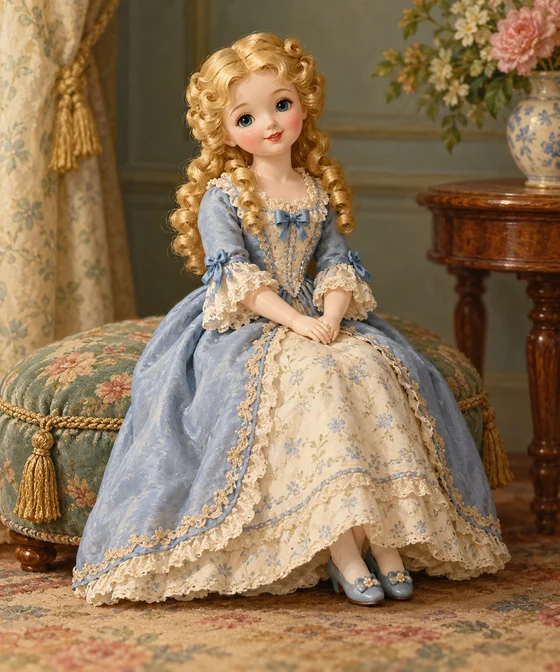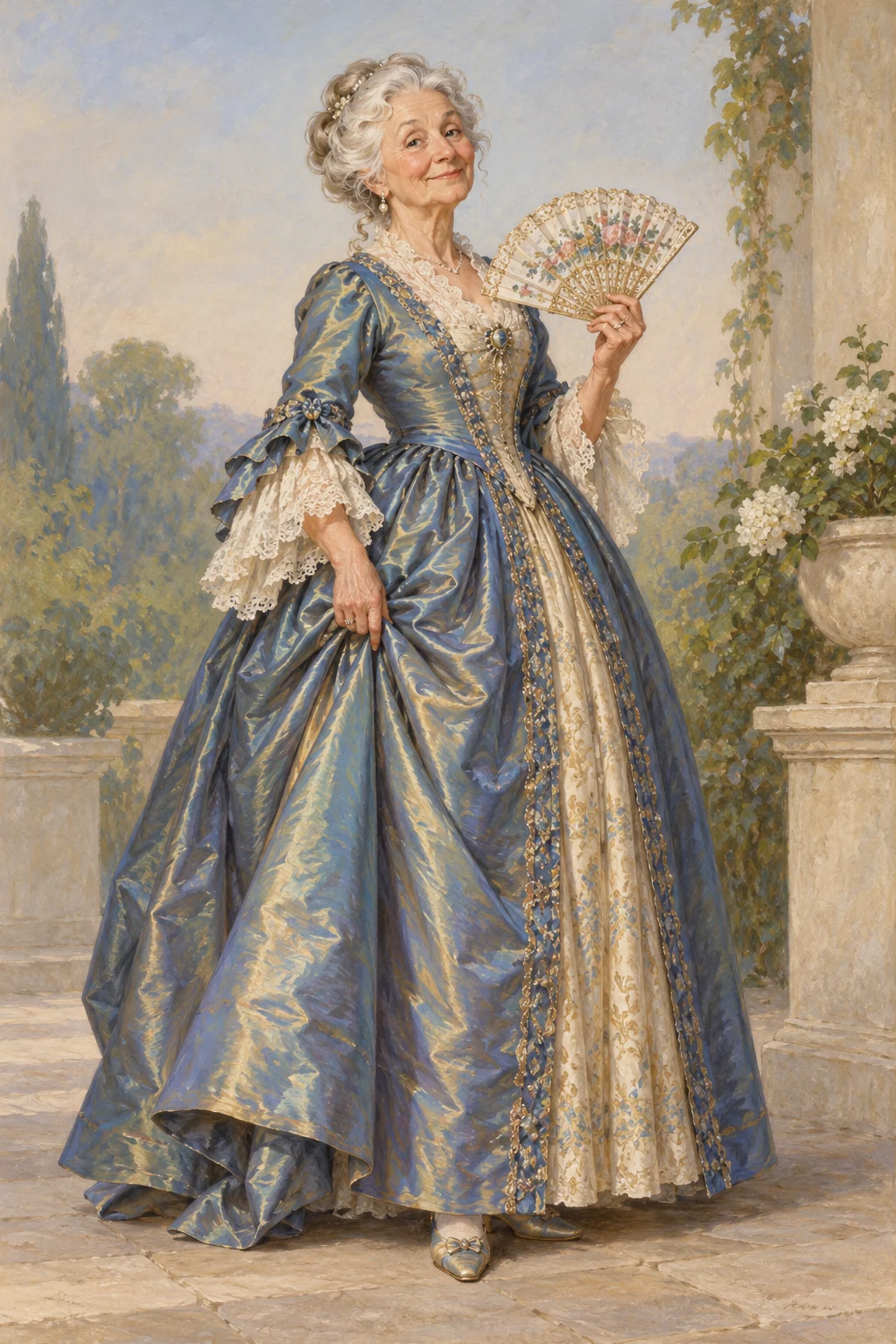
AI interpretation; independently composed.
Text-led interpretation; unspecified details imagined.
Overview
Grandmarina first appears as an old lady dressed in rich shot-silk smelling of dried lavender. King Watkins has not seen her in the fishmonger’s shop because she was invisible to him, although visible to the errand-boy. She identifies herself as the Good Fairy Grandmarina and answers the King’s unspoken thought. Her manner is forceful and impatient: she scolds his interruptions and demands for reasons, repeatedly telling him to be good. Later she calls Alicia her goddaughter. Her age and human dress are explicit; wings, a crown and a wand are not described.
She instructs the King to share his salmon with Alicia and have the girl dry, rub and polish the remaining bone until it shines like mother-of-pearl. The bone will grant one wish, provided it is made at the right time. Alicia privately works out that this means seeking help after trying her very best and exhausting the available ways. She therefore manages the household’s earlier difficulties without using it, to her father’s bewilderment. When his efforts to obtain money have failed, she wishes for quarter day, and the salary arrives down the chimney.
Grandmarina then enters in a carriage drawn by four peacocks, with the enchanted fishmonger’s boy attending her. She carries a sparkling fan. A wave brings the recovered Queen and newly clothed children; a tap removes Alicia’s coarse apron and reveals bridal dress. Further changes supply a wardrobe and transform the waiting prince’s appearance. Grandmarina exchanges compliments with the Duchess, carries the party to the prince and arranges the fairy-tale wedding and extravagant feast. These interventions are the fairy’s own actions rather than a series of additional wishes by Alicia.
At the feast she promises extra quarter days and a prodigiously large, perfect future family for the couple. The title presents the tale as a holiday romance from seven-year-old Miss Alice Rainbird, while the actual author is Dickens; the exaggerated household, marriage and blessings belong to that deliberately childish storytelling frame. The ending is sharper than a simple reward scene: Grandmarina announces that the fishbone must be disposed of and takes it from Alicia. It immediately flies into the throat of the snapping dog that earlier frightened a prince, killing it. The tale ends there, without explaining away that punitive conclusion.
First appearances & development
Dickens’s individual fairy godmother in The Magic Fishbone.
Canon & continuity
Complete narrative, including the child-author frame, single-wish condition, fairy’s separate interventions and final disposal of the bone.
Selected bibliography
Documented works and useful reading. This is not a list of every appearance.
- 01
Family & connections
A source-supported family tree or inspiration record has not yet been compiled for this profile. Related reading below indicates a connection in subject matter, not a proven lineage or creative influence.
References
Sources supporting this profile. Linked pages have their own scope and editorial standards.
- Primary literary textThe Magic Fishbone — complete original tale in the retained editionResearch access: 2026-10-18
Image credits
AI-generatedAI interpretation; independently composed.
Text-led interpretation; unspecified details imagined.