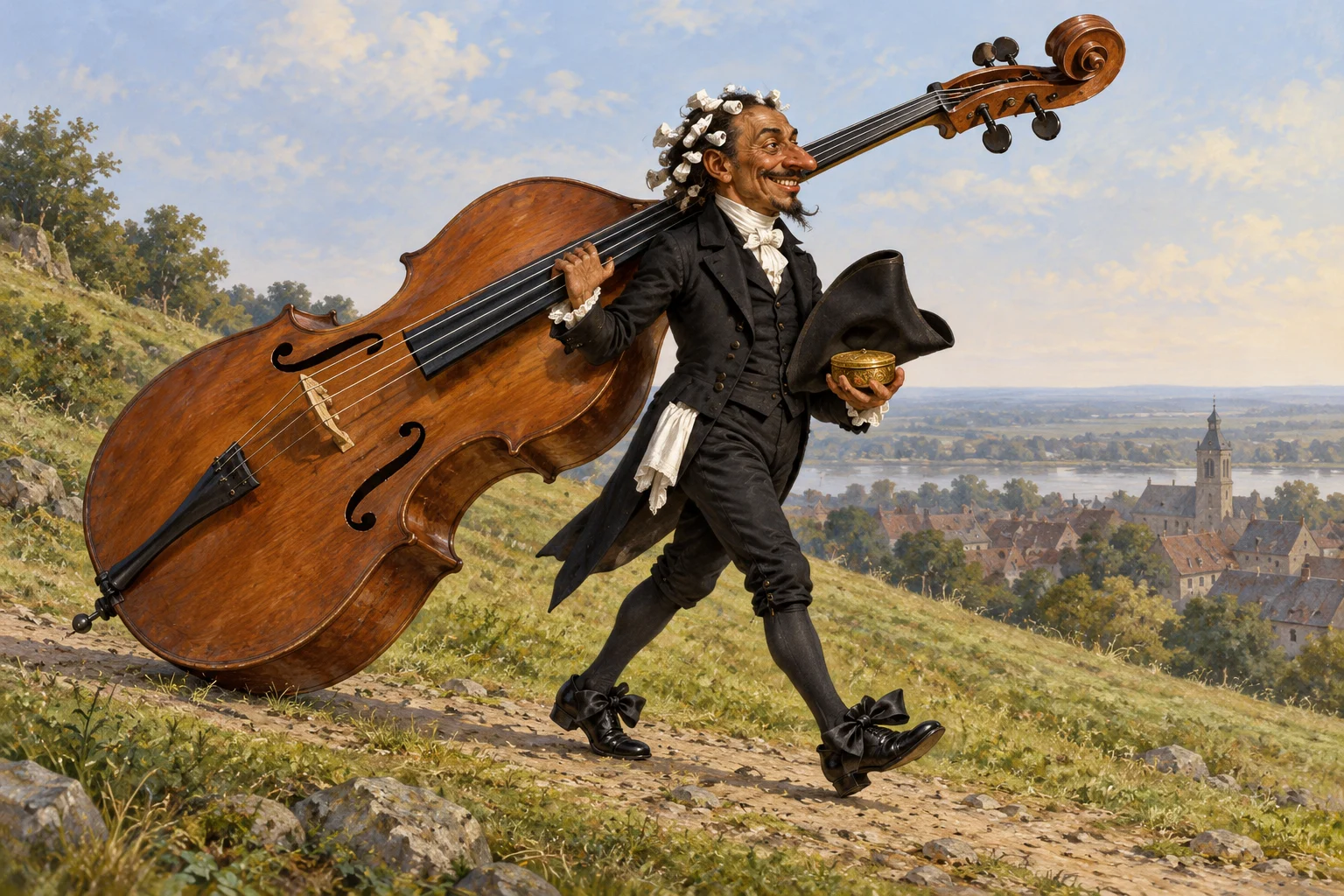
AI-generated interpretation of Poe’s belfry intruder arriving with his oversized fiddle; exact proportions, pose and scenery are reconstructed.
The human form and costume follow the tale; suspected demon features remain concealed and are not invented as visible anatomy.
Overview
The intruder in Poe’s tale arrives just before noon in Vondervotteimittiss, a supposedly unchanging borough whose residents prize clocks, cabbages and the old order. He is a very small young man with a snuff-brown complexion, a hooked nose, small eyes, a wide grin, moustaches and whiskers. His uncovered hair is arranged in papillotes. A black swallow-tailed coat, black knee-breeches, black stockings and short pumps with large ribbon bows contrast with the townspeople’s dress. He carries a large folded hat, a gold snuff-box and a fiddle described as nearly five times as big as himself. The narrator presents his appearance and untimely dancing as an alarming intrusion into the borough’s routines.
The newcomer dances into the belfry, seizes the dignified clock-keeper by the nose, covers his head with the hat and beats him with the fiddle. As the townspeople watch their timepieces, the great bell counts past twelve to thirteen. Their confidence in the regular hour collapses into complaints about food, hunger and exhausted pipes. In the ensuing comic disorder, the narration describes carved clocks dancing, pendulums wriggling and animals fleeing the watches tied to their tails. Above the uproar the intruder sits on the fallen keeper, jerks the bell-rope with his teeth and scrapes the oversized fiddle across his lap out of time and tune.
The narrator leaves and appeals to fellow defenders of correct time and good food to eject the offender. The story ends with that appeal, without showing his removal or restoring the clock. Although the title calls him the Devil and the residents react with a devil’s name, his bodily description remains that of the odd young fiddler. Suspicion about his shoes and the handkerchief hanging from his coat does not reveal hooves or a tail. Vondervotteimittiss is the tale’s invented Dutch borough, not a documented community or evidence that the character belongs to a Dutch folk tradition.
First appearances & development
Poe’s authored English-language satire, consulted in the dated 1895 Stedman–Woodberry volume IV. That edition’s historical notes identify a May 18, 1839 Philadelphia newspaper appearance; the retained 1895 text supplies the profile’s particular wording and incidents.
Canon & continuity
The complete selected tale and unresolved ending, dated volume title, complete 1894 General Preface and relevant historical notes were read and retained. No independent field collection, first newspaper facsimile or later musical adaptation was used.
Selected bibliography
Documented works and useful reading. This is not a list of every appearance.
- 01
The Works of Edgar Allan Poe, volume IV — The Devil in the Belfry
Stone & Kimball, Chicago; selected tale on pages 103–114. Historical English edition transcribed by the Edgar Allan Poe Society of Baltimore.
Family & connections
A source-supported family tree or inspiration record has not yet been compiled for this profile. Related reading below indicates a connection in subject matter, not a proven lineage or creative influence.
References
Sources supporting this profile. Linked pages have their own scope and editorial standards.
- Primary historical literary textThe Devil in the Belfry — complete 1895 tale transcriptionResearch access: 2026-10-18
- Historical title transcriptionVolume IV — dated title and contentsResearch access: 2026-10-18
- Historical editorial contextGeneral Preface — 1894 editorial textResearch access: 2026-10-18
- Historical publication notesVolume IV — historical publication notesResearch access: 2026-10-18
Image credits
AI-generatedAI-generated interpretation of Poe’s belfry intruder arriving with his oversized fiddle; exact proportions, pose and scenery are reconstructed.
The human form and costume follow the tale; suspected demon features remain concealed and are not invented as visible anatomy.