
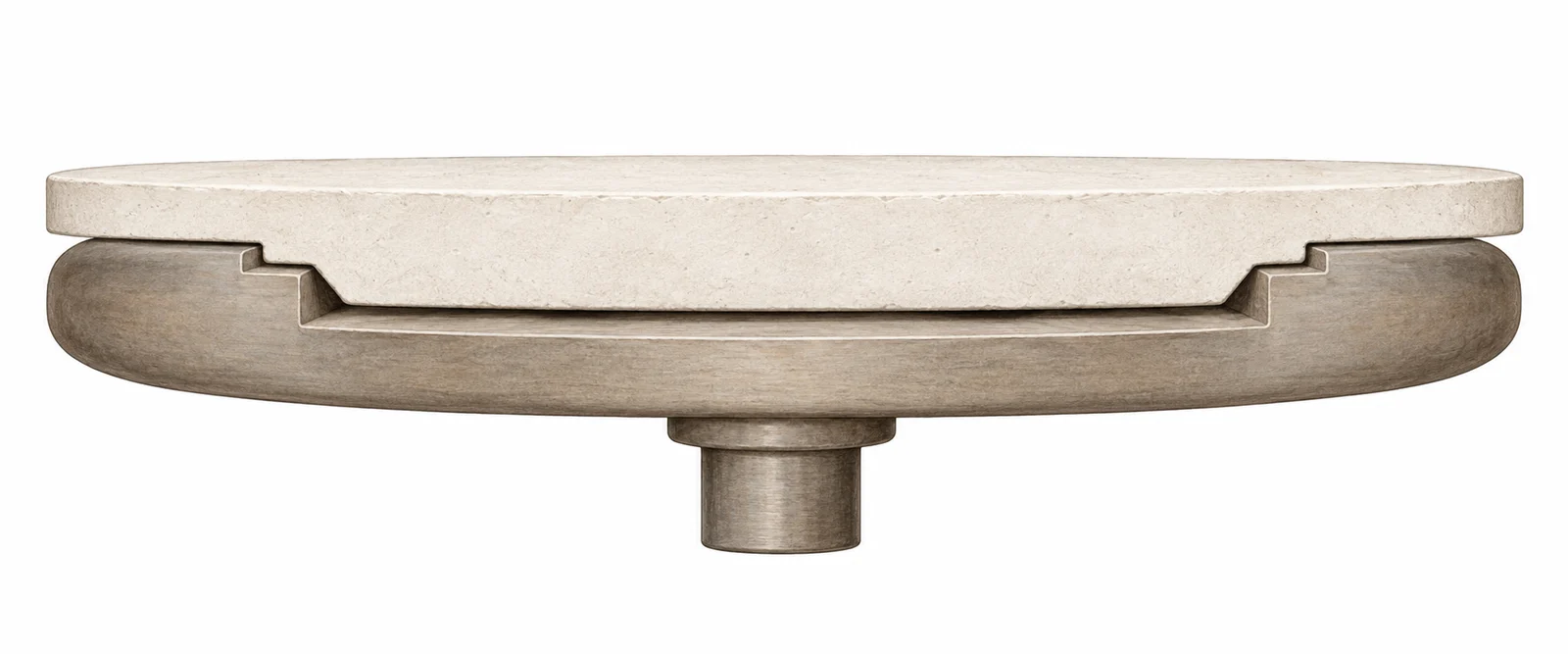
Generated interpretation of a published form; not an authenticated specimen or exact replica. Perspective and surface appearance are interpretive; concealed fittings are not reconstructed.
Overview
Charles F. Binns presents the detached plaster bat as a practical support for a student learning to throw pottery. A smooth hardwood or brass wheel head helps a skilled potter centre the clay, but removing the completed soft work requires cutting it free with a wire. For the beginner he instead recommends a head with a recess and several specially shaped plaster bats that fit it. The bat carries the newly formed piece away from the wheel so that the pottery can harden without being lifted directly. Figure 17 shows the relationship in section: a broad flat upper slab fits into the shaped head beneath it, above the central spindle connection.
The object belongs to Binns’s sequence of workshop lessons rather than to a named community’s inherited ceremonial equipment. He distinguishes throwing from the later tool-assisted operation he calls turning, and begins his throwing exercises by discussing the bat’s moisture. In his account excessive wetness lets the clay slip, so preparation is learned through experiment. The chapter then advances from centring a ball of clay to cylinders, bowls, globes and measured forms. His prefaces explain that the book grew from teaching and summer classes; the revised edition acknowledges separately authored chapters. This profile records the particular removable support within that historical instructional system, without presenting the old manual as a complete modern workshop specification.
History & identity
The retained second edition identifies Charles F. Binns as director of the New York State School of Clay-Working and Ceramics. Its prefaces are dated Alfred, New York, March 1922, and the copyright line gives 1910 and 1922. An exact physical printing date is not asserted.
Sources & representation
Complete title and prefaces, complete introduction, and complete Chapter IX, The Potter’s Wheel, including Figure 17. The native section drawing is retained; it establishes the depicted assembly rather than an exterior photograph or a dimensioned engineering specification.
Selected bibliography
Documented works and useful reading. This is not a list of every appearance.
- 01
The Potter’s Craft: A Practical Guide for the Studio and Workshop
Second edition, second printing; New York: D. Van Nostrand Company. Copyright 1910, 1922; prefaces March 1922. Chapter IX, especially printed pages 77–79, Figure 17.
Language & cultural connections
Source-supported language and cultural connections have not yet been compiled for this profile.
References
Sources supporting this profile. Linked pages have their own scope and editorial standards.
- Historical instructional accountThe Potter’s Craft, historical workshop instructionResearch access: 2026-10-18
Image credits
AI-generatedGenerated interpretation of a published form; not an authenticated specimen or exact replica. Perspective and surface appearance are interpretive; concealed fittings are not reconstructed.