
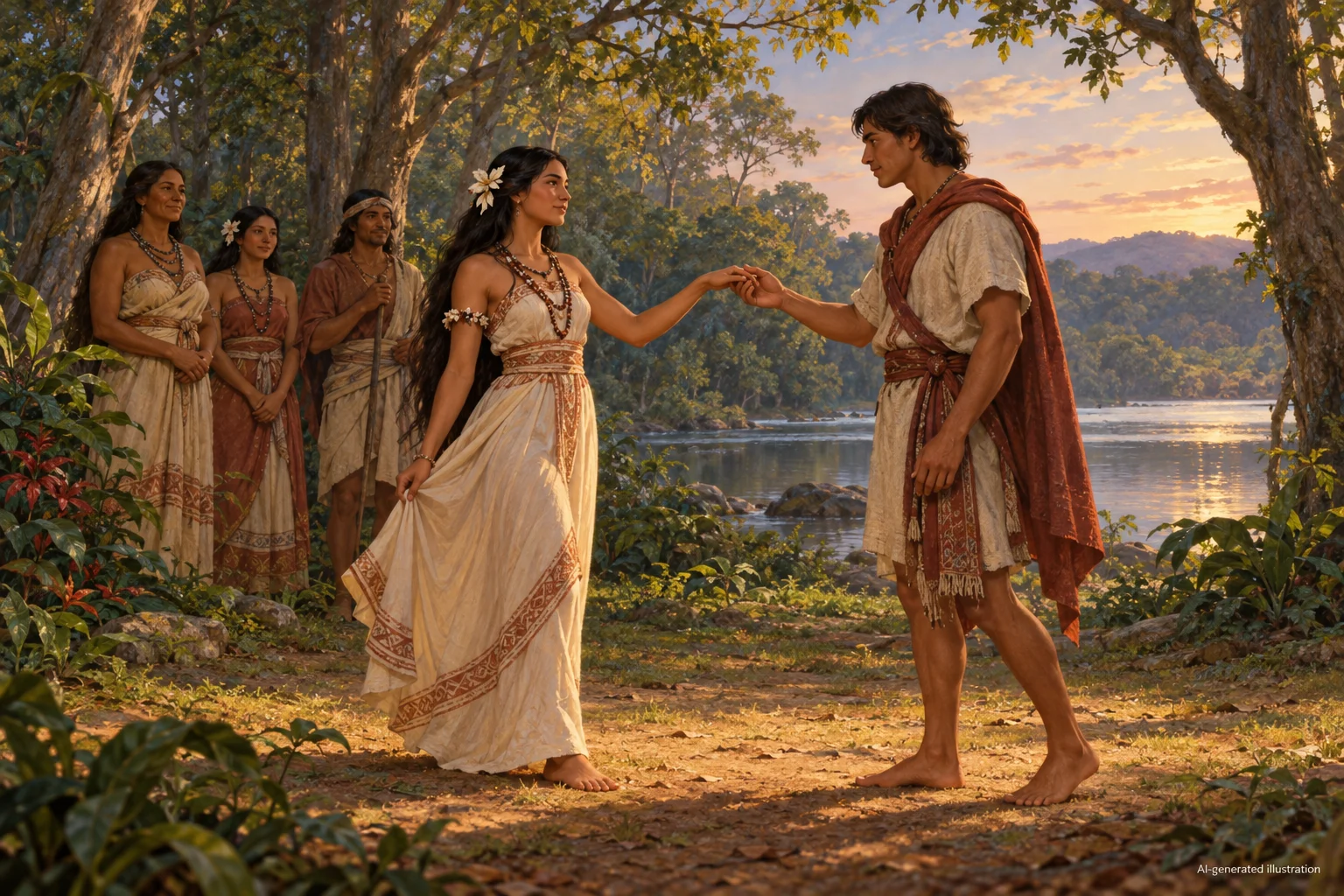
An imagined humanlike Demaredu bride meets a human suitor at her family’s dance.
Demaredu Bride — an imagined scene from Brett’s historical verse retelling. Human appearance, garments and setting are explicitly imagined narrative choices, not authenticated anatomy, costume or ethnographic reconstruction.
Overview
Brett’s short narrative begins with a human-born man encountering a company called the sons and daughters of the earth. He joins their mysterious dance, dances beside a maiden and asks to marry her. Her father challenges the suitor: no human has been brave enough to share their home deep beneath the earth or beneath the shining water. The young man accepts the challenge and names the Demaredu maiden as his desired bride. The father then admits the courageous suitor to the family and grants the marriage. The account ends with that consent; it does not narrate a later separation, a forbidden return or an escape from the hidden home.
The accompanying note relates the union to the Demarena, described by Brett as an Arawak family taking its mother’s family name. He distinguishes that family from the father’s Korobohana family and reports a former preference for marriages between the two. This is Brett’s historical explanation of a family narrative, not independent verification of descent or a rule asserted for present-day communities. His adjacent account of Korobohana ancestors descending from above the clouds and some becoming parrots belongs to the other family’s separate origin tradition; it does not turn the Demaredu bride into a bird.
Brett calls the maiden elfin and fairy in his verse, but supplies no wings, pointed ears, diminutive stature, special garment or fixed nonhuman anatomy. Her humanlike presentation comes from the encounter, courtship and familial dialogue. The hidden home can be beneath earth or wave in the father’s words; the narrative does not select one entrance or give it a precise geographical position. An illustration can therefore show the dance and meeting while marking faces, clothing and surroundings as imagined narrative choices.
Origins & earliest records
The Demarena, pp178–179 of Brett’s1880 collection, is a complete short verse narrative with a substantial family-origin note. It appears in PartV, the collection’s fanciful legends, rather than being assigned a separate named narrator.
Records & interpretation
The full poem and complete footnote were read, including the separate Korobohana account. Brett’s preface explicitly explains his adoption of English metrical form. His missionary categories and broad claims about Indigenous traditions are not adopted as current ethnographic conclusions.
Selected bibliography
Documented works and useful reading. This is not a list of every appearance.
- 01
Legends and Myths of the Aboriginal Indians of British Guiana
The Demarena, complete pp178–179 poem and footnote, with complete preface.
Family & connections
A source-supported family tree or inspiration record has not yet been compiled for this profile. Related reading below indicates a connection in subject matter, not a proven lineage or creative influence.
References
Sources supporting this profile. Linked pages have their own scope and editorial standards.
- Primary historical literary witnessBrett1880: The Demarena with family-origin footnoteResearch access: 2026-10-17
Image credits
Original literary interpretation; human appearance, garments and setting are imagined rather than authenticated ethnographic reconstruction.An imagined humanlike Demaredu bride meets a human suitor at her family’s dance.
Demaredu Bride — an imagined scene from Brett’s historical verse retelling. Human appearance, garments and setting are explicitly imagined narrative choices, not authenticated anatomy, costume or ethnographic reconstruction.