
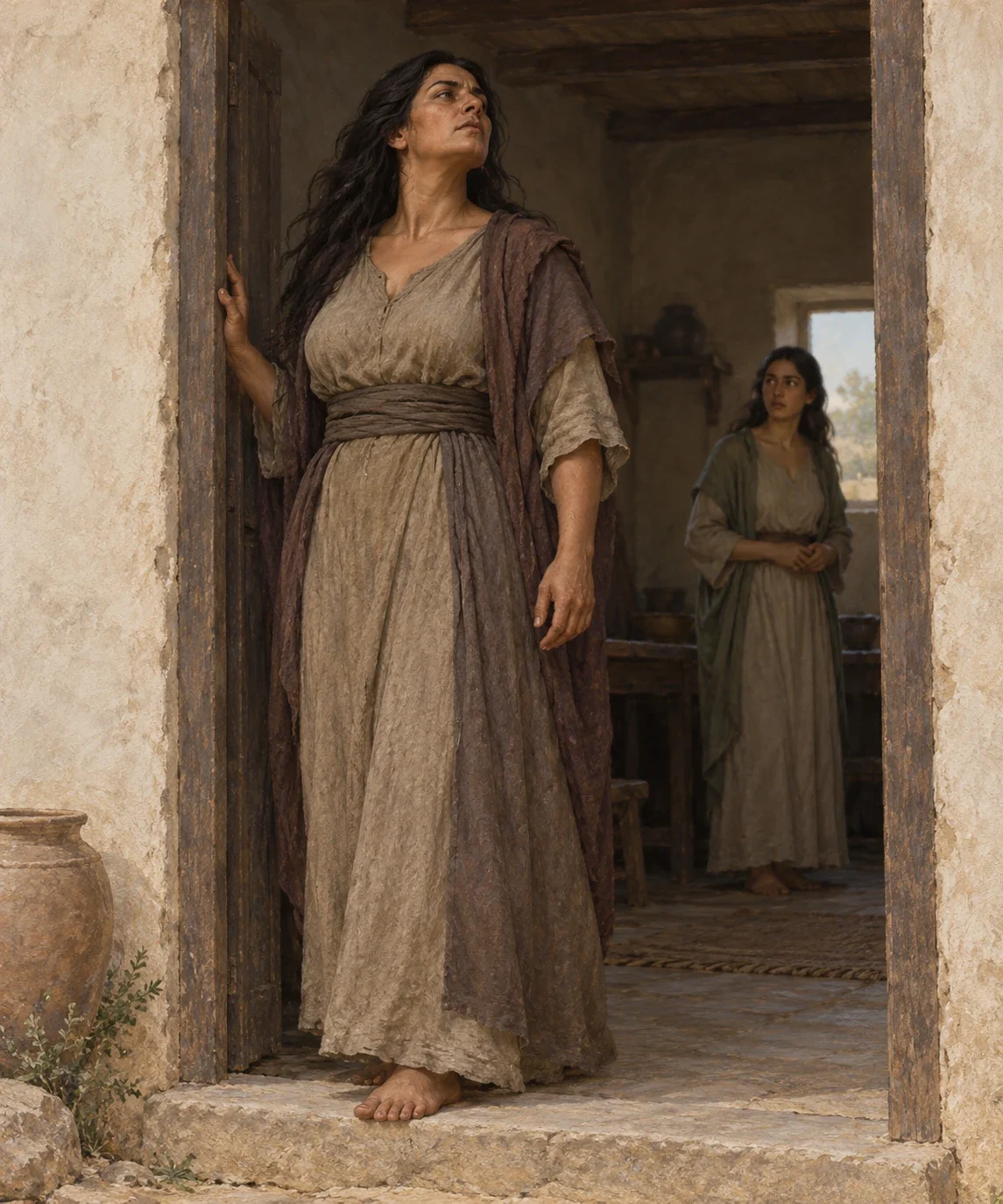
AI-generated narrative interpretation of Deg-dēr and her daughter in Jusuf Ali’s tale recorded by Reinisch.
The mother’s scent detection and distinct daughter follow narrative64. Faces, ages, skin colouring, garments and architecture are imagined; this is not an ethnic portrait, documented costume or authoritative ogress anatomy.
Overview
In narrative 64 of Leo Reinisch’s Die Somali-Sprache I: Texte, five sisters accompany their father to gather fruit. He rests beneath a tree with a bell suspended above him, telling them that its sound will mark his sleep. While they are away, a human-eating woman kills him and carries him off. Returning, the sisters discover his absence and signs of violence. One climbs the tree, sees a large house and leads the others there. The house belongs to the ogress, although the sisters initially encounter only her adult daughter.
The daughter says that the household has no food except human flesh. She identifies her mother as a human-eater and initially denies being one herself. She also says that the house has five rooms and tells the sisters to hide. Her mother returns and smells other girls inside. The daughter tries to explain away the scent, but the ogress searches the house and finds them. After hearing their account, she invites them to remain and join her in killing people, then gives them meat and water. The girls agree outwardly. When the ogress sleeps, the five sisters and her daughter deliberate together and kill her with heated water.
Only at this point does the narrative supply the ogress’s personal name: Reinisch prints deg-dēr in the Somali column and Langor in his German translation. Six men arrive the following day intending to kill her, learn that she is already dead, and marry the six young women. The subsequent episode concerns the ogress’s daughter rather than a resurrection of her mother. The daughter has four sons and eventually kills her husband. One boy discovers what has happened, tells his brothers and flees with them. Their mother pursues them, but a large speaking serpent refuses to let her pass. The boys escape while she argues with it. The serpent’s intervention belongs to this later episode and is not an ability of Deg-dēr.
Reinisch’s preface attributes the texts after printed page 187 to Jusuf Ali, identified as Samana of Habar-Dscha’alo; narrative 64 occupies pages 198–201 and therefore falls within his contribution. Reinisch supplies the recorded Somali text and German translation, with an explicit admission elsewhere in the preface that his linguistic forms may not all be correct. This profile follows that particular witness. The name alone does not establish a detailed body, extraordinary ear dimensions, a supernatural species classification, or identity with every later similarly named ogress. The story provides appetite, scent detection, domestic authority and mortal vulnerability, without a developed visual description. Contributor affiliation and Vienna publication context do not locate the fictional house within any modern state.
Origins & earliest records
Narrative 64, dictated by Jusuf Ali and published in Reinisch’s Die Somali-Sprache I: Texte (1900), pp.198–201.
Records & interpretation
Complete parallel Somali and German narrative pp.198–201; complete preface v–vi determines contributor attribution.
Selected bibliography
Documented works and useful reading. This is not a list of every appearance.
- 01
Die Somali-Sprache I: Texte — 64. Die menschenfreßerin
Complete parallel Somali and German narrative pp.198–201; complete preface v–vi determines contributor attribution.
Family & connections
A source-supported family tree or inspiration record has not yet been compiled for this profile. Related reading below indicates a connection in subject matter, not a proven lineage or creative influence.
References
Sources supporting this profile. Linked pages have their own scope and editorial standards.
- ReferenceReinisch1900, narrative64, complete bilingual textResearch access: 2026-10-21
Image credits
AI-generatedAI-generated narrative interpretation of Deg-dēr and her daughter in Jusuf Ali’s tale recorded by Reinisch.
The mother’s scent detection and distinct daughter follow narrative64. Faces, ages, skin colouring, garments and architecture are imagined; this is not an ethnic portrait, documented costume or authoritative ogress anatomy.