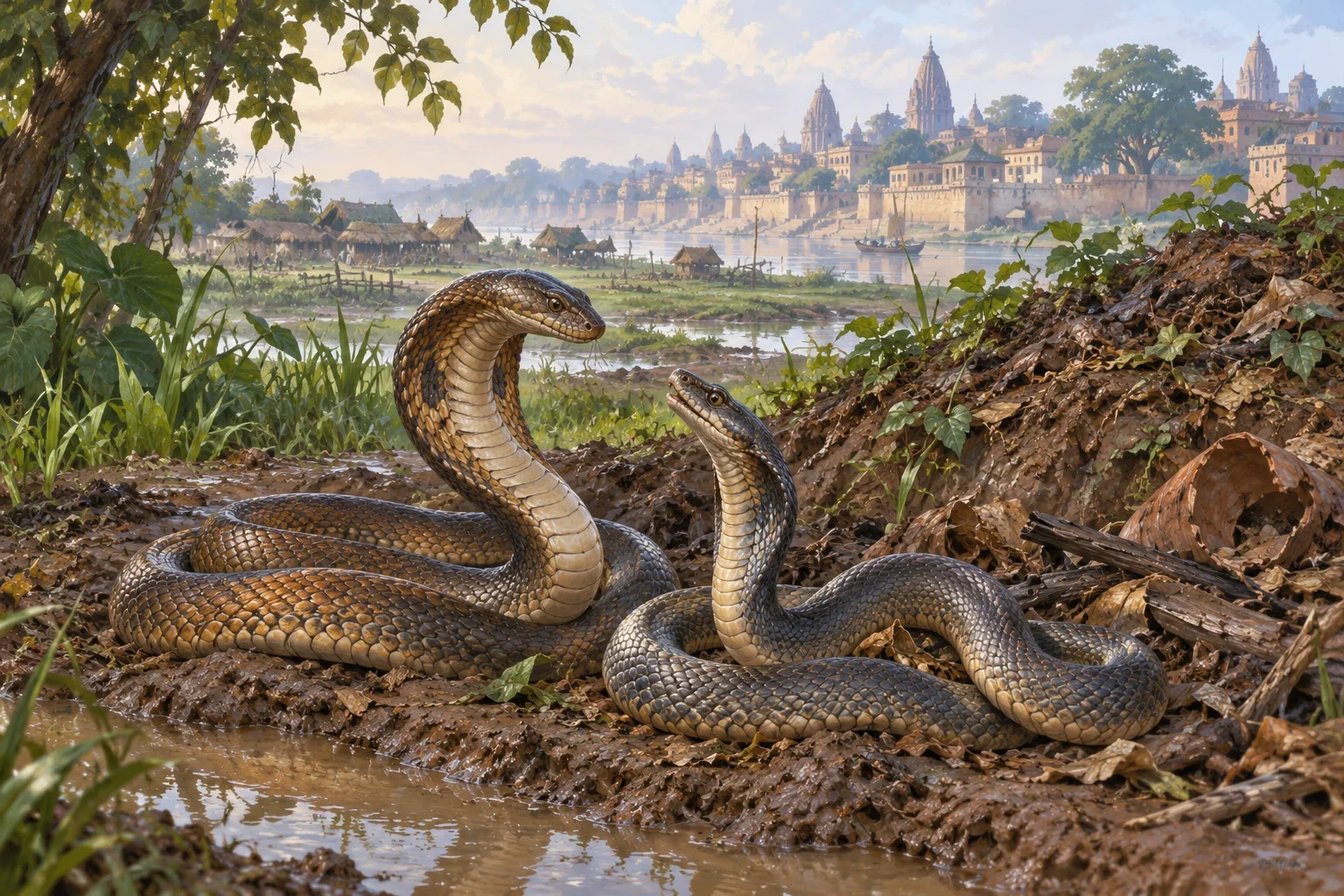
AI-generated interpretation of the Daddara brothers beside the ditch of their exile. Serpent colours, cobra-like hoods, poses and distant architecture are artistic choices; the threatened poisonous breath is not shown.
AI-generated interpretation of the Daddara brothers beside the ditch of their exile. Serpent colours, cobra-like hoods, poses and distant architecture are artistic choices; the threatened poisonous breath is not shown.
Overview
Mahādaddara and Culladaddara are sons of Sūradaddara, king of the Nāgas at the foot of Mount Daddara in the Himalayan region. In the Daddara-Jātaka, the elder brother is a former birth of the Bodhisatta. Culladaddara abuses and strikes the Nāga maidens, and his father orders him expelled. Mahādaddara obtains forgiveness twice. On the third occasion the king banishes both brothers, making the protector share the consequences of the conduct he has repeatedly excused.
The sentence sends them to Benares for three years, living on a dunghill and seeking food in the adjoining ditch. Village boys pelt them with clods and sticks and mock their appearance. The comparison with water lizards, large heads and needle-like tails belongs to the boys’ taunts; it is not an independent anatomical classification. Culladaddara identifies the brothers as venomous serpents and threatens to destroy the boys with breath from his nostril. The story never depicts that threat being carried out.
Mahādaddara answers with verses counselling endurance in a place where their rank is unknown. The brothers complete the exile, their father recalls them, and the narrator says their pride has diminished. The surrounding teaching addresses an angry monk: the final identification makes him Culladaddara and the Buddha Mahādaddara. This particular family’s moral history does not make violence or royal status universal properties of Nāgas. The account is preserved here through H. T. Francis’s historical English translation, rather than a newly collated Pāli text.
Origins & earliest records
Selected Pāli Buddhist narrative in a historical English witness; no earliest oral date asserted.
Records & interpretation
Complete selected story and attached notes read; title and full preface checked. Pāli original not collated.
Selected bibliography
Documented works and useful reading. This is not a list of every appearance.
- 01
The Jātaka, Volume III — No. 304
Complete narrative, frame, ending and attached notes, pp. 10–12. Hosted Pali Text Society/Luzac reprint; exact reprint date not independently verified. Preface assigns these pages to Francis.
Family & connections
A source-supported family tree or inspiration record has not yet been compiled for this profile. Related reading below indicates a connection in subject matter, not a proven lineage or creative influence.
References
Sources supporting this profile. Linked pages have their own scope and editorial standards.
- Historical primary-text translationJātaka III No. 304Research access: 2026-10-27
Image credits
Modern AI interpretation of a historical literary accountAI-generated interpretation of the Daddara brothers beside the ditch of their exile. Serpent colours, cobra-like hoods, poses and distant architecture are artistic choices; the threatened poisonous breath is not shown.
AI-generated interpretation of the Daddara brothers beside the ditch of their exile. Serpent colours, cobra-like hoods, poses and distant architecture are artistic choices; the threatened poisonous breath is not shown.