
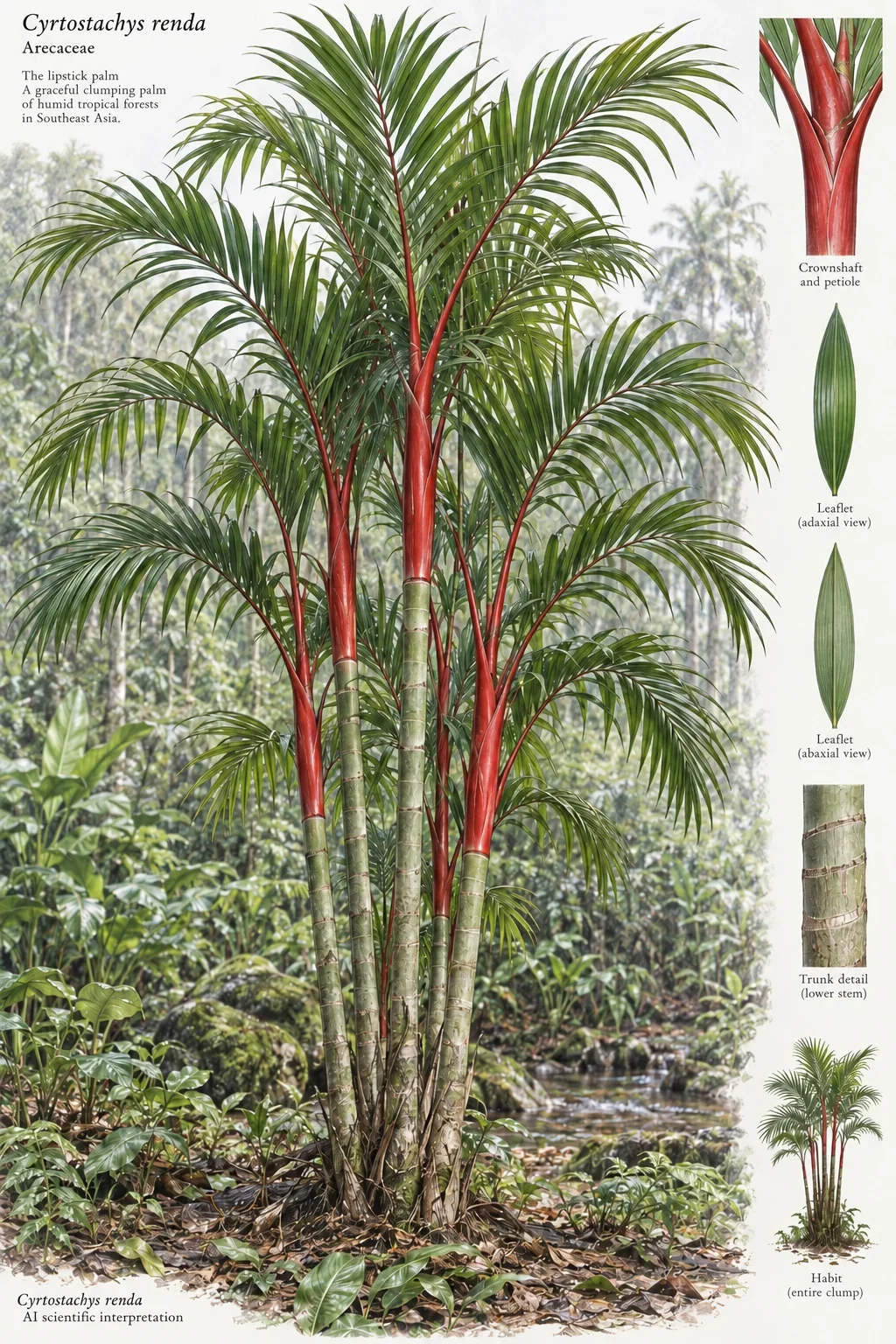
AI red palm crownshafts and green feather-like leaves.
AI scientific interpretation of an imagined red-crownshaft palm clump.
Overview
NParks describes scarlet leaf sheaths around slender stems, red leaf stalks and midribs, and pinnate leaves with boat-shaped leaflets. Small black fruits attract birds. The account places its native range across Thailand, Peninsular Malaysia, Singapore, Sumatra and Borneo; its critically endangered designation is explicitly local to Singapore.
Widyatmoko and colleagues surveyed sixteen sites in Sumatra’s Kerumutan Reserve. Suckers formed 89 percent of the recorded population. Estimated wild reproductive maturity was 25–30 years. Continuously waterlogged sites and dense canopies increased sucker mortality; well-drained areas supported greater abundance. A swamp association therefore does not imply equal suitability of every saturated microsite.
Gardenwise records the palm’s incorporation into the Singapore Botanic Gardens logo through Tan Wee Kiat’s selection and Eng Siak Loy’s artwork. Its account connects an ornamental red crownshaft with freshwater-swamp origins. This cultivated prominence is different evidence from recruitment within wild populations.
Origins & earliest records
Institutional diagnosis, field demography and garden history provide complementary evidence.
Evidence & interpretation
The demographic findings concern sampled reserve sites and estimated ages, not a present census.
Selected bibliography
Documented works and useful reading. This is not a list of every appearance.
- 01
- 02
- 03
Family, evolution & connections
Taxonomic classification
A hierarchy of classified groups, not a chain of direct ancestors.
Source note: NParks places this flowering monocot in Arecaceae.
- FamilyArecaceae
References
Sources supporting this profile. Linked pages have their own scope and editorial standards.
- Government botanical diagnosisCyrtostachys rendaResearch access: 2026-10-11
- Retained primary abstractPopulation status and habitat preferencesResearch access: 2026-10-11
- Institutional historical accountThe Gardens’ logoResearch access: 2026-10-11
Image credits
AI-generated interpretationAI red palm crownshafts and green feather-like leaves.
AI scientific interpretation of an imagined red-crownshaft palm clump.