
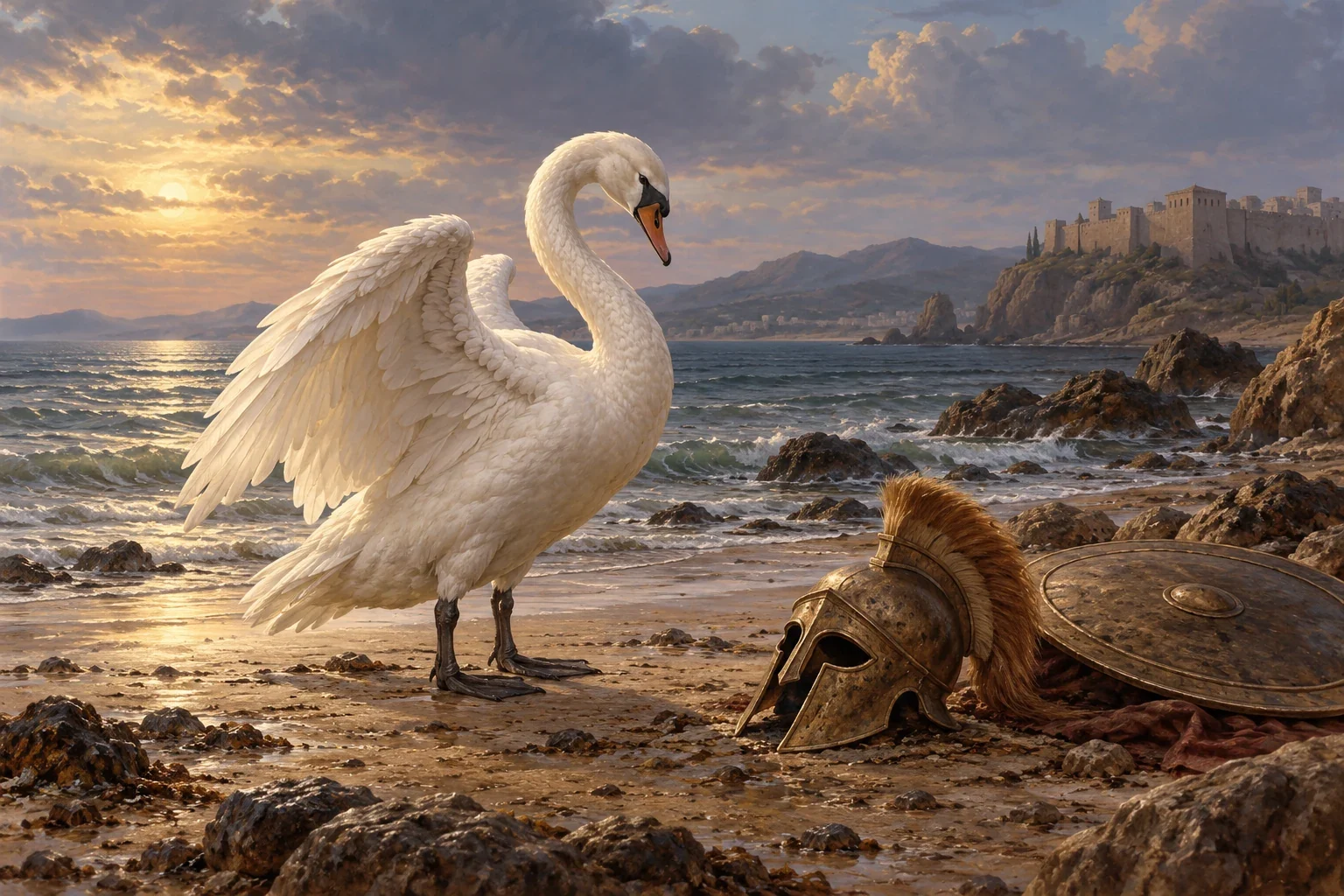
AI-generated illustration of Neptune’s son Cygnus after his transformation into a white swan in Ovid. The swan and abandoned armour follow the selected narrative; pose, armour design, sunset, shore and distant settlement are artistic choices. The secondary shield extends beyond the frame. This is not an archaeological reconstruction or a wildlife record.
AI-generated illustration of Neptune’s son Cygnus after his transformation into a white swan in Ovid. The swan and abandoned armour follow the selected narrative; pose, armour design, sunset, shore and distant settlement are artistic choices. The secondary shield extends beyond the frame. This is not an archaeological reconstruction or a wildlife record.
Overview
Cygnus enters Ovid’s Trojan narrative as a formidable defender of the shore. The Greeks have finally sailed after the events at Aulis, and the Trojans oppose their landing. Achilles seeks either Hector or Cygnus among the enemy ranks. This particular Cygnus is explicitly a son of Neptune: his exceptional resistance belongs to an individual warrior in the narrated combat, not to a general race of invulnerable people.
The first spear strikes his chest without piercing it. Cygnus explains that his helmet and shield are ornaments rather than the cause of his protection. He offers to dispense with defensive armour and boasts of a parent who rules the sea. His contrast with a Nereid’s son is aimed at Achilles, whose mother is Thetis; Riley’s attached note makes that allusion explicit. Cygnus’s own spear penetrates successive layers of Achilles’ shield, so the encounter does not make both combatants equally immune to ordinary weapons.
Achilles tries repeatedly to wound him, then tests his weapon on another soldier, Menœtes. The test succeeds. When the same spear again rebounds from Cygnus, the blood visible on his shoulder briefly seems to promise a wound, but the narrator explains that it came from Menœtes. This small reversal establishes the difference between an apparent injury and an actual breach of the protection. Achilles’ sword likewise fails against Cygnus’s body even after it damages his defensive equipment.
The decisive attack uses pressure and restraint rather than a penetrating wound. Achilles strikes with the sword hilt and drives his opponent backwards until a stone trips him. He pins him with shield and knees and tightens the helmet straps beneath his chin, stopping his breath. As Achilles prepares to take the armour, he finds the body gone. Neptune has changed his son into a white bird bearing the name Cygnus. The synopsis identifies it as a swan; the narrative leaves the armour behind and does not describe a later return to human form.
The transformation is therefore the ending of a defeated warrior’s encounter, not evidence that his invulnerability protected him from every means of harm. Riley’s subsequent explanation offers a different, historicalizing interpretation: he speculates about a sea-powerful prince, an effective shield and a name that suggested a swan. Those suggestions belong to the nineteenth-century commentary, whereas the translated poem presents divine parentage, bodily resistance and Neptune’s intervention as events within its story.
Origins & earliest records
Ovid, Metamorphoses XII, rendered in Henry T. Riley’s nineteenth-century English prose translation; selected retained edition is George Bell & Sons,1893. This profile concerns Neptune’s son in the Trojan combat.
Records & interpretation
Complete XII fablesI–II, verses1–145, synopsis and explanation read with notes1–16. The Aulis and Fame material was read as full episode framing; no separate profiles are inferred from it.
Selected bibliography
Documented works and useful reading. This is not a list of every appearance.
- 01
Metamorphoses, Book XII, Fables I–II
Complete translated unit1–145, explanation and notes1–16;1893 printed edition of the earlier Riley translation.
Family & connections
A source-supported family tree or inspiration record has not yet been compiled for this profile. Related reading below indicates a connection in subject matter, not a proven lineage or creative influence.
References
Sources supporting this profile. Linked pages have their own scope and editorial standards.
- Historical translation with separately identified commentaryMetamorphoses, Book XII, Fables I–II — retained public-domain textResearch access: 2026-10-27
Image credits
AI-generated illustrationAI-generated illustration of Neptune’s son Cygnus after his transformation into a white swan in Ovid. The swan and abandoned armour follow the selected narrative; pose, armour design, sunset, shore and distant settlement are artistic choices. The secondary shield extends beyond the frame. This is not an archaeological reconstruction or a wildlife record.
AI-generated illustration of Neptune’s son Cygnus after his transformation into a white swan in Ovid. The swan and abandoned armour follow the selected narrative; pose, armour design, sunset, shore and distant settlement are artistic choices. The secondary shield extends beyond the frame. This is not an archaeological reconstruction or a wildlife record.