
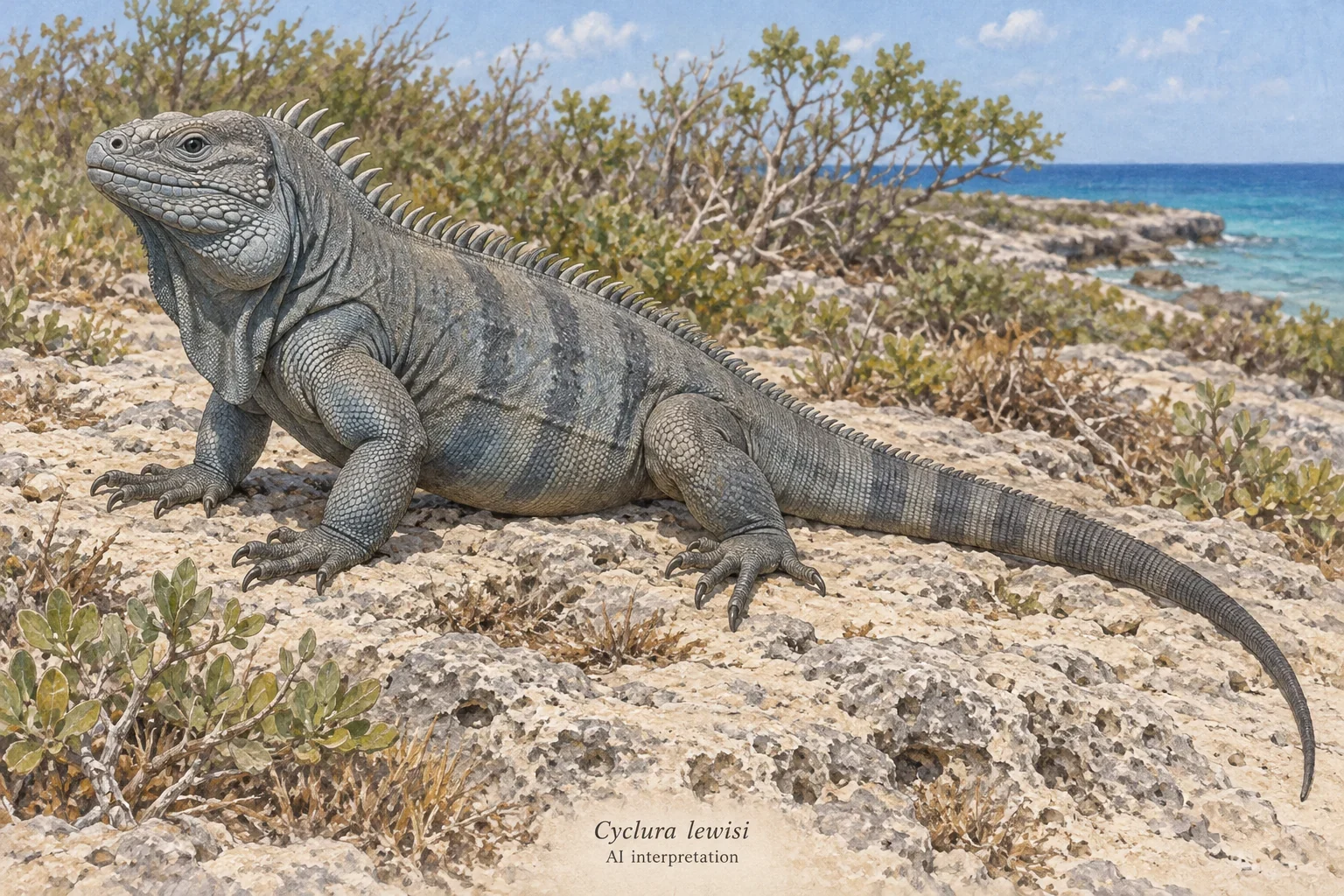
AI illustration of a blue-grey Grand Cayman iguana basking with its full tail visible.
AI interpretation: basking adult; rocky setting imagined.
Overview
The Smithsonian describes faint crossbands and a body exceeding 1.5 metres including the tail. Diurnal adults bask before foraging, primarily eating leaves, stems, flowers and fruits. Dry coastal rocks and scrub provide habitat; nighttime shelters include crevices and caves.
Goodman, Burton and Echternacht studied released captive-bred iguanas in a botanic park. Their compositional analysis found preference for modified habitats at landscape and within-range scales; artificial retreats were frequently occupied and females also nested in artificial sites. Findings from this managed population do not establish fitness or describe every wild population.
Smithsonian placement identifies an iguanid squamate. Colour and ground basking distinguish this portrait without supplying an untested species phylogeny.
Origins & earliest records
Institutional natural history and a reintroduction study provide complementary evidence.
Evidence & interpretation
Radiotracking and habitat analysis concern the study population; historical population estimates are not current censuses.
Selected bibliography
Documented works and useful reading. This is not a list of every appearance.
- 01
- 02
Family, evolution & connections
Taxonomic classification
A hierarchy of classified groups, not a chain of direct ancestors.
Source note: Family placement follows Smithsonian; no divergence date is inferred.
References
Sources supporting this profile. Linked pages have their own scope and editorial standards.
- Institutional natural historySpecies accountResearch access: 2026-10-11
- Retained primary abstractHabitat selection studyResearch access: 2026-10-11
Image credits
AI-generated interpretationAI illustration of a blue-grey Grand Cayman iguana basking with its full tail visible.
AI interpretation: basking adult; rocky setting imagined.