
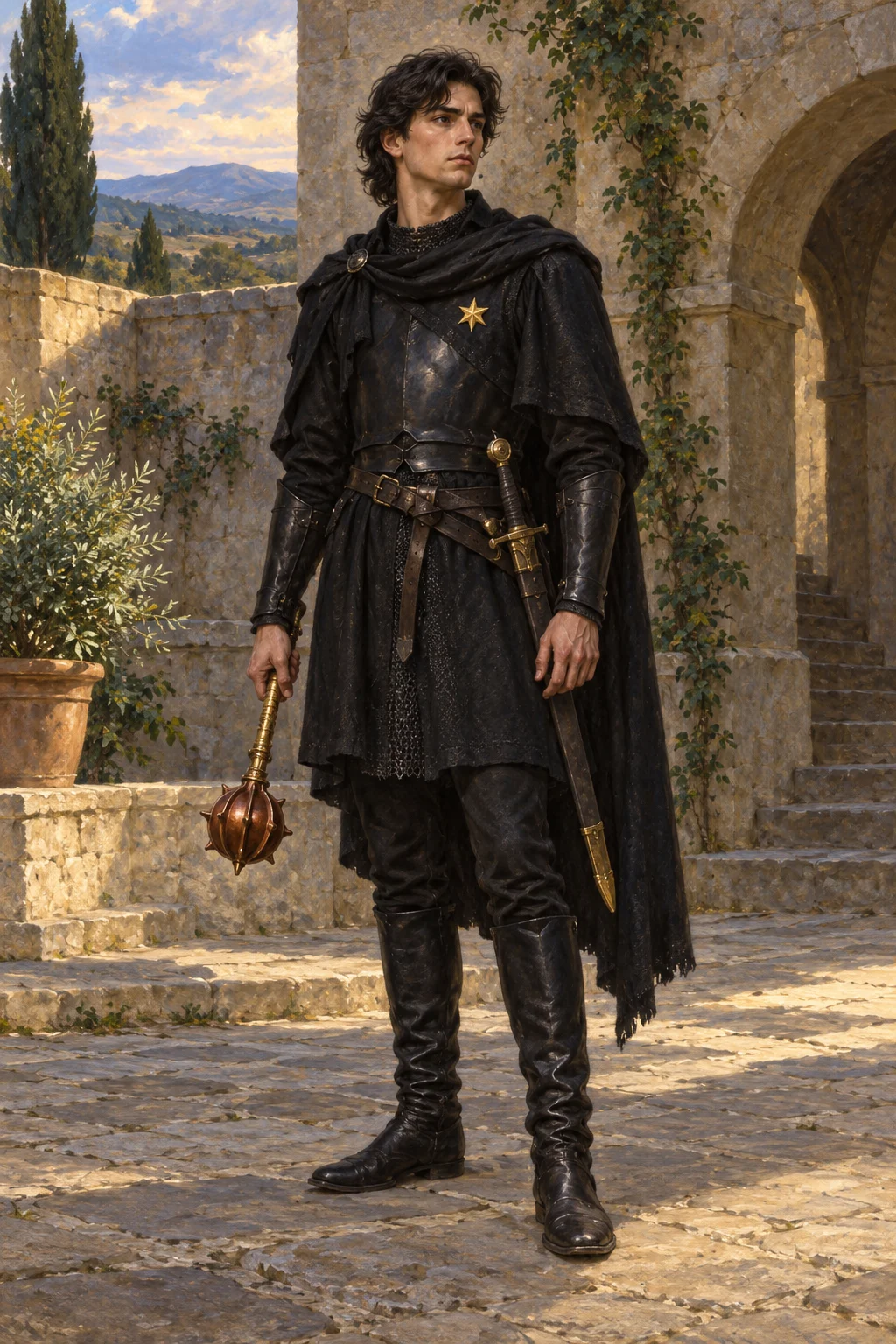
Csabor Úr in black armour with a gold star and lowered mace; appearance, equipment design and courtyard interpretive.
Original narrative illustration; visual particulars and staging interpretive, not an authenticated historical or cultural record.
Overview
Csabor is introduced as a tall, slender young prince, perhaps not yet twenty-five, whose clothing and armour are black. His sole ornament is a gold star awarded for saving the great king’s life. He gives freely to poor people, but his refusal to pay priests for masses earns their hostility. Sent across the snowy mountains to investigate the king’s neighbours in Roumania, he learns that a bishop and the king’s own head priest are encouraging a conspiracy. He enters the cathedral in local dress and hears the plot himself.
His attempt to warn the king fails when spies kill his messenger and seize the letter. The bishop then locks the congregation inside the cathedral and tries to expose the intruder through an oath. Csabor remains by the entrance, drops his brown fur cloak and confronts his attackers with a copper mace with a gilt handle and a broad double-edged sword. He kills several attackers but is himself killed. The king imprisons the head priest and marches in revenge; Dame Margit accompanies the army and dies grieving at the blood-marked column. The claimed enduring stain belongs to the legend’s ending, not an independently inspected historical relic.
Origins & earliest records
The editors identify Csabor Úr as Erdélyi i.3 and call it a Csángó tale. Their footnote places the Csángós in historical Moldavia. They say some writers associate the story with King Matthias and his black troop, but present that as an interpretation of folk-history, not proof of Csabor’s biography. No individual teller is named in the supplied attribution.
Records & interpretation
Complete XXII, Csabor Ur, pp.123–125, with the full note on p.380 and its Csángó footnote; the tale’s lethal ending is retained.
Selected bibliography
Documented works and useful reading. This is not a list of every appearance.
- 01
The Folk-Tales of the Magyars
London: Elliot Stock for the Folk-Lore Society. Original historical English translation, with comparative editorial notes.
Family & connections
A source-supported family tree or inspiration record has not yet been compiled for this profile. Related reading below indicates a connection in subject matter, not a proven lineage or creative influence.
References
Sources supporting this profile. Linked pages have their own scope and editorial standards.
- Historical collected tale and English translationJones and Kropf, The Folk-Tales of the Magyars, original English editionResearch access: 2026-10-18
- Original title, selected complete tales and editorial attribution witnessOriginal 1889 edition scanResearch access: 2026-10-18
Image credits
AI-generatedCsabor Úr in black armour with a gold star and lowered mace; appearance, equipment design and courtyard interpretive.
Original narrative illustration; visual particulars and staging interpretive, not an authenticated historical or cultural record.