
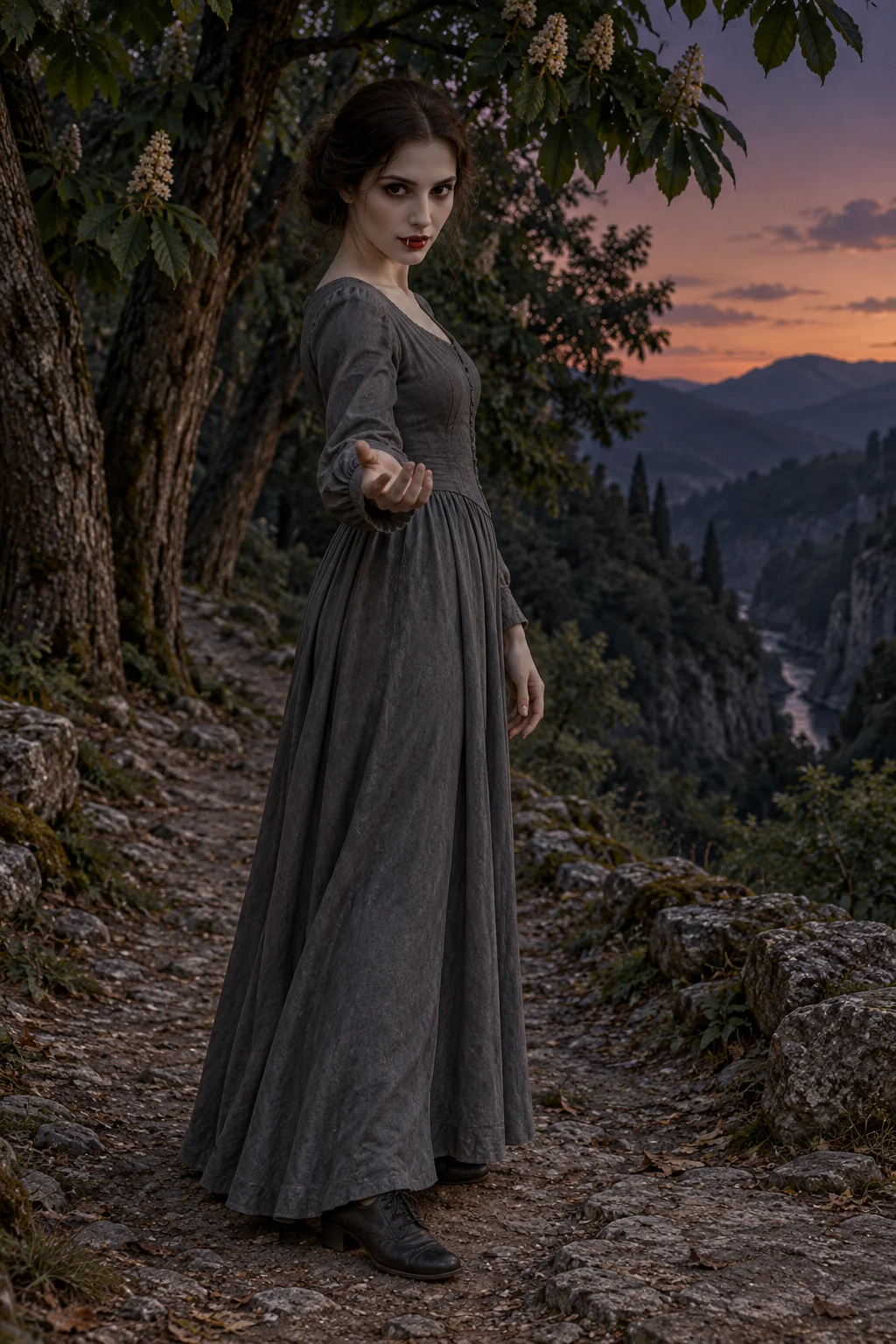
AI-generated interpretation of Crawford’s Cristina beckoning beneath chestnut trees; dress, hair colour and precise facial features are reconstructed.
The small sharp teeth follow the story; costume and staging are imagined, and no community identity is inferred from the narrator’s comparison.
Overview
Cristina is a poor young woman whose unreturned love for Angelo becomes the centre of a haunting. Before her disappearance, the narrator describes very black eyes, red lips and a lean build compared to a greyhound’s. Angelo is expected to inherit his father Alario’s money and marry another woman. When Alario is dying, Cristina is sent to fetch a doctor. Two masons steal the old man’s chest of money and bury it near the narrator’s coastal tower. Cristina, returning without the absent doctor, comes upon them; they strike her and conceal her with the chest. The narrator explicitly reconstructs this unwitnessed sequence as what must have happened. His certainty about her killers therefore belongs to his telling, rather than to an independently witnessed account.
After Angelo loses both the money and his expected marriage, he encounters the dead Cristina during lonely twilight walks. She waits beneath chestnut trees and beckons without speaking. Her red lips reveal two small sharp teeth; her face becomes distinctly pale, and her eyes appear hungry. At first he experiences the meetings as waking dreams. Gradually he is drawn down the gorge and into her embrace, returning from nights with her increasingly weak and bloodless. Antonio, the tower’s caretaker, finally sees the dead woman feeding on him. Cristina’s attraction combines the love Angelo had ignored with a destructive physical hunger; the narrative does not turn her into a general account of Italian vampire belief or define rules for every revenant.
Antonio brings an old priest to the mound. Holy water interrupts Cristina’s embrace, and Angelo is moved away while the two men open the grave. Antonio descends with a stake and a pick, but the priest is too frightened to look inside. He hears a struggle, blows and a terrible cry before the stolen chest is thrown out and Antonio hurriedly fills the grave. The exact encounter below is withheld. Angelo recovers his inheritance, leaves for South America and is not heard from again. The framing scene nevertheless shows the haunting persisting: from the tower the narrator and his guest Holger see a body-shaped outline on the mound, invisible at close quarters. When Holger approaches, the narrator sees it rise and stretch towards him without its feet leaving the grave. The final question of whether Cristina is wholly dead remains unanswered.
First appearances & development
F. Marion Crawford’s authored English supernatural fiction, read in the dated 1911 Macmillan collection Wandering Ghosts. The coastal setting and the narrator’s attitudes are parts of the literary construction, not evidence of a collected community tradition.
Canon & continuity
The complete selected narrative and its unresolved frame ending were read, together with the collection’s historical title, copyright page and contents. No first-periodical date is assigned from the collection’s pooled copyright years. No historical illustration supplied the image design.
Selected bibliography
Documented works and useful reading. This is not a list of every appearance.
- 01
Wandering Ghosts — For the Blood Is the Life
New York: The Macmillan Company; title and copyright page state Published March, 1911. The consulted story begins on page 167.
Family & connections
A source-supported family tree or inspiration record has not yet been compiled for this profile. Related reading below indicates a connection in subject matter, not a proven lineage or creative influence.
References
Sources supporting this profile. Linked pages have their own scope and editorial standards.
- Primary historical authored fictionWandering Ghosts — historical title and complete For the Blood Is the LifeResearch access: 2026-10-18
Image credits
AI-generatedAI-generated interpretation of Crawford’s Cristina beckoning beneath chestnut trees; dress, hair colour and precise facial features are reconstructed.
The small sharp teeth follow the story; costume and staging are imagined, and no community identity is inferred from the narrator’s comparison.