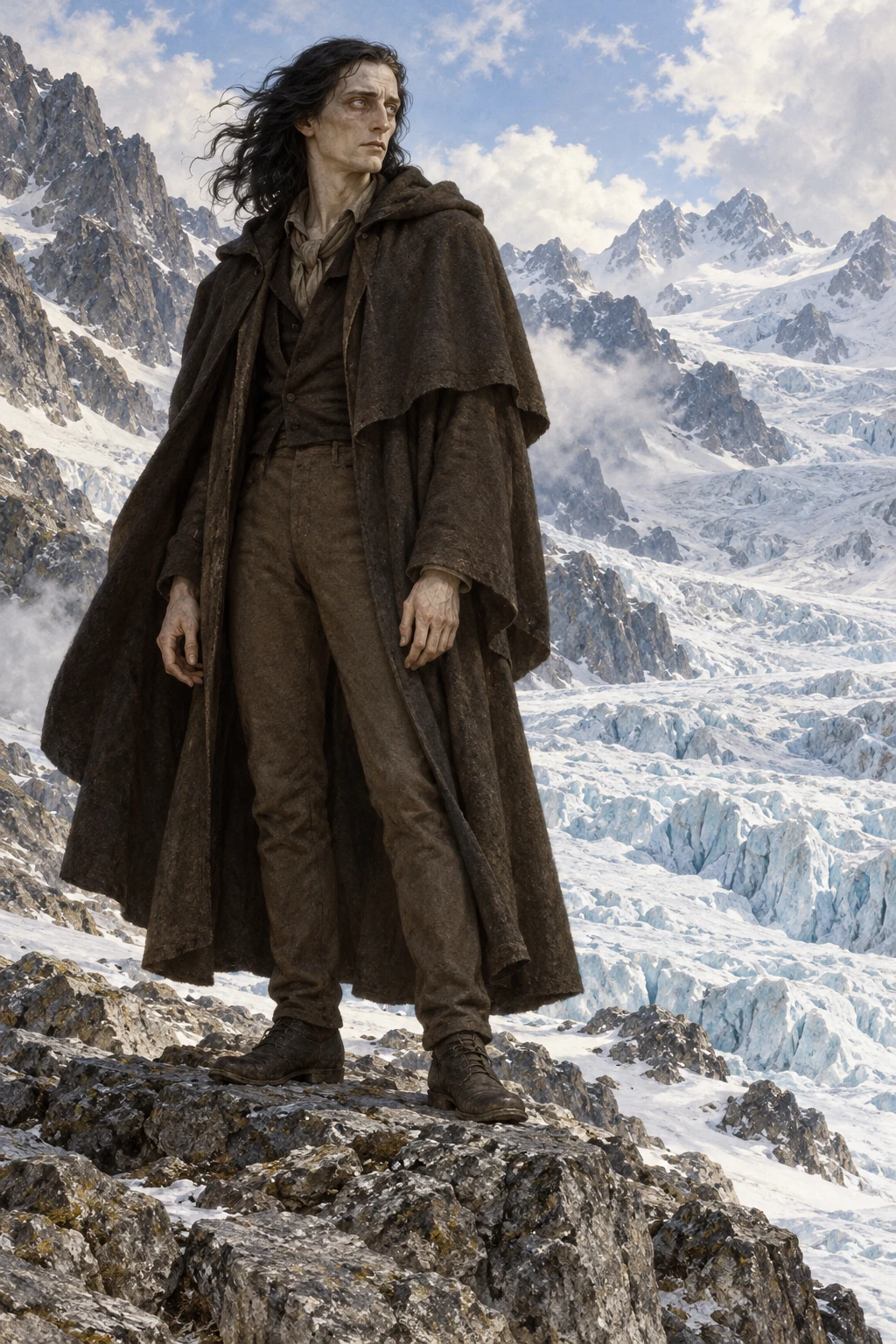
AI-generated interpretation of Shelley’s creature near the 1818 novel’s glacier encounter. Black hair and the pale yellowish complexion draw on Victor’s description. Face, pose, clothing, footwear and scenery details are imagined; the picture is not a measured reconstruction or a later film design.
This profile and illustration concern the selected 1818 literary text. They do not identify which version a later game designer consulted.
Overview
Mary Shelley’s 1818 novel presents a humanlike being made by Victor Frankenstein, rather than a traditional species of monster. In Volume I, chapter III, Victor describes his study of anatomy and bodily decay, followed by a discovery that he claims lets him animate lifeless matter. He withholds the secret from his listener. Preparing a complex human frame remains a separate difficulty, and he chooses a body about eight feet tall because the smallness of ordinary parts would slow his work. The chapter names charnel houses, the dissecting room and the slaughterhouse among the places furnishing materials; it does not provide a reproducible method of creation.
The following chapter places the awakening on a rainy November night at about one in the morning. The first signs are an opening yellow eye, hard breathing and convulsive movement. Victor describes proportionate limbs, thin yellow skin, flowing black hair, white teeth, watery eyes, a shrivelled complexion and straight black lips. Features he had selected as beautiful become dreadful to him when the body moves. This description belongs to Victor’s frightened narration. The selected passage does not describe a flat skull, green skin, neck bolts or a visible electrical apparatus.
Victor flees instead of caring for the being. When he wakes from a nightmare, the creature is beside his bed, moving its mouth, making inarticulate sounds and extending a hand. Victor interprets the gesture as an attempt to detain him and escapes into the courtyard. The next morning he meets Henry Clerval, returns fearfully to his rooms and discovers that the creature has gone. Victor’s later collapse and recovery under Clerval’s care complete that chapter; they are not evidence that the abandoned being has ceased to exist.
Volume II, chapter II, gives a very different encounter on the glacier near Montanvert. The creature crosses the ice with exceptional speed and agility and speaks in sustained, reasoned sentences. It asks Victor to hear its defence, argues that a creator owes duties to the life he has made, and compares its position with Adam and the fallen angel. Its account of an originally benevolent nature ruined by misery is its own moral explanation. The appeal also contains threats against Victor’s surviving friends if he refuses its conditions. Victor eventually follows it to a mountain hut and agrees to listen. The creature is therefore represented in these selected chapters as physically formidable and capable of argument, accusation, suffering and negotiation, rather than as a permanently speechless figure.
First appearances & development
Mary Shelley, Frankenstein; or, The Modern Prometheus, London: Lackington, Hughes, Harding, Mavor, & Jones, 1818. The consulted transcription states that it was made from a photo-reprint of the 1818 edition.
Canon & continuity
Complete selected chapters read: Volume I, III–IV, from Victor’s scientific studies through awakening, abandonment and recovery; Volume II, II, from the mountain journey through the creature’s appeal and entry into the hut. This is selected narrative coverage, not a complete-novel reading or a collation with the 1831 revision.
Selected bibliography
Documented works and useful reading. This is not a list of every appearance.
- 01
Frankenstein; or, The Modern Prometheus
1818 text from a photo-reprint, Project Gutenberg 41445; complete Volume I chapters III–IV and Volume II chapter II. The separately catalogued 1831 revision is not blended into this profile.
Family, evolution & connections
Garangolm
Shelley’s 1818 novel provides an earlier literary account of an artificially animated humanlike being. This contextual comparison does not identify which later version or edition informed Garangolm; its separately recorded inspiration statement retains its existing scope.
References
Sources supporting this profile. Linked pages have their own scope and editorial standards.
- Original literary fiction; historical English textMary Shelley, Frankenstein (1818), Volume I chapters III–IV and Volume II chapter IIResearch access: 2026-10-25
Image credits
Modern interpretation of original literary fictionAI-generated interpretation of Shelley’s creature near the 1818 novel’s glacier encounter. Black hair and the pale yellowish complexion draw on Victor’s description. Face, pose, clothing, footwear and scenery details are imagined; the picture is not a measured reconstruction or a later film design.
This profile and illustration concern the selected 1818 literary text. They do not identify which version a later game designer consulted.