
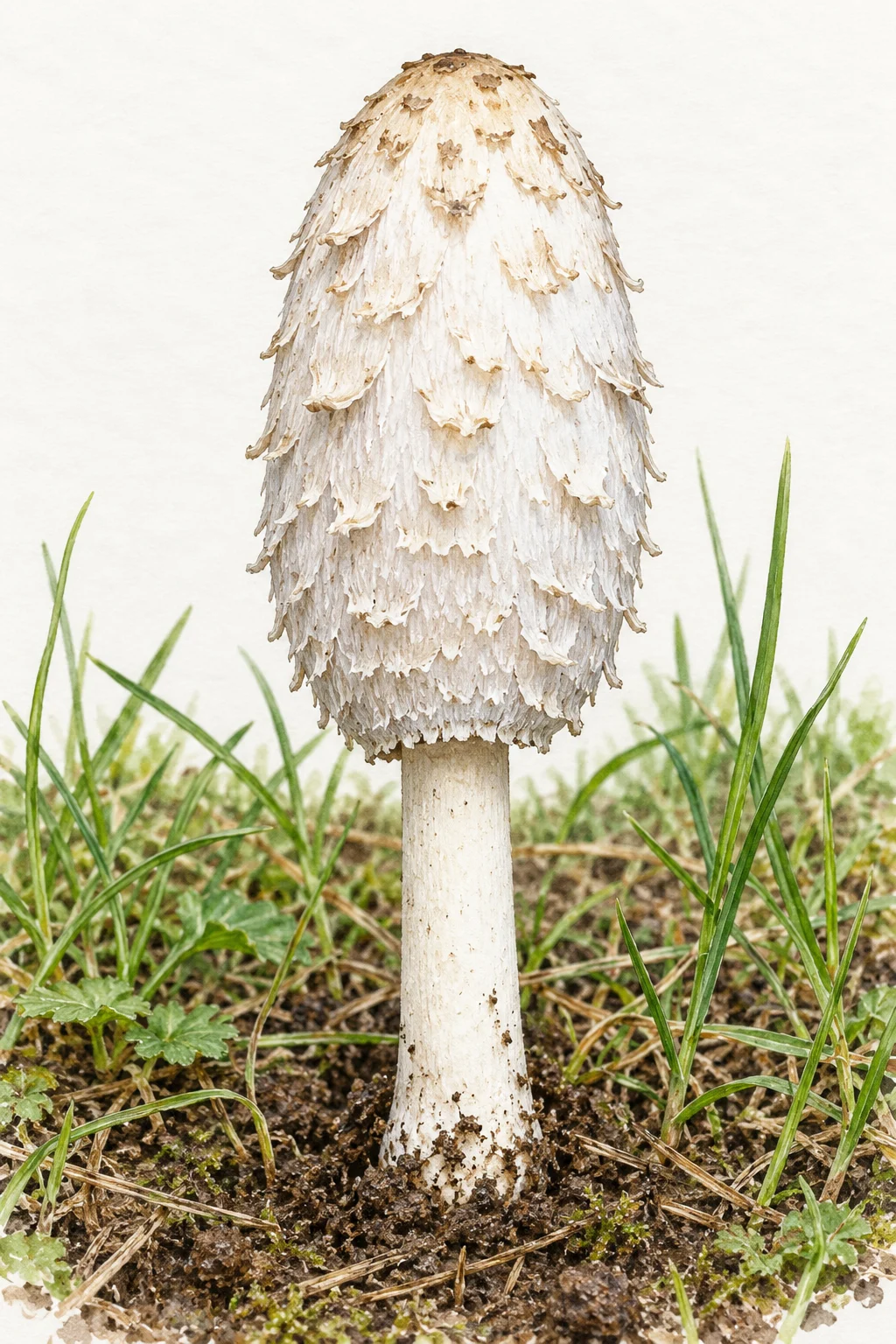
AI-generated young fruiting-body study.
Interpretation; microscopic identification is not claimed.
Overview
Shaggy inkcaps begin with elongated, egg-shaped white caps carrying darker, flaky scales. As a fruiting body develops, its cap becomes bell-shaped. Aging starts an unusual transformation at the outer edge: the cap turns black and liquefies, with the change progressing inward from the rim.
The University of Évora account describes this saprotrophic fungus in nutrient-rich meadows, pastures, woodland clearings, verges and gardens. Its slender white stem is hollow and fibrous, with a fragile ring. The densely packed gills change from white through pink to black, joining the cap in its eventual liquefaction.
Origins & earliest records
Organic-rich soils
Evidence & interpretation
Published accounts.
Selected bibliography
Documented works and useful reading. This is not a list of every appearance.
- 01
- 02
Family & connections
A source-supported family tree or inspiration record has not yet been compiled for this profile. Related reading below indicates a connection in subject matter, not a proven lineage or creative influence.
Look for a taxonomic record and classified relativesReferences
Sources supporting this profile. Linked pages have their own scope and editorial standards.
- Community species accountShaggy InkcapResearch access: 2026-10-18
- University museum accountCoprinus comatusResearch access: 2026-10-18
Image credits
AI-generated illustrationAI-generated young fruiting-body study.
Interpretation; microscopic identification is not claimed.