
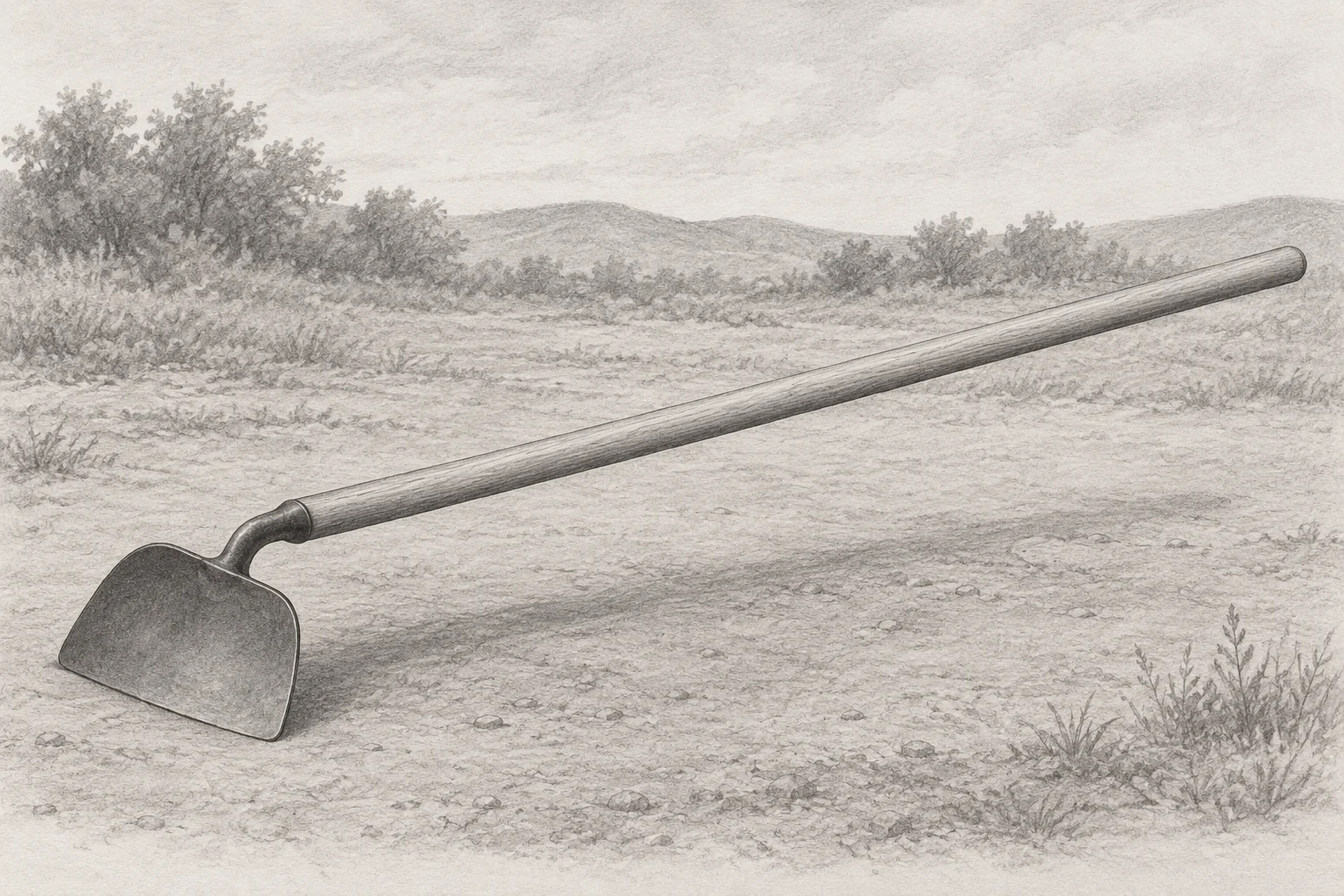
Generated interpretation of a published historical form; not an authenticated specimen or exact replica. Fine construction is not reconstructed.
Overview
The entry on hoes distinguishes the ordinary form from narrower or pointed kinds and from the push hoe or scarifier. Hunn and Bailey assign the ordinary hoe to rougher work such as digging and preparing the ground, while other patterns serve subsequent cultivation or cutting off weeds. The small captioned illustration shows a long, plain shaft connected through a short bent neck to a broad blade. Its face and overall outline can be followed, but the cut does not specify the materials, dimensions or details of the connection. It represents a tool category used in the manual's gardening sequence, rather than an individually attributed workshop specimen.
The separate entry on tillage explains why the authors did not regard one implement as sufficient for every task. Their account associates cultivation with making soil fine and loose, maintaining moisture and providing room for roots, and says that the method depends on the soil and season. They distinguish heavier initial work from later surface cultivation, recommending finer tools for the latter in their historical advice. The short entry on tools also places care and storage within the household routine: implements are to be kept clean, dry, under cover and in their appointed places. Together these passages connect the illustrated hoe with both a working sequence and the organisation of a home garden.
History & identity
The Practical Garden-Book names C. E. Hunn and L. H. Bailey as authors. In the foreword, Bailey identifies Hunn as gardener to Cornell University’s Horticultural Department and explains that he edited and amplified Hunn’s notes for household gardeners. The retained third edition was published in 1903, with copyright dated 1900 and a foreword dated 22 February 1900 at Ithaca, New York. This establishes the instructional context, not a tool’s manufacturing origin.
Sources & representation
The Hoes entry supplies the named form and its role; the Tillage and Tools entries explain the broader working context. The small published cut supports the overall outline. Materials, exact dimensions, concealed construction and the identity of a maker are not supplied.
Selected bibliography
Documented works and useful reading. This is not a list of every appearance.
- 01
The Practical Garden-Book
Third edition, Macmillan, New York and London. Copyright 1900; foreword dated 22 February 1900. Alphabetical practical entries with marginal illustrations.
Language & cultural connections
Source-supported language and cultural connections have not yet been compiled for this profile.
References
Sources supporting this profile. Linked pages have their own scope and editorial standards.
- Period practical horticultural manual with captioned tool cutsThe Practical Garden-Book, third editionResearch access: 2026-10-18
Image credits
AI-generatedGenerated interpretation of a published historical form; not an authenticated specimen or exact replica. Fine construction is not reconstructed.