Original AI literary interpretation; unspecified visual details are artistic choices.
Overview
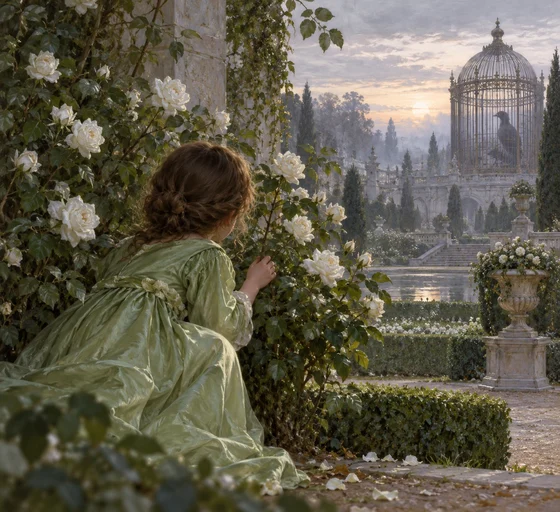
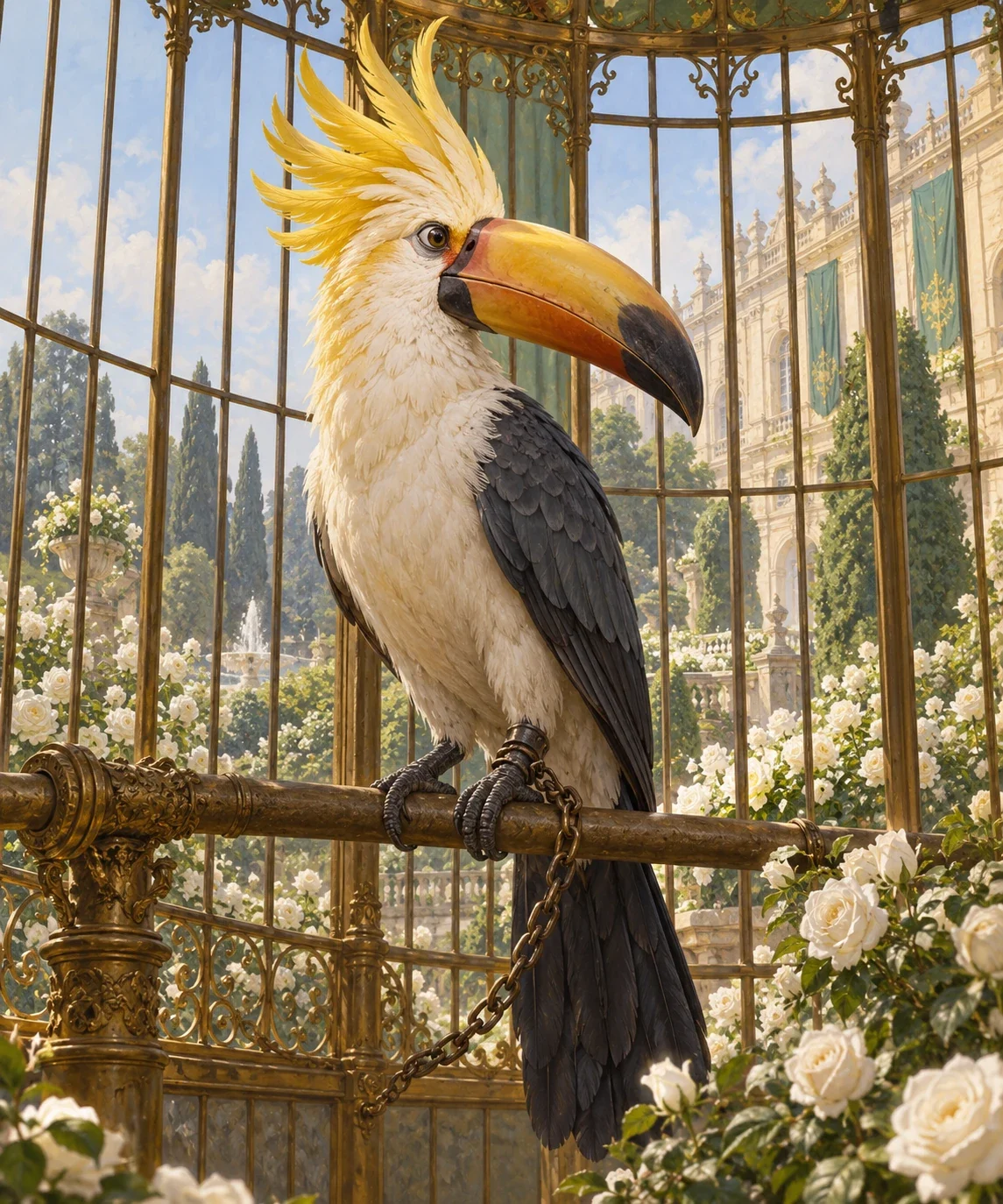
The Cockatoucan is the Princess’s valuable pet in the Green Land, a kingdom reached by the wrong omnibus from Brixton. Matilda first sees him chained to a perch inside a cage large enough to occupy an entire side of the white-rose garden. His explicit distinguishing features are a yellow crest like a cockatoo’s and a very large bill like a toucan’s. The Princess says that if he dies or is stolen, the Green Land will wither into a place resembling the London districts she fears. This dependency is her account within the tale; the story does not supply a natural history or a population of similar birds.
His laughter produces transformations that disrupt bodies, occupations, government and even the calendar. Matilda sees her nursemaid Pridmore turn into an Automatic Nagging Machine, and the King recounts ministers becoming boys, a dragon becoming a cat and days going astray. The palace later becomes a butcher’s shop, the King a villa and military ceremonies change into quite different events. The King initially treats the bird as the malicious author of these disasters and tries to burden him with lessons. Matilda’s dawn watch reveals a different immediate cause: the exceedingly thin Princess slips through the bars and tickles him under the wings. She eventually admits that he never laughs except when tickled and that he dislikes it.
The Princess also explains that ordinary laughter changes only one or two things at a time and can yield results the bird does not expect. To reverse everything, he must laugh on the wrong side of his mouth. Matilda and the Princess bring Pridmore’s machine before his cage, and the Princess tickles him until it becomes Pridmore again. The angry nursemaid shakes him and produces the required wrong-sided laughter, restoring the kingdom and removing Matilda’s magical cleverness. The Cockatoucan then falls into two parts, which become an ordinary toucan and a weathercock. The narrator playfully retains some weather-changing power for the latter, while saying that the bird has never smiled again. This is the tale’s literal treatment of an idiom, not evidence for a real animal’s abilities.
First appearances & development
The unnamed Princess’s pet in E. Nesbit’s authored fairy tale, not a reported zoological animal or a traditional species.
Canon & continuity
Complete tale and retained original title/contents framing read. Direct introduction supplies yellow cockatoo-like crest and very large toucan-like bill; later action revises the King’s initial accusation of deliberate mischief.
Selected bibliography
Documented works and useful reading. This is not a list of every appearance.
- 01
Nine Unlikely Tales - The Cockatoucan or Great Aunt Willoughby
Selected complete English tale, printed pp3–47. No claim to establish first publication or date of this transcribed edition.
Family & connections
A source-supported family tree or inspiration record has not yet been compiled for this profile. Related reading below indicates a connection in subject matter, not a proven lineage or creative influence.
References
Sources supporting this profile. Linked pages have their own scope and editorial standards.
- Primary authored English literary narrativeE. Nesbit - The Cockatoucan or Great Aunt Willoughby, complete taleResearch access: 2026-10-23
Image credits
AI-generated literary illustrationOriginal AI literary interpretation; unspecified visual details are artistic choices.