
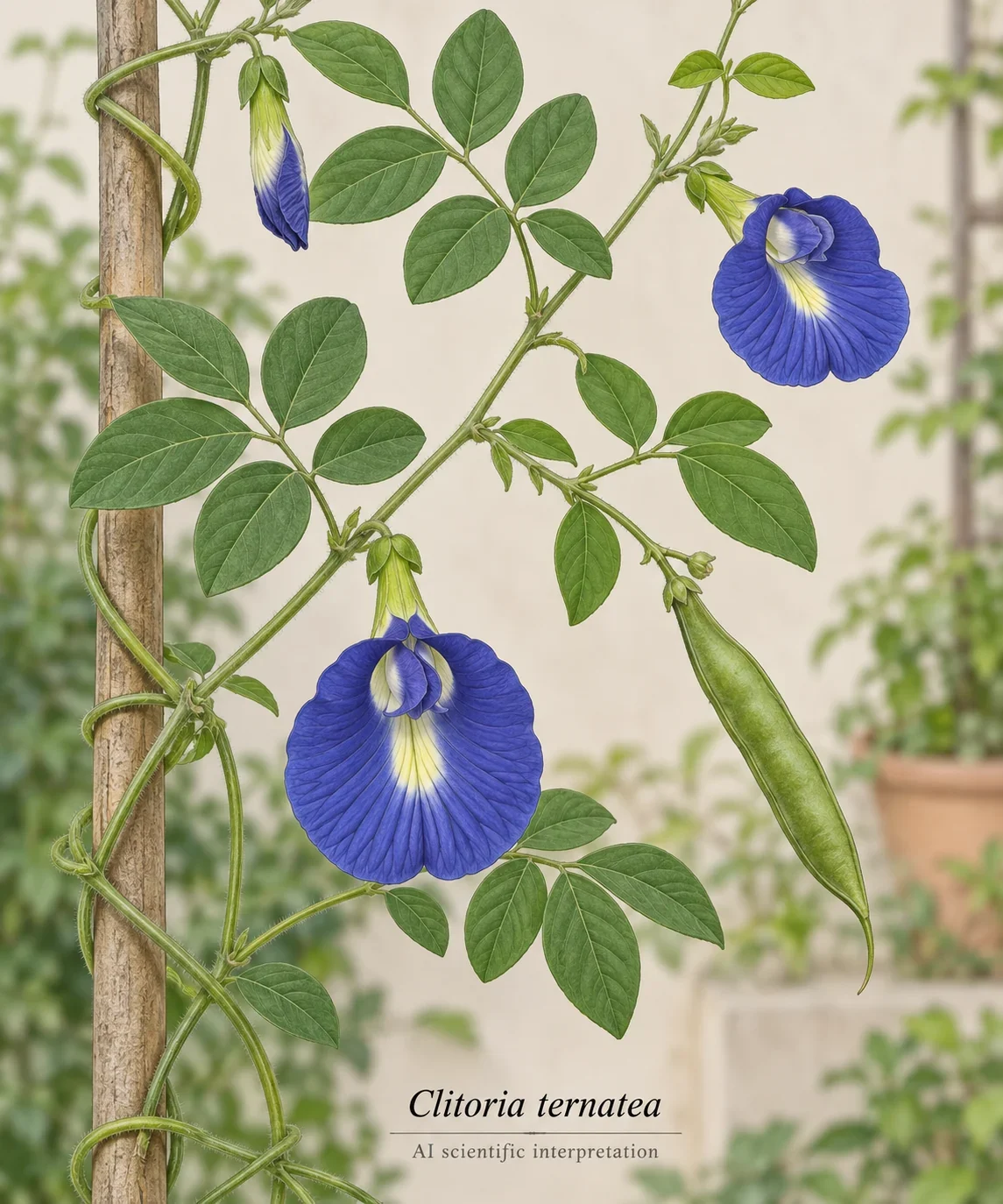
AI scientific interpretation of Clitoria ternatea.
AI scientific interpretation of an imagined Clitoria ternatea.
Overview
NParks describes soft-haired stems, leaves with five to seven elliptic or ovate leaflets, and solitary flowers varying from white through pink to blue. Blue flowers have a yellow base. Linear-oblong pods end in a pointed tip. The account records cultivation and occurrence in disturbed, open ground.
Sinjushin’s 2022 comparative study examined normal and double-flowered Clitoria among several legumes. The double form had five flag-like petals and free stamens. Both forms were collected in Thailand, probably as garden escapes; fixed, dissected flowers were examined microscopically.
The accessions were not isogenic, so nectary comparisons were qualitative. The normal flower is resupinated. These observations concern floral development, rather than proof of a therapeutic effect or a universal wild pollination rate.
Origins & earliest records
A government flora and comparative floral study supply complementary evidence.
Evidence & interpretation
Microscopic observations are distinguished from external floral diagnosis.
Selected bibliography
Documented works and useful reading. This is not a list of every appearance.
- 01
- 02
Family, evolution & connections
Taxonomic classification
A hierarchy of classified groups, not a chain of direct ancestors.
Source note: Family follows NParks; the study places its sampled legumes in Papilionoideae.
- FamilyFabaceae
- SubfamilyPapilionoideae
References
Sources supporting this profile. Linked pages have their own scope and editorial standards.
- Government floraClitoria ternateaResearch access: 2026-10-11
- Primary microscopyPhenotypes of Floral Nectaries in Developmental Mutants of Legumes and What They May Tell about Genetic Control of Nectary FormationResearch access: 2026-10-11
Image credits
AI-generated interpretationAI scientific interpretation of Clitoria ternatea.
AI scientific interpretation of an imagined Clitoria ternatea.