
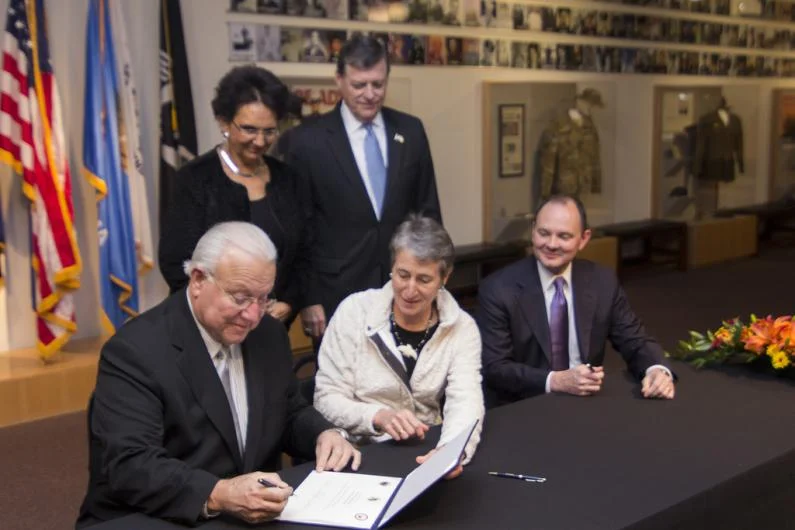
Citizen Potawatomi Nation Chairman John Barrett signing tribal leasing regulations with Secretary Sally Jewell and other officials at the November 2013 ceremony
The Department of the Interior identifies Chairman John Barrett signing the Citizen Potawatomi Nation’s leasing regulations with Sally Jewell, Kevin Washburn, Tom Cole and Vice-Chairman Linda Capps present. This records a particular governance event in November 2013. It does not portray every Nation member or imply endorsement of this compendium by the participants.
Overview
Citizen Potawatomi Nation is a distinct tribal nation based in Oklahoma, with citizens living beyond its immediate service area. Its government overview describes executive, legislative and judicial functions and identifies constitutional changes in 1938, 1985 and 2007. The same page discusses tribal enrollment as a documented relationship to an enrolled ancestor. This is a specific political framework, not a definition of every Potawatomi person or a biological classification. The public overview is an introduction to national institutions; the underlying constitution, enrollment documents and individual citizenship decisions have not been independently examined here.
The Cultural Heritage Center’s history connects Great Lakes homelands, forced removal to Kansas and the later formation of the Citizen Potawatomi community in Indian Territory. It explains the Citizen designation through the 1861 treaty’s combination of land allotments and United States citizenship, while describing the difficulties that followed. Its account dates the earliest families’ arrival at the new reservation to 1872 and notes that paying their own moving costs affected which families could relocate first. This specificity resists treating removal as one identical experience for all Potawatomi communities. The history also describes the 2007 expansion of legislative representation for citizens living across the United States.
In a February 2017 Hownikan report, then-director Kelli Mosteller explained the Cultural Heritage Center as a place connecting objects with family histories and ongoing community relationships. The report dates its opening to January 2006 and describes the Tribal Heritage Project’s invitation to record personal and inherited family stories. It also lists language, preservation, enrollment and youth programmes operating around the centre. Its plans for new exhibits were future expectations at the time. The article documents an institutional approach and a historical development stage; no recording or completed exhibition is inferred from that announcement alone.
A December 2025 Hownikan article presents four staff perspectives on related work. Spring Cleveland described the care and confidentiality involved in maintaining membership records. Keisha Lindsay discussed the institution’s daily operations, while Czarina Thompson connected cultural classes with learning, friendship and the confidence to help other participants. Robert Collins described language teaching across community and educational settings. These named accounts show that cultural work includes administration, relationships and teaching as well as collections. Their roles and experiences are dated to the article; they are not claims about present staffing, every citizen’s practice or the measured results of all programmes.
History & identity
Community historical account distinguishes forced removal, treaty-era designation and later national institutions.
Sources & representation
Complete government overview, heritage timeline and both dated Hownikan reports read; linked legal texts and oral-history recordings unexamined.
Selected bibliography
Documented works and useful reading. This is not a list of every appearance.
- 01
Cultural Heritage Center staff members work together to preserve CPN heritage
Complete15December report with four named staff perspectives.
Language & cultural connections
Source-supported language and cultural connections have not yet been compiled for this profile.
References
Sources supporting this profile. Linked pages have their own scope and editorial standards.
- Tribal governmentCitizen Potawatomi Nation: GovernmentResearch access: 2026-10-06
- Community historyCPN Cultural Heritage Center: HistoryResearch access: 2026-10-06
- Community newspaperHownikan: Heritage center is more than a museum,2017Research access: 2026-10-06
- Community newspaperHownikan: Cultural Heritage Center staff,2025Research access: 2026-10-06
Image credits
Contextual community governance photographCitizen Potawatomi Nation Chairman John Barrett signing tribal leasing regulations with Secretary Sally Jewell and other officials at the November 2013 ceremony
The Department of the Interior identifies Chairman John Barrett signing the Citizen Potawatomi Nation’s leasing regulations with Sally Jewell, Kevin Washburn, Tom Cole and Vice-Chairman Linda Capps present. This records a particular governance event in November 2013. It does not portray every Nation member or imply endorsement of this compendium by the participants.