
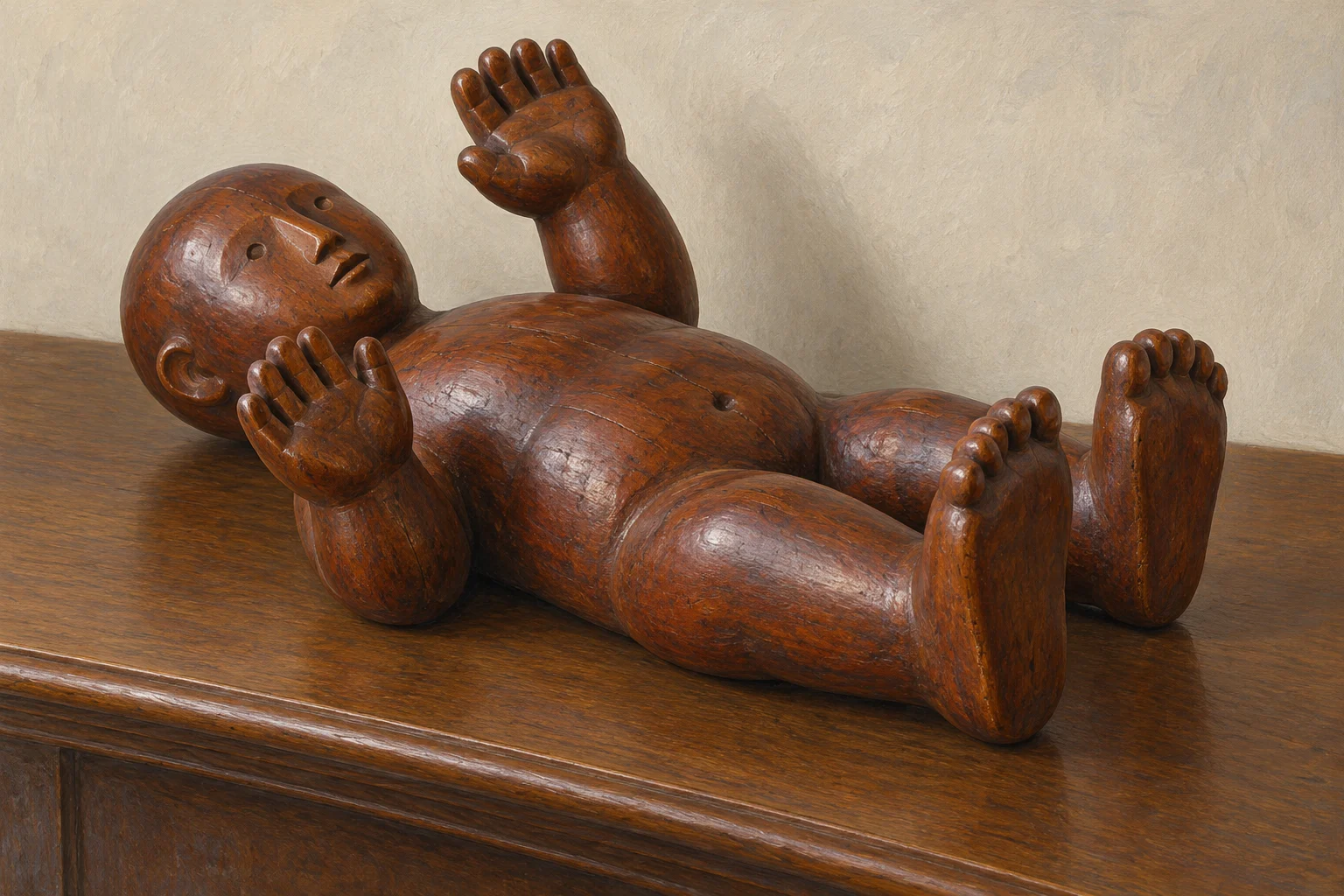
An imagined complete mahogany Chu-bu figure lying on its back with wooden hands and toes raised.
The illustration reconstructs the figure’s unspecified face, proportions and carving style. Its recumbent pose and raised hands and toes follow the ending. It does not reproduce a real sacred object or claim documentary evidence of a community’s practice.
Overview
Chu-bu has received worship for more than a century when the priests introduce Sheemish into his temple. His polished mahogany figure stands on a diorite pedestal, with a brazier and plates for offerings in front. The new rival is visibly recent carving, stained dark red, and now shares the people’s gifts. Chu-bu tries to assert his exclusive importance by producing an earthquake, then opposes the same miracle when he senses that Sheemish is attempting it. Neither succeeds while they work against one another. Their quarrel descends into silent mutual taunts after the temple’s birds soil their heads. The narrator explains their communication as divine awareness rather than ordinary audible speech, and treats their prolonged jealousy with comic solemnity.
Eventually Chu-bu again concentrates upon an earthquake, no longer noticing that Sheemish is willing one too. Their combined effort produces the small disturbance they sought, but the loosened masonry brings the temple down upon them. The worshippers divide over which god caused the disaster and come to fear touching Chu-bu or looking at Sheemish; none understands the rivalry behind it. The narrator later finds Chu-bu on his back in the ruins, his hands and toes projecting upward, while Sheemish is broken. He takes Chu-bu home and keeps him in that recumbent position on his mantelpiece. The figure’s fat raised hands look so helpless that the narrator sometimes prays to him out of compassion. A favourable bridge card is the sole possible later assistance mentioned, immediately qualified as something chance could equally have supplied. This individual is a figure of authored satire, not a report of an actual community’s deity or ritual practice.
First appearances & development
Lord Dunsany’s authored English fantasy in The Book of Wonder. The retained title and complete selected tale establish authorship and narrative scope; the consulted electronic body does not identify its exact historical print edition.
Canon & continuity
The complete twenty-four-paragraph narrative includes the wood and pedestal description, rival miracles, collapse, recovery and final qualification about chance. The narrator’s possession of the figure forms the ending of the fiction.
Selected bibliography
Documented works and useful reading. This is not a list of every appearance.
- 01
Family & connections
A source-supported family tree or inspiration record has not yet been compiled for this profile. Related reading below indicates a connection in subject matter, not a proven lineage or creative influence.
References
Sources supporting this profile. Linked pages have their own scope and editorial standards.
- Primary historical authored fictionThe Book of Wonder — complete selected tale and framingResearch access: 2026-10-18
- Bibliographic search evidence onlyNational Library of Ireland catalogue search witness; direct record access heldResearch access: 2026-10-18
Image credits
AI-generatedAn imagined complete mahogany Chu-bu figure lying on its back with wooden hands and toes raised.
The illustration reconstructs the figure’s unspecified face, proportions and carving style. Its recumbent pose and raised hands and toes follow the ending. It does not reproduce a real sacred object or claim documentary evidence of a community’s practice.