
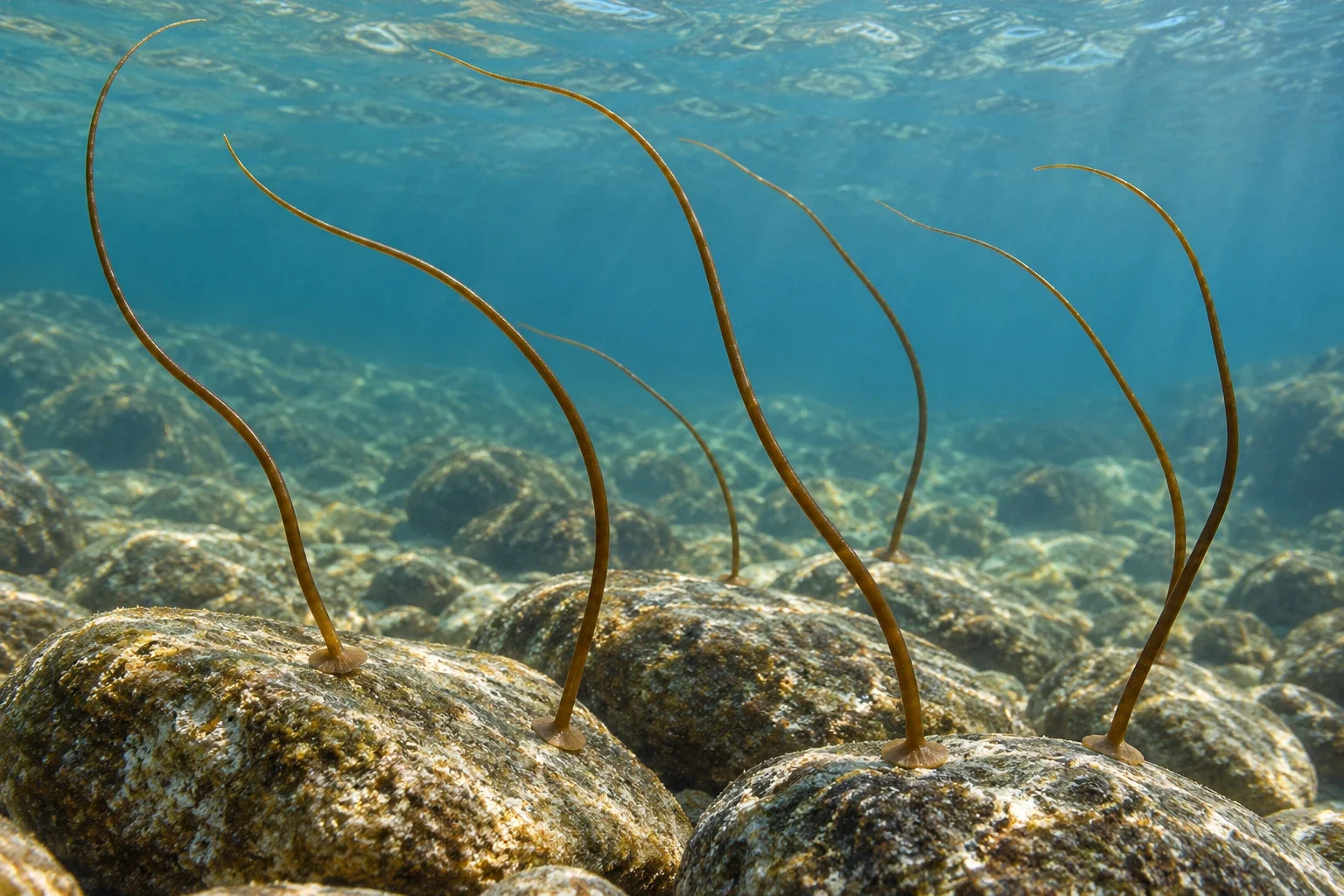
AI-generated botanical interpretation.
Overview
Sea lace has long, slippery, unbranched brown cords rather than leaf-like blades. Its hollow fronds may reach eight metres, yet remain only about five millimetres across. A small disc attaches each plant to its substrate. The visible summer growth occurs in sheltered shallow water, often anchored to small stones or shells.
The large sporophytes decline in autumn and disappear during winter, while microscopic stages maintain the life cycle. MarLIN describes separate male and female gametophytes and a prolonged reproductive season. Older fronds have fewer hairs; the growing region lies below the continuously wearing tip.
Furneaux’s 1922 impression of The Sea Shore supplies an earlier illustrated witness. Plate VIII identifies the long cord-like form as Chorda filum, distinct from the broad blades and branching seaweeds alongside it. His account describes a cylindrical tube and young hairs that disappear with age. This historical plate supports external form; its old classification is not adopted as current taxonomy.
Origins & earliest records
Marine
Evidence & interpretation
Institutional species account.
Selected bibliography
Documented works and useful reading. This is not a list of every appearance.
- 01
- 02
Family & connections
A source-supported family tree or inspiration record has not yet been compiled for this profile. Related reading below indicates a connection in subject matter, not a proven lineage or creative influence.
Look for a taxonomic record and classified relativesReferences
Sources supporting this profile. Linked pages have their own scope and editorial standards.
- Institutional accountChorda filumResearch access: 2026-10-21
- Historical illustrated natural-history accountThe Sea ShoreResearch access: 2026-10-21
Image credits
AI-generatedAI-generated botanical interpretation.