
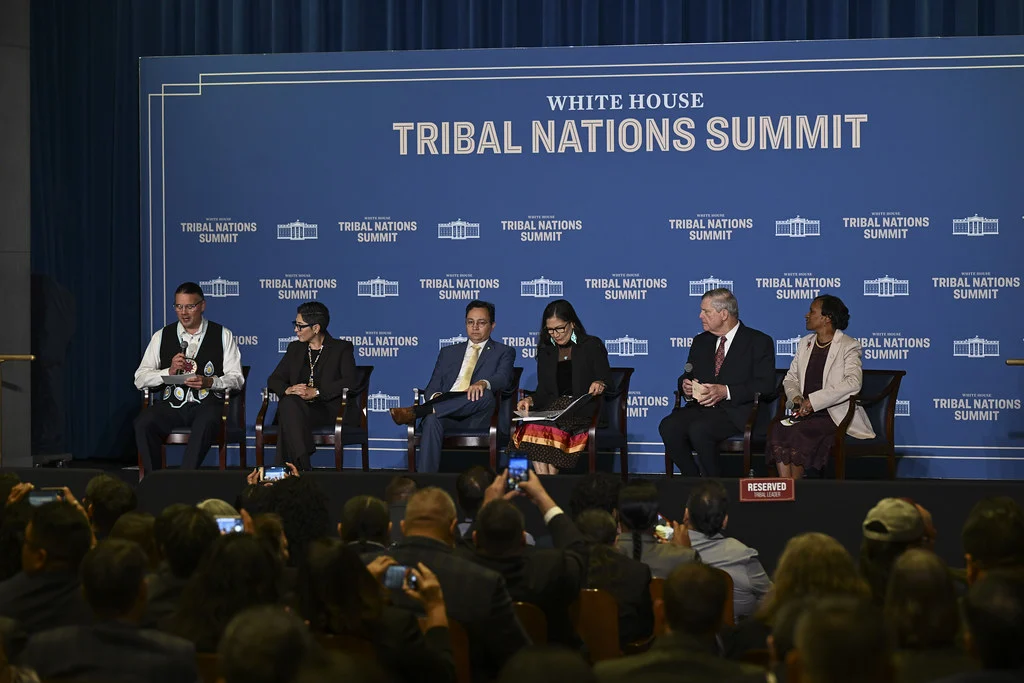
Cherokee Nation Principal Chief Chuck Hoskin, third seated participant from the left, at the 2024 White House Tribal Nations Summit panel, USDA photograph
Cherokee Nation Principal Chief Chuck Hoskin appears third from the left in this USDA photograph of the 9 December 2024 Tribal Nations Summit panel. Other tribal and federal officials share the stage. The photograph records a particular government-to-government meeting; it does not imply that all participants or audience members belong to the Cherokee Nation.
Overview
The Cherokee Nation is a living tribal government with a reservation in northeastern Oklahoma. It is distinct from the United Keetoowah Band of Cherokee Indians in Oklahoma and the Eastern Band of Cherokee Indians in North Carolina. Shared histories do not make their governments or citizenship rules interchangeable.
The Nation’s historical account follows southeastern homelands, treaty-driven land losses, earlier westward migration and the forced removal of 1838. Many people died in camps and on the Trail of Tears. Survivors joined earlier migrants in Indian Territory, amid serious internal disputes, and adopted a new constitution in 1839. Rebuilding at Tahlequah included schools, government institutions and the bilingual Cherokee Advocate, founded in 1844 using Sequoyah’s syllabary. Later allotment and restrictions on tribal government damaged collective institutions without ending the Nation. Its historical account also records slavery and the 1866 treaty; descendants of Cherokee Freedmen have full citizenship rights, including eligibility for office. A history of survival must retain these difficult political histories alongside achievements.
The Nation bases citizenship on documented descent from an ancestor on its Dawes Rolls, without a minimum blood-quantum requirement. This legal relationship is distinct from cultural knowledge or genetic testing. Citizens live beyond the reservation and outside the United States. Their Cherokee-language fluency varies; community classes, online learning and immersion schooling support language transmission. First-language use therefore cannot establish citizenship.
The Nation’s culture statement explicitly presents culture as changing. Families, individuals and localities differ in knowledge, practice and faith. Storytelling, food, language, spirituality and practical or decorative arts remain important, but there is no single authorized lifestyle that describes every citizen. The statement also explains that some ceremonial knowledge is not shared publicly. Published educational material is consequently a selected public account, not a complete inventory of community religious life.
For further reading, the Nation’s history FAQ recommends Cherokee Nation: A History of Survival, Self Determination, and Identity, by Bob Blackburn, Duane King and Neil Morton. That recommendation supplies a specific bibliographic route rather than an invented quotation or a claim that the book has been fully examined here. The government pages used for this profile were updated in August 2026; they provide a contemporary institutional perspective, which can be read alongside family accounts and scholarship without collapsing those different kinds of witness.
The Cherokee Language Consortium provides a specific example of cooperation across the three distinct Cherokee tribal governments. The Nation’s September 2026 account identifies an agreement involving those governments, Northeastern State University and Western Carolina University. Each tribe appoints both fluent speakers and second-language learners. Rotating quarterly meetings and elected consortium leadership organize work on new vocabulary and teaching materials. This makes language development a collaborative process with identifiable participants and procedures, rather than the automatic product of a single central authority. The linked word list is identified as updated in May 2019; the later webpage update does not establish that the vocabulary document was revised in 2026.
History & identity
Cherokee history precedes European written contact; southeastern homelands and subsequent removal are distinguished from the Nation’s continuing Oklahoma institutions.
Sources & representation
Four Cherokee Nation public pages: complete history, common questions, history FAQ and culture statement. These are institutional accounts, not independent interviews with every community.
Selected bibliography
Documented works and useful reading. This is not a list of every appearance.
- 01
Cherokee Nation: A History of Survival, Self Determination, and Identity
Recommended by the Nation’s history FAQ; edition date and complete book text not independently examined.
Language & cultural connections
These connections link languages or specific cultural works and institutions; they do not establish biological ancestry or ethnic identity.
Cherokee Language Consortium
Cherokee Nation collaborates with the United Keetoowah and Eastern Bands and two universities to develop Cherokee vocabulary and teaching curriculum.
References
Sources supporting this profile. Linked pages have their own scope and editorial standards.
- Community-authoredCherokee Nation history, updated23August2026Research access: 2026-10-05
- Community-authoredCommon questions, updated13August2026Research access: 2026-10-05
- Community-authoredHistory FAQ, updated13August2026Research access: 2026-10-05
- Community-authoredCulture, updated13August2026Research access: 2026-10-05
- Community-authoredCherokee Language ConsortiumResearch access: 2026-10-05
Image credits
Contextual community governance photographCherokee Nation Principal Chief Chuck Hoskin, third seated participant from the left, at the 2024 White House Tribal Nations Summit panel, USDA photograph
Cherokee Nation Principal Chief Chuck Hoskin appears third from the left in this USDA photograph of the 9 December 2024 Tribal Nations Summit panel. Other tribal and federal officials share the stage. The photograph records a particular government-to-government meeting; it does not imply that all participants or audience members belong to the Cherokee Nation.