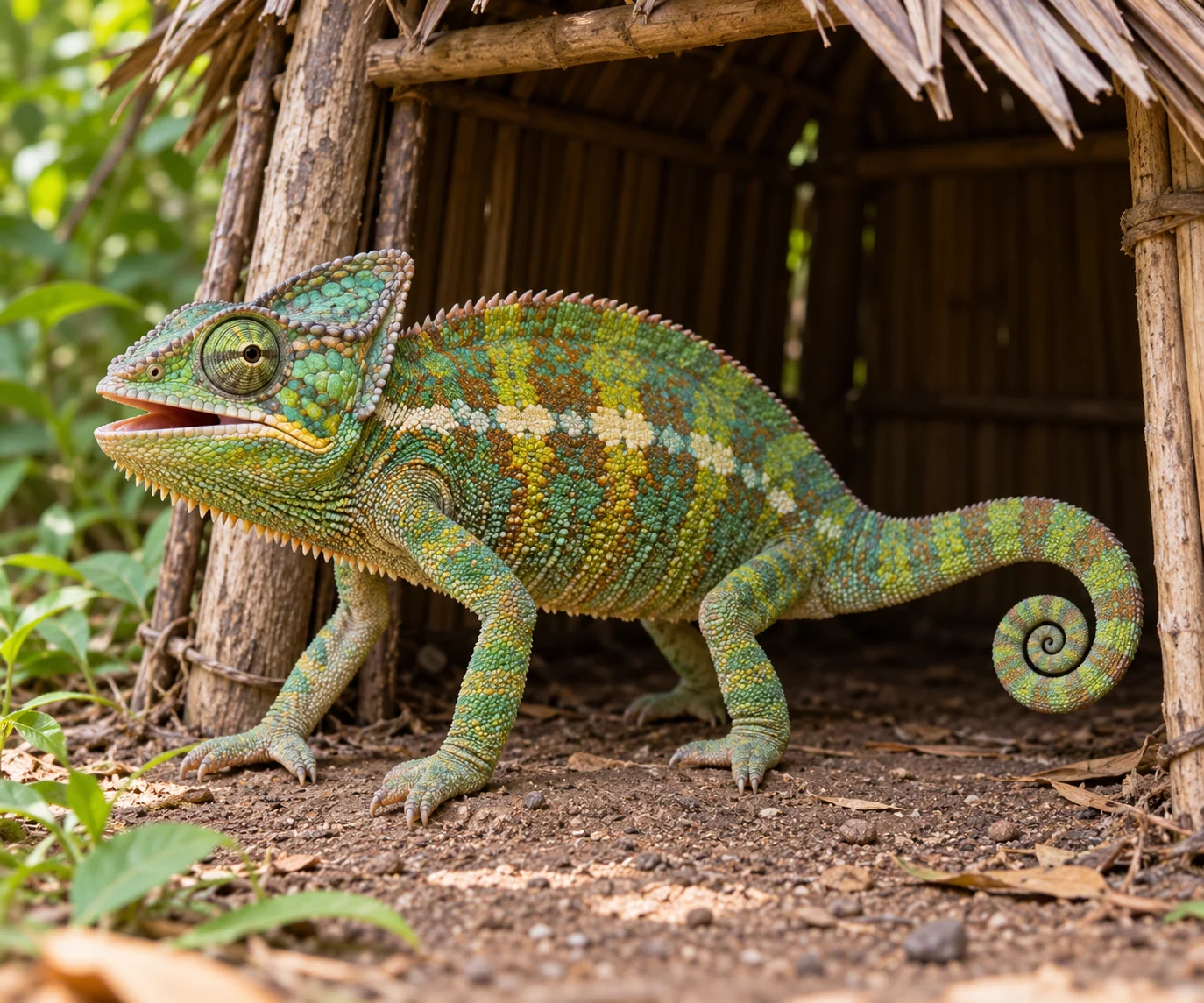
AI-generated tale-chameleon interpretation.
Species, colour, posture and shelter are imagined; living scene before the fatal dance.
Overview
A chameleon occupies the house of a frog who has gone to work on her farm, taking control of the two children left inside. She equips them with knives and bells and makes them dance. When their mother returns, the intruder threatens to tread her into a pulp. The frightened mother seeks help rather than confronting the animal herself. The chameleon is referred to as female throughout this particular English telling; no personal name is given.
Elephant offers to remove the intruder with his trunk, but flees when she snarls from the doorway. Leopard likewise promises an easy rescue and runs away at the same sound. The narrative extends this failure to the other animals: their size and confident declarations cannot overcome their fear. It does not explain the snarl as a separate spell, describe a transformation, or give the chameleon an enormous body.
A flock of sparrows succeeds through a performance. After drying their drums at a fire, they dance and sing a chorus telling the dancers to leave their heads off. Some tuck their heads under their wings. Looking out of the doorway, the chameleon mistakes concealed heads for removed ones. Eager to imitate the skilled dancers, she cuts off her own head and dies. The mother returns to nurse her children, and the closing sentence credits the sparrows’ cleverness with accomplishing what strength could not.
Weeks’s accompanying note connects the chameleon’s reputation as a dancer with its characteristic movement while standing still. This is the collector’s explanation for a feature of the tale, not an exact species identification or a record of an actual decapitation trick. The display title distinguishes this house-occupying actor from other chameleon narratives.
Origins & earliest records
Lower Congo collection published by Weeks in 1911; the introduction names several collection channels around San Salvador and Ngombe Lutete without assigning this tale to a particular narrator or site.
Records & interpretation
Complete Part II tale XXVII and footnote 74, with the continuous folklore introduction and preface.
Selected bibliography
Documented works and useful reading. This is not a list of every appearance.
- 01
Congo Life and Folklore
Part II, XXVII, Why the Chameleon cut off his own Head, listed pp. 445–446; footnote 74
Family & connections
A source-supported family tree or inspiration record has not yet been compiled for this profile. Related reading below indicates a connection in subject matter, not a proven lineage or creative influence.
References
Sources supporting this profile. Linked pages have their own scope and editorial standards.
- Original historical collected narrativeWeeks 1911 — Part II, XXVII, Why the Chameleon cut off his own Head, listed pp. 445–446; footnote 74Research access: 2026-10-18
- Original collector contextCollection introduction and preface in Weeks 1911Research access: 2026-10-18
Image credits
AI-generatedAI-generated tale-chameleon interpretation.
Species, colour, posture and shelter are imagined; living scene before the fatal dance.