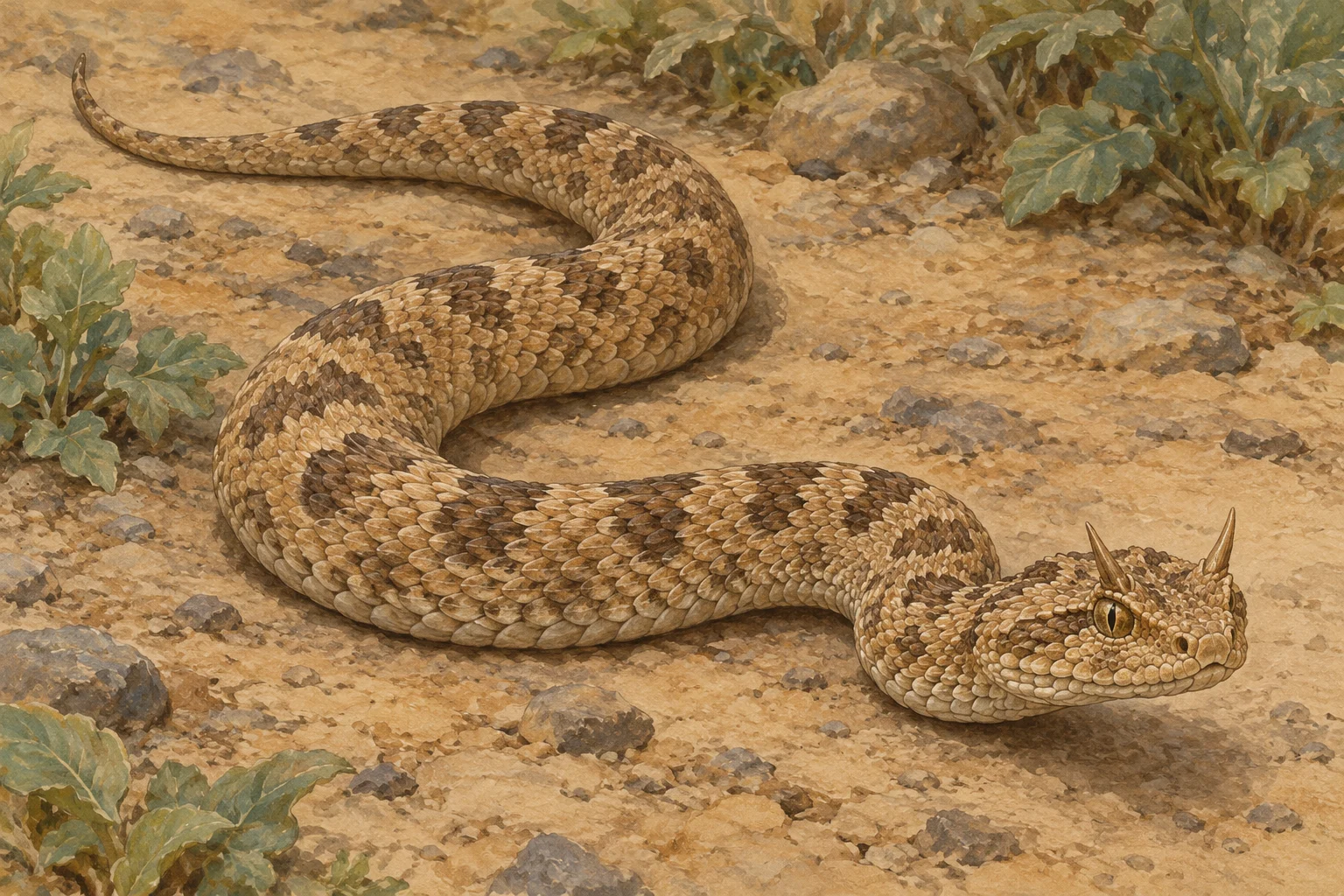
Pa R’of interpreted as a horned viper; exact species, colours and proportions imagined.
Original contextual illustration; landscape, species interpretation, colours, proportions and setting imagined, not authenticated Temne iconography, medical practice or modern national origin.
Overview
The Cerastes is one of the hungry beings Tamba feeds while travelling to seek a king’s daughter in Schlenker’s seventh Temne fable. Tamba gives the snake two fowls. In return, it supplies a medicine called ka-woso and specifies a gruesome condition involving the brains of a deceitful person. Other recipients of Tamba’s generosity later help him recover the king’s lost possessions and separate mixed grain. Yet the hostile ministers repeatedly reject his successes, beat him and have him chained. The snake’s later action changes the king’s dependence on the suitor.
When the king sends four wives and another girl to fetch water, the Cerastes strikes the four women and spares the girl. She reports what happened, and Tamba is summoned because the others cannot cure them. The king kills deceitful ministers to meet the condition attached to the snake’s gift, and the women recover through Tamba’s intervention. The remaining ministers flee. The full ending gives Tamba the marriage, wealth and enslaved communities, then the kingdom after the king’s death; those are narrative rewards, not endorsed institutions. The vocabulary glosses r’of as a horned viper or cerastes. It does not identify a scientific species or turn the fable into a real remedy.
Origins & earliest records
Part I, Chapter IV, Fable VII, The King and his Daughter, and Mr. Tamba. Pa R’of is the animal’s honorific label in this telling; no separate personal biography is established.
Records & interpretation
Complete bilingual fable, printed pp. 87–97, including final outcome. All English narrative pages viewed against original PDF; full preface retained.
Selected bibliography
Documented works and useful reading. This is not a list of every appearance.
- 01
A Collection of Temne Traditions, Fables and Proverbs, with an English Translation
Part I, Chapter IV, printed pp. 87–97; complete tale and relevant original footnotes retained.
Family & connections
A source-supported family tree or inspiration record has not yet been compiled for this profile. Related reading below indicates a connection in subject matter, not a proven lineage or creative influence.
References
Sources supporting this profile. Linked pages have their own scope and editorial standards.
- Original historical bilingual Temne/English collectionSchlenker 1861, complete fable, pp. 87–97Research access: 2026-10-18
Image credits
AI-generatedPa R’of interpreted as a horned viper; exact species, colours and proportions imagined.
Original contextual illustration; landscape, species interpretation, colours, proportions and setting imagined, not authenticated Temne iconography, medical practice or modern national origin.