
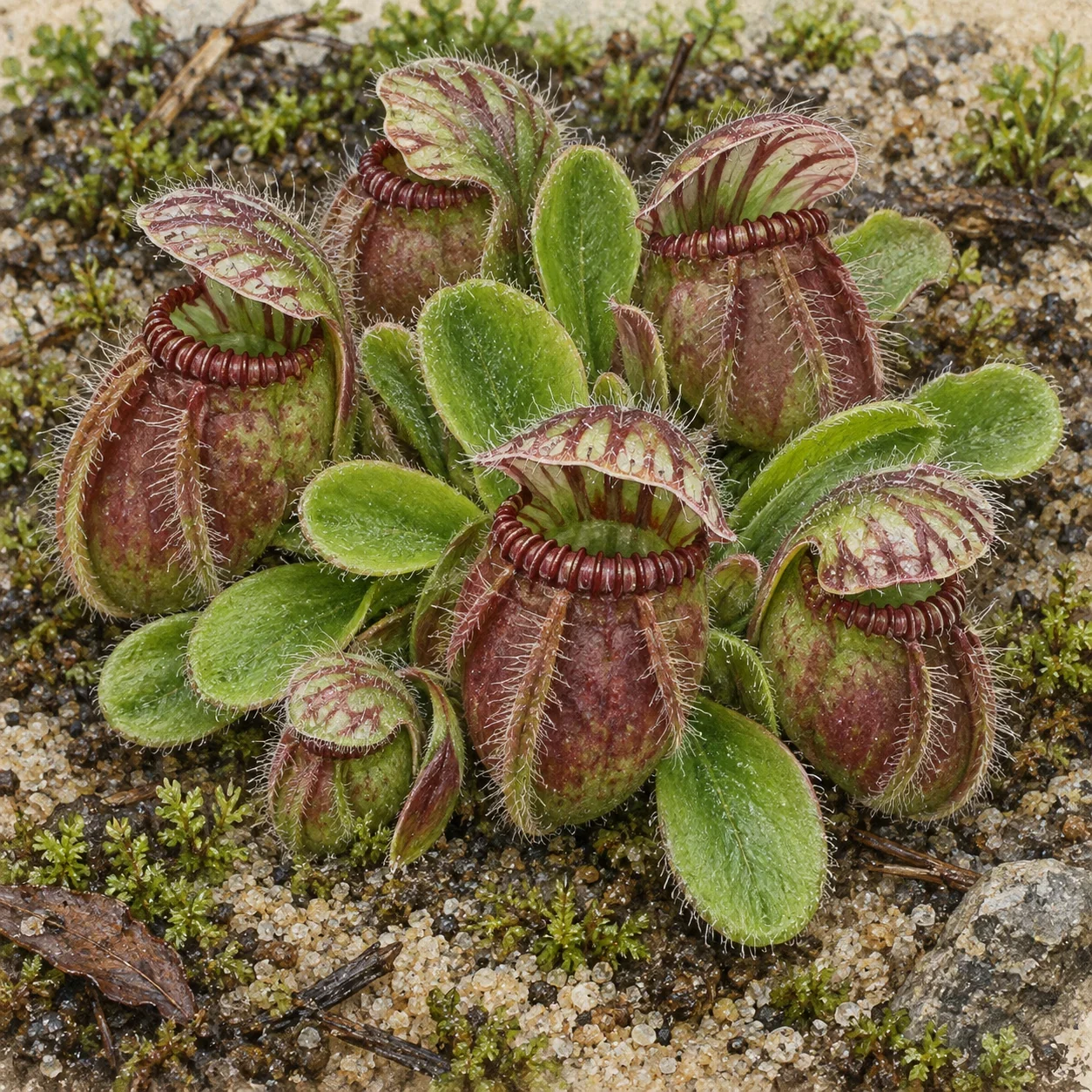
AI scientific interpretation of Cephalotus follicularis.
AI scientific interpretation of an imagined Cephalotus follicularis.
Overview
Kew describes clustered red-green leaves in damp sandy soils near streams and swamps. Hairy pitchers have ridges, a toothed rim and a translucent, striped lid. They contain digestive fluid. Bright green, hairy oval leaves occur alongside the traps; summer flowering stems bear small white flowers.
Fukushima and colleagues sequenced the genome in 2017 and compared transcripts from carnivorous and non-carnivorous leaves. Their analysis identified changes associated with attraction, capture, digestion and nutrient absorption. Comparison with three independently evolved carnivorous plants found repeated recruitment of stress-responsive protein lineages.
Convergent amino-acid changes accompanied digestive physiology. Similar pitcher shapes therefore do not establish close kinship with other pitcher plants. The paper places this species in Cephalotaceae within Oxalidales; its genome results illuminate evolutionary routes, not an illustration’s measured anatomy.
Origins & earliest records
Botanical diagnosis complements genome and digestive-protein comparisons.
Evidence & interpretation
Independent origins make carnivory a case of convergent evolution.
Selected bibliography
Documented works and useful reading. This is not a list of every appearance.
- 01
- 02
Family, evolution & connections
Taxonomic classification
A hierarchy of classified groups, not a chain of direct ancestors.
Source note: Order and family follow the genome study, not superficial trap resemblance.
- FamilyCephalotaceae
- OrderOxalidales
References
Sources supporting this profile. Linked pages have their own scope and editorial standards.
- Botanical garden accountAustralian pitcher plantResearch access: 2026-10-11
- Primary genomicsGenome of the pitcher plant Cephalotus reveals genetic changes associated with carnivoryResearch access: 2026-10-11
Image credits
AI-generated interpretationAI scientific interpretation of Cephalotus follicularis.
AI scientific interpretation of an imagined Cephalotus follicularis.