
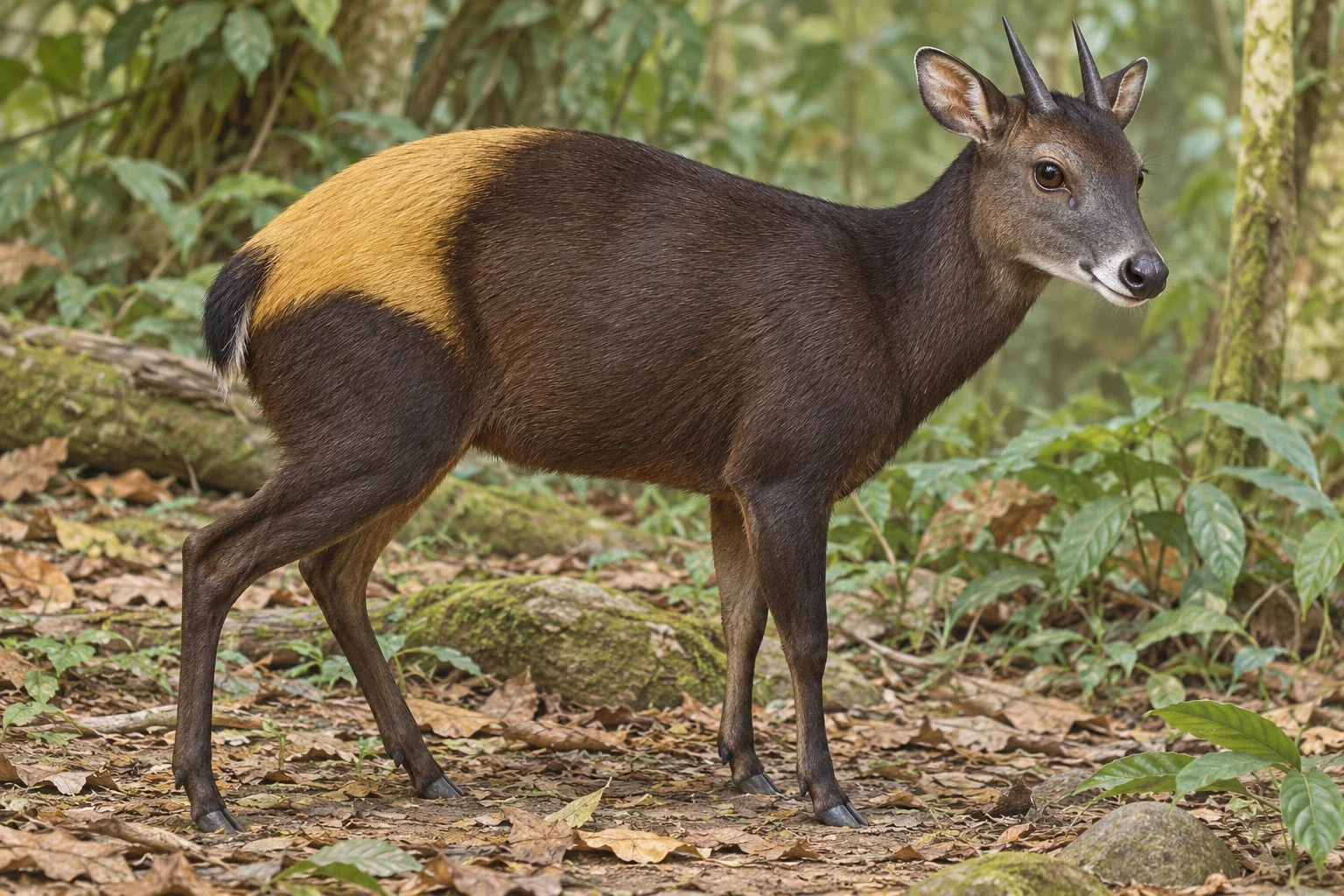
AI-generated natural-history study.
Interpretive portrait; no authenticated specimen claim.
Overview
The yellow-backed duiker has a dark brown to black coat with a triangular yellow patch near the rump. The Uganda Wildlife Authority describes a pale grey muzzle surrounding white lips, short conical horns in both sexes, and an arched body with shorter forelegs than hindlegs.
Zoo Frankfurt places it in scrub forest, dense undergrowth, forest edges and clearings. Animals live alone or in pairs and are most active around twilight and at night. When alarmed they escape into thick vegetation, behaviour reflected in the Afrikaans name duiker, meaning a diver.
Frankfurt lists leaves, grasses and herbs alongside termites, other invertebrates and occasional birds or eggs. The zoo reports a single young per birth. The conspicuous back patch develops after birth according to the wildlife authority, so a newborn should not automatically be illustrated with an adult’s fully developed yellow marking.
Origins & earliest records
Dense forest and undergrowth
Evidence & interpretation
Institutional accounts and observed reference pixels.
Selected bibliography
Documented works and useful reading. This is not a list of every appearance.
- 01
- 02
Family & connections
A source-supported family tree or inspiration record has not yet been compiled for this profile. Related reading below indicates a connection in subject matter, not a proven lineage or creative influence.
Look for a taxonomic record and classified relativesReferences
Sources supporting this profile. Linked pages have their own scope and editorial standards.
- Wildlife authority species accountDuiker — Yellow-backed duikerResearch access: 2026-10-23
- Zoo species accountYellow-backed duikerResearch access: 2026-10-23
Image credits
AI-generated interpretive illustrationAI-generated natural-history study.
Interpretive portrait; no authenticated specimen claim.