
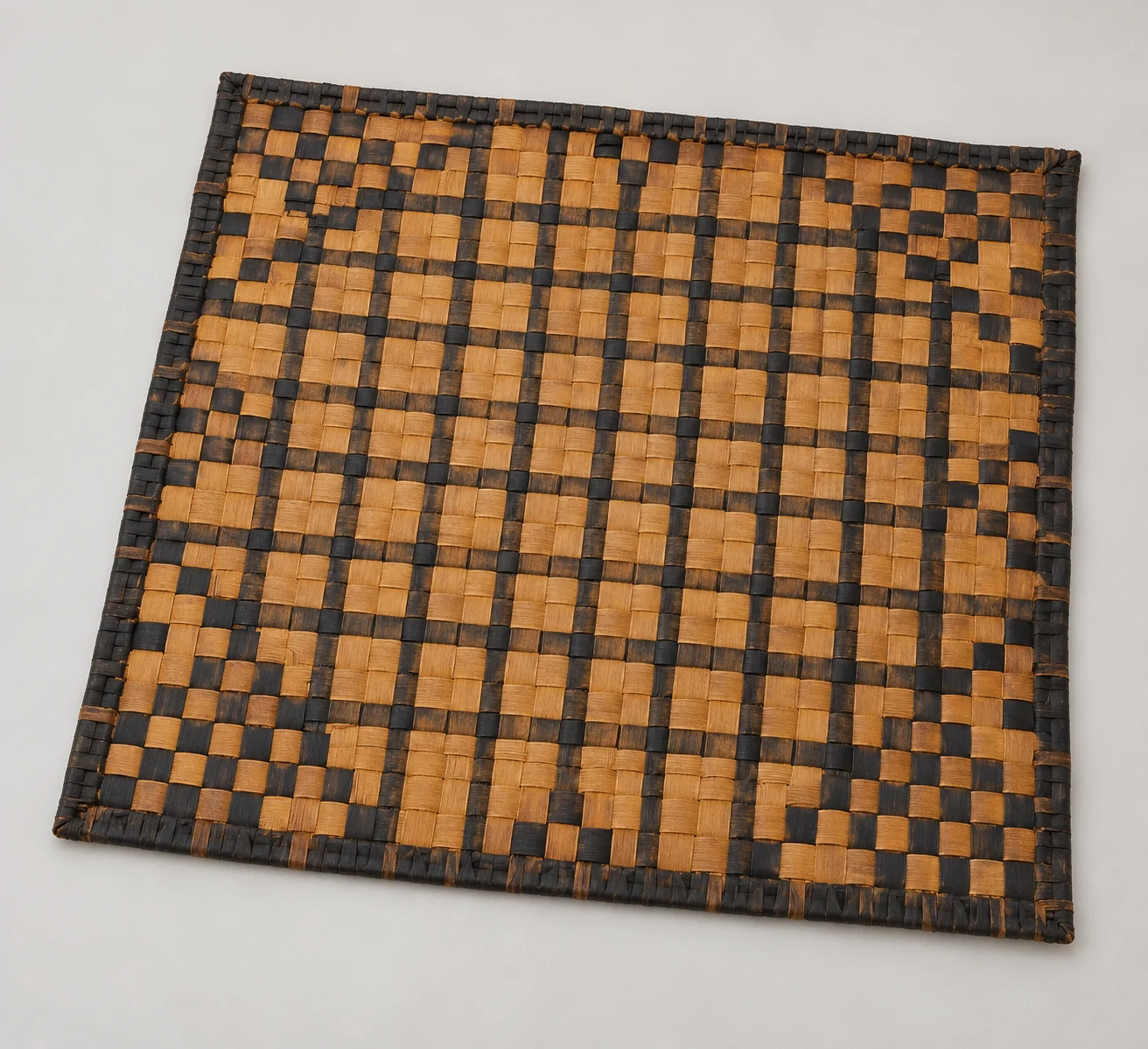
Generated material interpretation of Kissell’s historical description; not a photographed or authenticated specimen.
Overview
Kissell’s paper describes two ways of making mats from cedar bark in western British Columbia. In the checked technique, broad inner-bark strips are folded over a wooden crossbar between upright supports. The front halves are divided into narrower strands and secured with fine twining. A doubled horizontal element crosses the hanging strands in alternating over-and-under order, turns at the far edge and is tucked into the completed work. Once the first half is finished, the other half is made. The lower ends are turned upward and secured by another twined row. Figure 2 presents a nearly square, flat mat whose light and dark checks form a central grid and larger angular arrangements around it; the text describes golden-brown bark with black lines or groups of black checks.
The second technique uses the same material but crosses the strips obliquely, with no separately added horizontal weft. At each side the strips turn through a right angle and continue in the changed direction; the lower ends are folded back into the finished surface. Figure 3 shows this plaited work suspended from a crossbar, with loose strips still hanging. Kissell places these examples within a regional comparison of American textile techniques in a paper addressed to cotton manufacturers. Her language contrasts machinery with an evolutionary category of primitive production; that hierarchy is historical mediation, not an assessment adopted here. The captions and nearby prose do not identify the maker or a named community for either pictured mat. An adjacent weaving photograph has a historical community label, but it does not establish that attribution for these separate figures.
History & identity
Mary Lois Kissell’s illustrated comparative paper, presented to the National Association of Cotton Manufacturers.
Sources & representation
Complete reproduced narrative and title context read; native figures 2 and 3 inspected.
Selected bibliography
Documented works and useful reading. This is not a list of every appearance.
- 01
Aboriginal American Weaving
Title states paper read at the eighty-eighth meeting, Boston, 27 April 1910; reproduced text, figures 2–3.
Language & cultural connections
Source-supported language and cultural connections have not yet been compiled for this profile.
References
Sources supporting this profile. Linked pages have their own scope and editorial standards.
- Historical museum-author comparative material studyKissell’s complete reproduced paper and native figuresResearch access: 2026-10-18
Image credits
AI-generatedGenerated material interpretation of Kissell’s historical description; not a photographed or authenticated specimen.