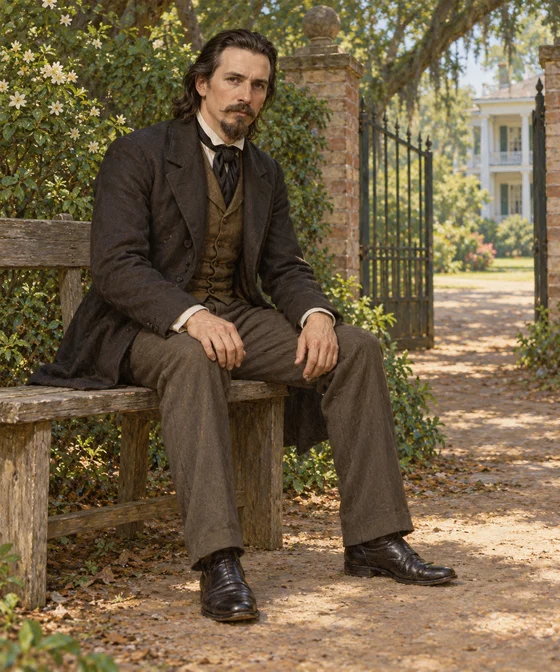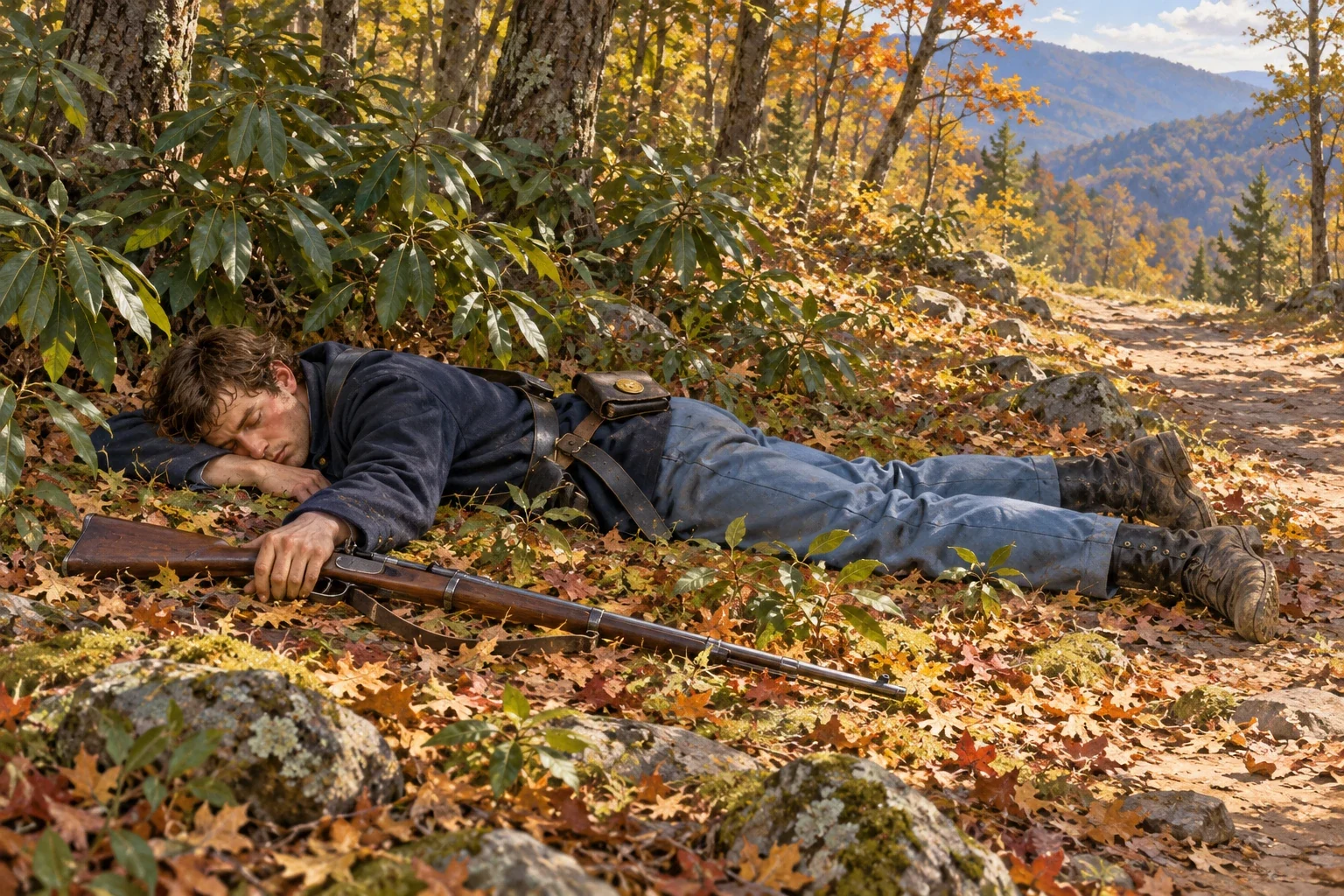
Original AI interpretation of a fictional literary character.
Overview
Carter Druse is a young adult Virginian serving as a Federal private in A Horseman in the Sky. An only child raised in wealth and comfort, he tells his father that he intends to join a Union regiment at Grafton. His father calls him a traitor to Virginia but tells him to act according to his conception of duty; their final parting is formally courteous and deeply painful. Druse's courage, devotion and knowledge of the surrounding country later earn him a dangerous outpost assignment. Exhaustion nevertheless overcomes him, and the story opens with him asleep among laurels above a concealed Federal force preparing a surprise movement.
On waking he sees a gray-clad horseman at the edge of a high rock. The mounted figure initially strikes him as a monumental work of art, but its slight movement brings him back to the danger: the rider can look down upon the troops in the valley. Druse aims at the man's breast, falters almost to a faint, then considers whether the rider might depart without discovering anything. When men and horses become visible below, he aims instead at the horse and fires, recalling his father's injunction about duty. The narrative's declarations that his duty is clear form part of its account of this agonising choice, rather than a general moral endorsement of killing a relative.
An officer below sees the rider and horse descend through the air and briefly understands the fall as an impossible aerial ride. The narration corrects that impression: the descent is downward, and the officer searches in the wrong place. Druse reloads and resumes his watch. Questioned by a sergeant, he says that he shot a horse which went over the cliff; only when pressed does he identify its rider as his father. His pale face and turned-away gaze accompany the disclosure, but no later reconciliation, punishment or inner recovery is supplied. He is a human soldier, not an enchanted marksman, and the rider's apparent flight does not establish supernatural power.
First appearances & development
Individual in Ambrose Bierce’s authored American fiction. Cited original narratives are distinct from modern reprint design and digital apparatus.
Canon & continuity
Complete selected tale and first-edition preface dated September 4, 1891, plus complete contents read. Native title image viewed: The Collected Works of Ambrose Bierce, Volume II, In the Midst of Life (Tales of Soldiers and Civilians), New York, Gordian Press, Inc., 1966.
Selected bibliography
Documented works and useful reading. This is not a list of every appearance.
- 01
The Collected Works of Ambrose Bierce, Volume II: In the Midst of Life - A Horseman in the Sky
Year identifies the native Gordian Press reprint title actually viewed, not the tales’ original publication. The HTML 1909 heading is not adopted as proof of this copy’s date.
Family & connections
A source-supported family tree or inspiration record has not yet been compiled for this profile. Related reading below indicates a connection in subject matter, not a proven lineage or creative influence.
References
Sources supporting this profile. Linked pages have their own scope and editorial standards.
- Primary authored fiction in later reprint transcriptionA Horseman in the Sky - complete primary literary narrativeResearch access: 2026-10-21
- Native reprint title-page image, research onlyNative title: Gordian Press, New York, 1966Research access: 2026-10-21
Image credits
AI-generated illustrationOriginal AI interpretation of a fictional literary character.