
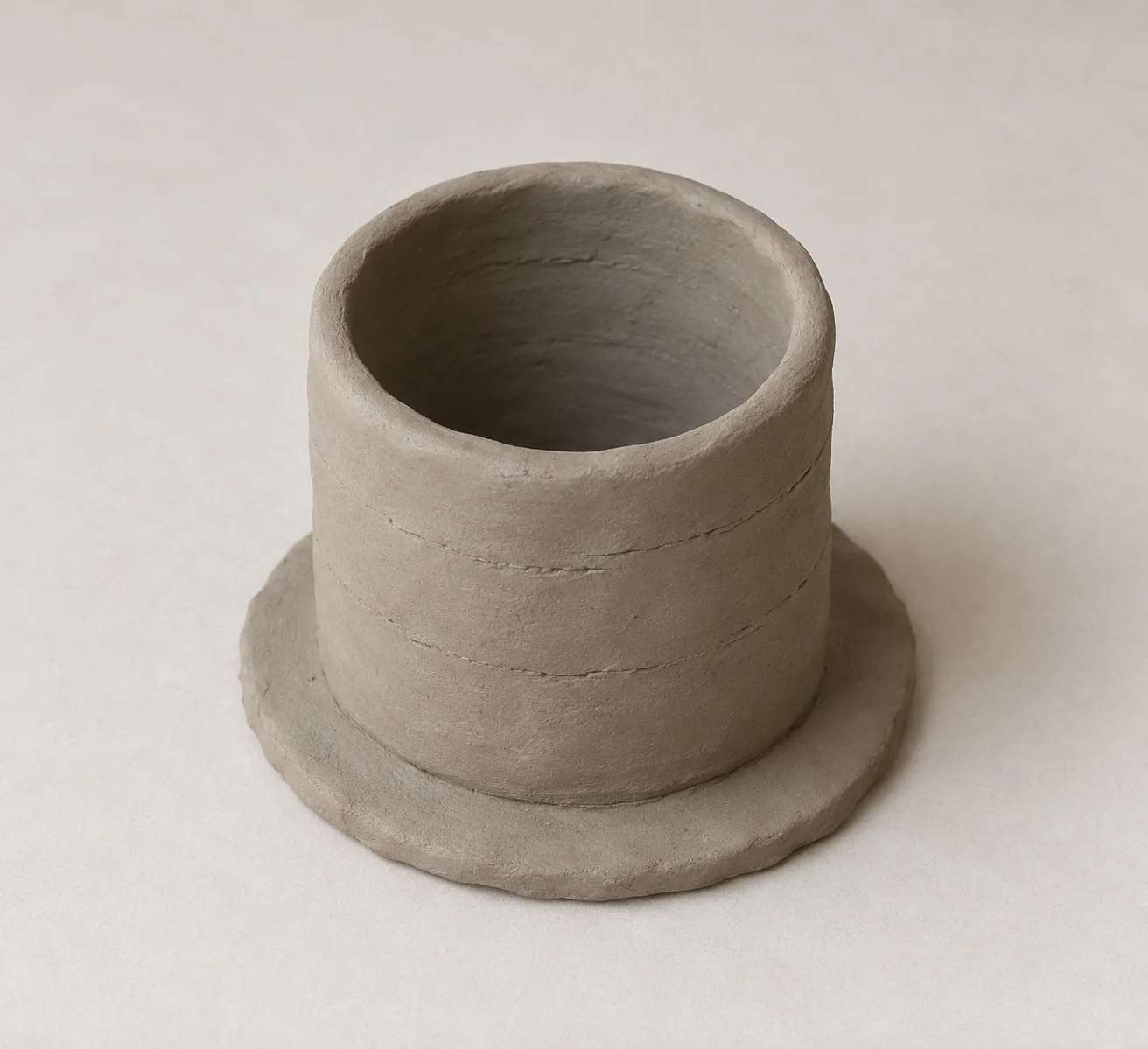
Generated schematic interpretation of an unfinished vessel in White’s dated pottery lesson. Proportions, surface and joining traces are interpretive; this is not an authenticated specimen, exact replica or reconstruction of a named community’s practice.
Generated schematic interpretation of an unfinished vessel in White’s dated pottery lesson. Proportions, surface and joining traces are interpretive; this is not an authenticated specimen, exact replica or reconstruction of a named community’s practice.
Overview
White’s lesson treats the cardboard outline as a way to train the eye while building a vessel by hand. After deciding on a jar’s profile, the learner makes a full-size drawing, divides it vertically and cuts a guide that can be held beside the growing clay form. This offers a check on the contour without enclosing the vessel in a mould. The complete Figure 9 shows the cut guide, and the accompanying process plate includes a view of it being tested against the work. White recommends a form close to a cylinder for a first attempt, such as a flower jar. The method therefore connects drawing and comparison with the gradual addition of material.
The vessel is built from successive clay strips joined above a round base. White describes checking the outline repeatedly, allowing the walls to stiffen, and smoothing the inside before the jar becomes too tall to reach easily. Her later finishing steps remove unevenness and visible joins rather than making raised coils a required decorative pattern. The plate presents beginning, testing and continuation as stages of one teaching sequence; it does not establish an individual maker’s biography or a workshop location. Although White uses a broad Indigenous attribution for coiling, her lesson names no community whose practice could responsibly be reconstructed from it. The contextual illustration consequently shows an unfinished, nearly cylindrical clay form and makes its schematic proportions explicit.
History & identity
How to Make Pottery names Mary White as author and illustrator. Its title and copyright text identify Doubleday, Page & Company, New York, and publication in October 1904. The preface addresses people beginning clay-working. This is a publishing and teaching context, not evidence that every demonstrated piece was manufactured in New York.
Sources & representation
The complete contour-guide drawing and three-part process plate accompany the full lesson. Hands obscure small areas of the work; the proposed illustration is a schematic unfinished vessel, not a reconstruction of the demonstrator or a finished archaeological specimen.
Selected bibliography
Documented works and useful reading. This is not a list of every appearance.
- 01
How to Make Pottery
Full preface and Chapter II, Hand-made Pottery; Figure 9 contour guide and complete plate Building a Piece of Pottery, facing page18.
Language & cultural connections
Source-supported language and cultural connections have not yet been compiled for this profile.
References
Sources supporting this profile. Linked pages have their own scope and editorial standards.
- Historical first-person craft instruction with explanatory drawing and photographic plateWhite 1904, Chapter II, Figure9 and process plateResearch access: 2026-10-18
Image credits
AI-generatedGenerated schematic interpretation of an unfinished vessel in White’s dated pottery lesson. Proportions, surface and joining traces are interpretive; this is not an authenticated specimen, exact replica or reconstruction of a named community’s practice.
Generated schematic interpretation of an unfinished vessel in White’s dated pottery lesson. Proportions, surface and joining traces are interpretive; this is not an authenticated specimen, exact replica or reconstruction of a named community’s practice.