
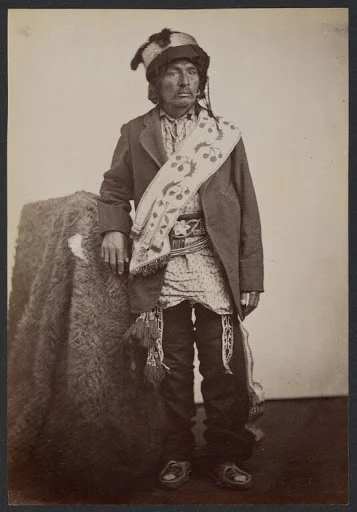
George Washington Caddo, identified as Principal Chief, standing beside a buffalo-robe-draped prop in William Stinson Soule’s photograph, 1869–1874
Soule’s historical portrait shows George Washington Caddo, identified by the Getty as Principal Chief, wearing a decorative sash and Western jacket beside a prop draped with a buffalo robe. It documents this particular sitter and photographic setting in 1869–1874; it does not define a universal appearance of Caddo people or depict the contemporary nation.
Overview
The Caddo Nation is a living Indigenous nation whose community history reaches across parts of present-day Oklahoma, Texas, Arkansas and Louisiana. Its own historical account connects the Kadohadacho, Natchitoches and Hasinai confederacies and their constituent bands with agricultural life and the construction of earthen mounds. It also describes repeated forced removals, geographical consolidation in Indian Territory and further losses under allotment. Modern Oklahoma residence therefore does not erase the wider homeland. The Nation frames continuity through inherited values, collective memory and renewed institutions, rather than treating Caddo people as a vanished archaeological population.
The language programme makes a particularly clear distinction between linguistic relationships and nations. Caddo belongs to the Caddoan family, alongside Pawnee, Wichita, Arikara and Kitsai, but the programme explicitly describes these as separate peoples with distinct histories and cultures. It also notes differences in pronunciation among Caddo speakers. Preservation activities include building an archive, developing teaching materials and sharing language through community events. The invitation to contribute recordings addresses both members and descendants; that wording is not itself an enrollment rule. Language use is understood in relation to gatherings, shared history and cultural practice, not solely as the preservation of isolated vocabulary.
Constitutional discussion is another form of continuing community life. The Nation’s Constitution Project traces the initial constitution to 1938 and describes a contemporary process of research and citizen consultation. Its account records two surveys and eight outreach meetings in 2026, including online meetings and gatherings beyond Oklahoma. A commission report was delivered to the Tribal Council on 1 July 2026. A subsequent phase, planned through August 2027, concerns research, education and drafting. These are documented stages in considering change; they do not establish that a new constitution has already been adopted or that proposed language is current law.
Caddo historical writing also has named authors. Cecile Elkins Carter’s Caddo Indians: Where We Come From, published by the University of Oklahoma Press in 1995, is identified by the publisher as a narrative drawing on oral histories, archaeological evidence and historical documents. The publisher’s description presents Carter as a cultural liaison for the Caddo Tribe of Oklahoma. This bibliographic reference offers a route toward a sustained authored history, while the present account rests on the Nation’s public descriptions. It does not claim a complete reading of Carter’s book or treat an older author biography as a current appointment.
History & identity
The Nation identifies ancestral confederacies and multiple forced removals; modern institutional dates do not mark the beginning of Caddo identity.
Sources & representation
Complete official history, language-programme and Constitution Project written bodies read, with complete publisher description and metadata. Linked legal documents, recordings and book not read.
Selected bibliography
Documented works and useful reading. This is not a list of every appearance.
- 01
Caddo Indians: Where We Come From
Publisher bibliography and description only; no complete-book reading claim.
- 02
Artist statement — Caddo Pottery
Undated artist-controlled About page, accessed5October2026; statement has four paragraphs.
- 03
Caddo Pottery in Modern and Contemporary Art and Protection of Native American Cultures in Fine Arts by the IACB’s Indian Arts and Crafts Act
Index of Texas Archaeology2012 article14, DOI10.21112/.ita.2012.1.14; catalogue and abstract inspected, full article unavailable.
Language & cultural connections
Source-supported language and cultural connections have not yet been compiled for this profile.
Located primary passages
Specific passages supporting details in this entry, grouped by their published witness.
Artist statement — Caddo Pottery
Undated artist-controlled About page, accessed5October2026; statement has four paragraphs.
- Earles presents his pottery as a respectful public expression of Caddo identity while acknowledging sensitivities around ancestral objects. He also describes contemporary sculpture as a personal interpretation shaped by changing circumstances. This is a named artist’s account of his own practice, rather than a claim that Caddo culture is static or uniformly represented by one maker.
ARTIST STATEMENT, complete four paragraphs, especially paragraphs2 and4
Detailed historical assertions are not independently corroborated here. Making procedures and sensitive-object details are not reproduced; no collection images reused.
References
Sources supporting this profile. Linked pages have their own scope and editorial standards.
- Community historyCaddo Nation: historyResearch access: 2026-10-05
- Community language programmeCaddo Nation: language preservationResearch access: 2026-10-05
- Tribal government project accountCaddo Nation: Constitution ProjectResearch access: 2026-10-05
- Publisher bibliographyUniversity of Oklahoma Press: Carter bibliographyResearch access: 2026-10-05
Image credits
Historical photograph of a named community memberGeorge Washington Caddo, identified as Principal Chief, standing beside a buffalo-robe-draped prop in William Stinson Soule’s photograph, 1869–1874
Soule’s historical portrait shows George Washington Caddo, identified by the Getty as Principal Chief, wearing a decorative sash and Western jacket beside a prop draped with a buffalo robe. It documents this particular sitter and photographic setting in 1869–1874; it does not define a universal appearance of Caddo people or depict the contemporary nation.