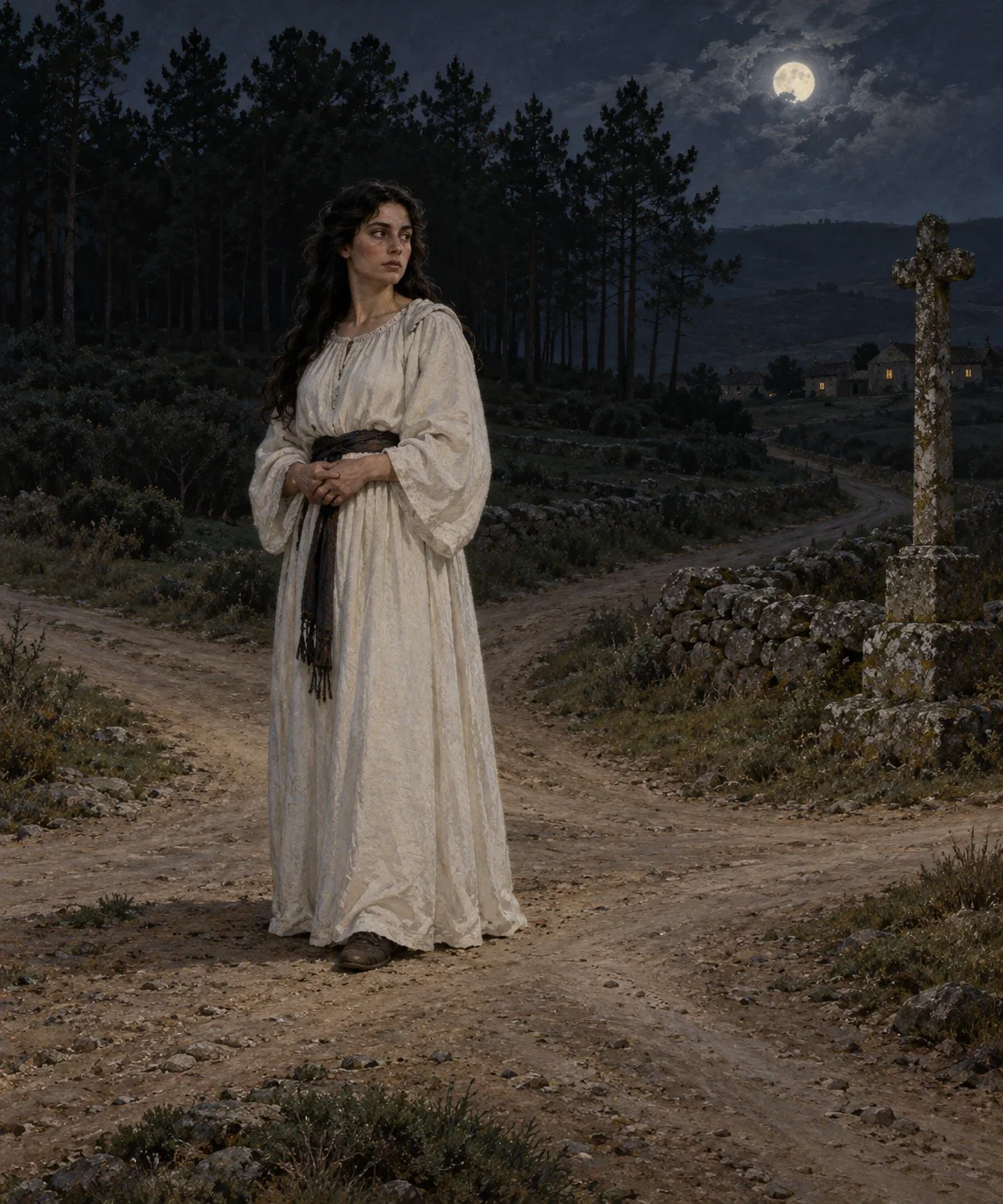
AI-generated imagined illustration of the white-clothed human form reported among Vasconcellos’s bruxa accounts. Clothing, face and setting details are artistic choices; no single appearance covers the other local forms.
Imagined illustration of the white-clothed human form reported among Vasconcellos’s bruxa accounts. Clothing, face and setting details are artistic choices; no single appearance covers the other local forms. Artistic interpretation, not a verified portrait, specimen or game artwork.
Overview
Vasconcellos’s 1882 collection gives bruxas several local forms and activities rather than one fixed body. Reports from Vouzella describe large rats disturbing pools, while Guimarães material includes geese washing in marshy places. Elsewhere they wear white, carry lights through villages, clap, laugh, howl or strike unseen. A Vila Real report has them gather on Tuesdays and Fridays and become doves. These alternatives belong to different reports; they are not stages of a single obligatory transformation.
The section also preserves complete stories about joining their nocturnal journeys. In one account from Freixo de Espada-Cinta, a man copies their anointing and flight formula but reverses its directions. Instead of travelling safely above brambles, he passes beneath them and is injured. A woman near Guimarães tells a related adventure in which the companions enter a wine store through a keyhole. The man invokes Jesus when he sees the wine escaping, and the bruxas abandon him there. Their departure concludes that particular misadventure.
Other reports accuse bruxas of entering through keyholes or roof openings to take children’s blood. A story localized to Saúde, in the Santarém district, gives this danger a verbal defence. A neighbouring bruxa teaches a mother a formula protecting her house. The mother mistakenly extends its wording to the whole district. The bruxa then asks her to restore the narrower wording, because otherwise the bruxas cannot harm anyone. The mother agrees, her own child thrives, and the story says other children remain exposed. This is a recorded accusation and folktale, not evidence explaining actual childhood illness or death.
Vasconcellos adds ways of identifying or restraining bruxas and records a retaliation story from São Miguel de Nogueira near Chaves. A man who exposes women in church is attacked on a later journey and left in a stream, where a passer-by finds him nearly dead the next morning. The collector himself questions a detail about protective bread in this account. His final note acknowledges confusion between bruxa and feiticeira in ordinary usage, while distinguishing the metamorphosis and blood-taking attributed to the former. He also reports a belief that their condition is a fate rather than free choice. His speculative explanations of ancient origins are not adopted here.
Origins & earliest records
J. Leite de Vasconcellos, Tradições populares de Portugal, Porto: Livraria Portuense de Clavel & C.ª, 1882, §380, XXXI Bruxas, pp.306–311.
Records & interpretation
Complete selected Portuguese section and its footnotes read; English prose is an original paraphrase of that Portuguese witness. No whole-book reading or modern translated edition is claimed.
Selected bibliography
Documented works and useful reading. This is not a list of every appearance.
- 01
Tradições populares de Portugal
§380, XXXI Bruxas, pp.306–311, including complete narrative endings and collector footnotes.
Family, evolution & connections
Bruxa (The Witcher)
Vasconcellos’s §380 reports nocturnal metamorphoses and blood-taking among localized Portuguese bruxa accounts. This is a limited name and motif comparison; it does not establish that the Witcher creators used this book or that its bruxas form the game’s vampire category.
References
Sources supporting this profile. Linked pages have their own scope and editorial standards.
- Historical primary Portuguese folklore collectionVasconcellos, Tradições populares de Portugal (1882), §380, XXXI Bruxas, pp.306–311 and notesResearch access: 2026-10-24
Image credits
AI-generated source-specific cultural interpretationAI-generated imagined illustration of the white-clothed human form reported among Vasconcellos’s bruxa accounts. Clothing, face and setting details are artistic choices; no single appearance covers the other local forms.
Imagined illustration of the white-clothed human form reported among Vasconcellos’s bruxa accounts. Clothing, face and setting details are artistic choices; no single appearance covers the other local forms. Artistic interpretation, not a verified portrait, specimen or game artwork.