
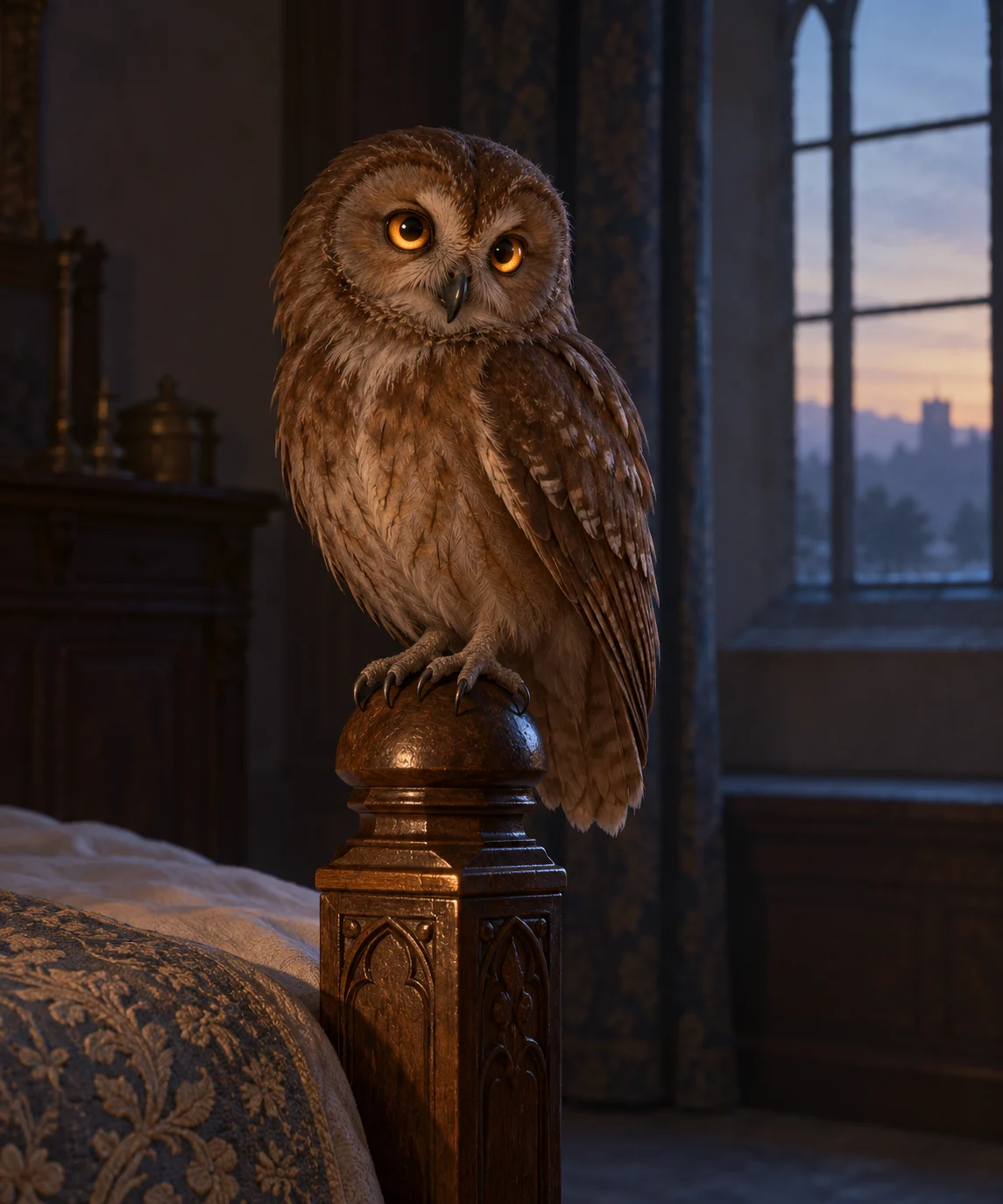
AI-generated interpretation of Hueffer’s Brown Owl; precise bird anatomy, eye colour and room staging are reconstructed.
The illustration selects the smaller companion form; it does not identify a natural owl species or reproduce F. Madox Brown’s illustrations.
Overview
The Brown Owl becomes Princess Ismara’s constant companion after the apparent death of her father, the magician King Intafernes. Before that parting, he makes her promise to cherish the Owl and never leave its sight. The creature appears where the King’s body had lain, then insists on accompanying the Princess. It has soft, dusky-brown feathers, a sharp beak and claws, and eyes bright enough to illuminate a dark bedroom. Their fierce light softens when directed at Ismara. It flies noiselessly to her, settles on her shoulder or bed and responds with nods and shakes of its head. Its comforting presence also helps her through her grief.
The Owl’s companionship becomes essential when the rebellious Chancellor Merrymineral challenges Ismara’s rule. While it is with her, his attempt to change her into a mouse fails and he cannot approach close enough to attack her. After he transforms three pages into water-rats, the Owl retrieves them and places them on the table, where they become men again. It can also seize and shake the otherwise unmanageable Chancellor. In the later battle it grows until its spread wings cover Ismara and the Prince of India. It pursues Merrymineral, catches his thrown battle-axe and sends it back against his dragon, then returns to the Princess’s shoulder at its smaller size. These episodes establish particular protective acts, not an unlimited rule that the Owl reverses every kind of magic.
The companion eventually speaks when necessary and answers thoughts Ismara has not uttered. It carries her through a wall and into the night, allowing her to overhear the supposed Knight of London plotting to seize her kingdom. Its help gives her knowledge with which to arrange a second tournament. At the final confrontation the Owl changes into King Intafernes, who exposes the handsome knight as Merrymineral and sentences him to ten thousand years underground. The King then resumes the Brown Owl’s form and departs, promising to visit every seven years. The ending identifies the royal and avian forms without supplying a detailed explanation of the earlier apparent death or a general law of resurrection.
First appearances & development
Ford H. Madox Hueffer’s authored English fairy story, consulted in the explicitly dated 1892 Cassell third edition. Its playful mixture of invented kingdoms and familiar place-names is literary geography, not a historical account or an independently collected owl tradition.
Canon & continuity
The complete retained narrative, including the final transformations and departure, and the dated title were read. The text’s corrections are disclosed in the retained electronic transcriber’s note. The two credited historical illustrations were not used as visual references.
Selected bibliography
Documented works and useful reading. This is not a list of every appearance.
- 01
The Brown Owl: A Fairy Story
Third edition; New York: Cassell Publishing Company. The title credits two illustrations to F. Madox Brown; no first-edition claim is made.
Family & connections
A source-supported family tree or inspiration record has not yet been compiled for this profile. Related reading below indicates a connection in subject matter, not a proven lineage or creative influence.
References
Sources supporting this profile. Linked pages have their own scope and editorial standards.
- Primary historical authored fictionThe Brown Owl — complete narrative and 1892 third-edition titleResearch access: 2026-10-18
Image credits
AI-generatedAI-generated interpretation of Hueffer’s Brown Owl; precise bird anatomy, eye colour and room staging are reconstructed.
The illustration selects the smaller companion form; it does not identify a natural owl species or reproduce F. Madox Brown’s illustrations.