
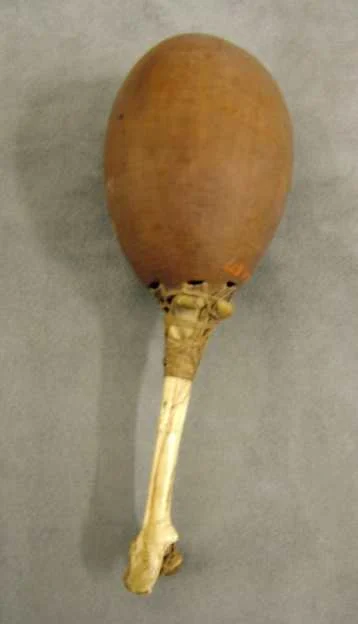
Gourd-and-bone rattle from Talamanca, Costa Rica, circa 1873, catalogued as probably Bribri by the Metropolitan Museum of Art
This gourd, bone and cord rattle comes from Talamanca, Costa Rica, and is dated circa 1873. The Met attributes it to the Bribri with the qualification “probably.” It is shown as a particular historical object with an uncertain attribution, rather than a universal instrument or a portrait of present-day Bribri communities.
Overview
Bribri communities are represented here through sources from Costa Rica’s Talamanca and Buenos Aires regions. Carlos Sánchez Avendaño’s university language overview describes Bribri on both the Atlantic and Pacific sides of the Talamanca range and places it within the Chibchan language family. It distinguishes geographical varieties commonly called Amubre, Coroma and Salitre. These labels identify linguistic variation, not three interchangeable political units. The same account emphasizes differences in language vitality from one settlement to another. Its older census measure is not used as a current test of who belongs to the Bribri people.
Bribri researcher and language adviser Alí García Segura has helped produce resources for learners alongside linguist Carla Jara Murillo. The University of Costa Rica’s 2009 announcement of their teaching book describes an audience including Bribri people learning to write their language and non-Indigenous learners seeking to communicate. García connected this work with understanding difficulties in communication between communities. The publication combined written material with an interactive course. The announcement establishes the project’s purpose and authorship; it does not substitute for reading the whole book or listening to its recordings, and learning the language does not by itself confer community membership.
In a 2022 interview with journalist Katzy O’neal Coto, García argued that recognition must extend beyond a commemorative day or official declarations. He called for educational materials built around communities’ languages, knowledge and ways of learning, and challenged institutions to act on their promises. He also criticized approaches that make outside models the measure of all education. These are a named Bribri intellectual’s arguments at a particular moment, rather than a claim that everyone shares an identical political position. They place language work within broader questions of autonomy and institutional responsibility.
Community organization also takes economic forms. Stibrawpa’s own history from Yorkín describes women seeking alternatives when declining cacao production and outside plantation work strained local livelihoods. The association moved from selling crafts elsewhere toward receiving visitors in Yorkín and sharing cultural activities locally. It recounts rebuilding after a destructive 2008 flood and contributing to community infrastructure and school activities. Its retrospective reaches 2017, so membership figures there are not treated as current. This is one association’s account of organizing livelihoods and community work, not evidence that tourism defines every Bribri community or that cultural knowledge is universally available to visitors.
García and Olivia Sylvester’s article on ulàpeitök offers a further account of intellectual collaboration. Its opening sections describe work begun in 2009 and situate the authors differently: García as a Bribri researcher trained by elders, Sylvester as a non-Indigenous collaborator. They argue that research should begin with community invitation and that communities should shape its purposes and resulting materials. The article presents reciprocity and relationships as foundations of inquiry, rather than treating Bribri knowledge merely as information collected by outsiders. These are the authors’ stated methodological commitments, not an independently verified account of every project. The journal labels the issue 2025 but records publication in March 2026; the complete opening framework and research-design sections were read here.
History & identity
Community histories precede the dates of university publications and particular associations; this source selection is geographically bounded to Costa Rica.
Sources & representation
Complete four written bodies read, including full2022 interview and 2009 announcement. No teaching-book, interactive-course or audio completion claim.
Selected bibliography
Documented works and useful reading. This is not a list of every appearance.
- 01
Se’ e’ yawö bribri wa: Aprendemos la lengua bribri
Bibliographic attestation; university news renders the Spanish title as Aprendamos. Full book not read.
- 02
Alí García: Menos discurso y más acción a favor de los pueblos milenarios
Complete19April2022 interview read; policy criticisms retain individual attribution and historical date.
- 03
Propuesta metodológica ulàpeitök: sabiduría y prácticas bribris para la investigación
Issue190 labelled2025; full sections1–3 read, not whole article.
Language & cultural connections
Source-supported language and cultural connections have not yet been compiled for this profile.
References
Sources supporting this profile. Linked pages have their own scope and editorial standards.
- University linguistic referenceDIPALICORI: Bribri regional language overviewResearch access: 2026-10-05
- Participating university publication reportUCR:2009 teaching-book announcementResearch access: 2026-10-05
- Named Indigenous intellectual’s interviewUCR:2022 Alí García interviewResearch access: 2026-10-05
- Community association historyStibrawpa: Nuestra historiaResearch access: 2026-10-05
- Authored researchSylvester and García: Propuesta metodológica ulàpeitökResearch access: 2026-10-05
Image credits
Contextual cultural object photograph with qualified attributionGourd-and-bone rattle from Talamanca, Costa Rica, circa 1873, catalogued as probably Bribri by the Metropolitan Museum of Art
This gourd, bone and cord rattle comes from Talamanca, Costa Rica, and is dated circa 1873. The Met attributes it to the Bribri with the qualification “probably.” It is shown as a particular historical object with an uncertain attribution, rather than a universal instrument or a portrait of present-day Bribri communities.