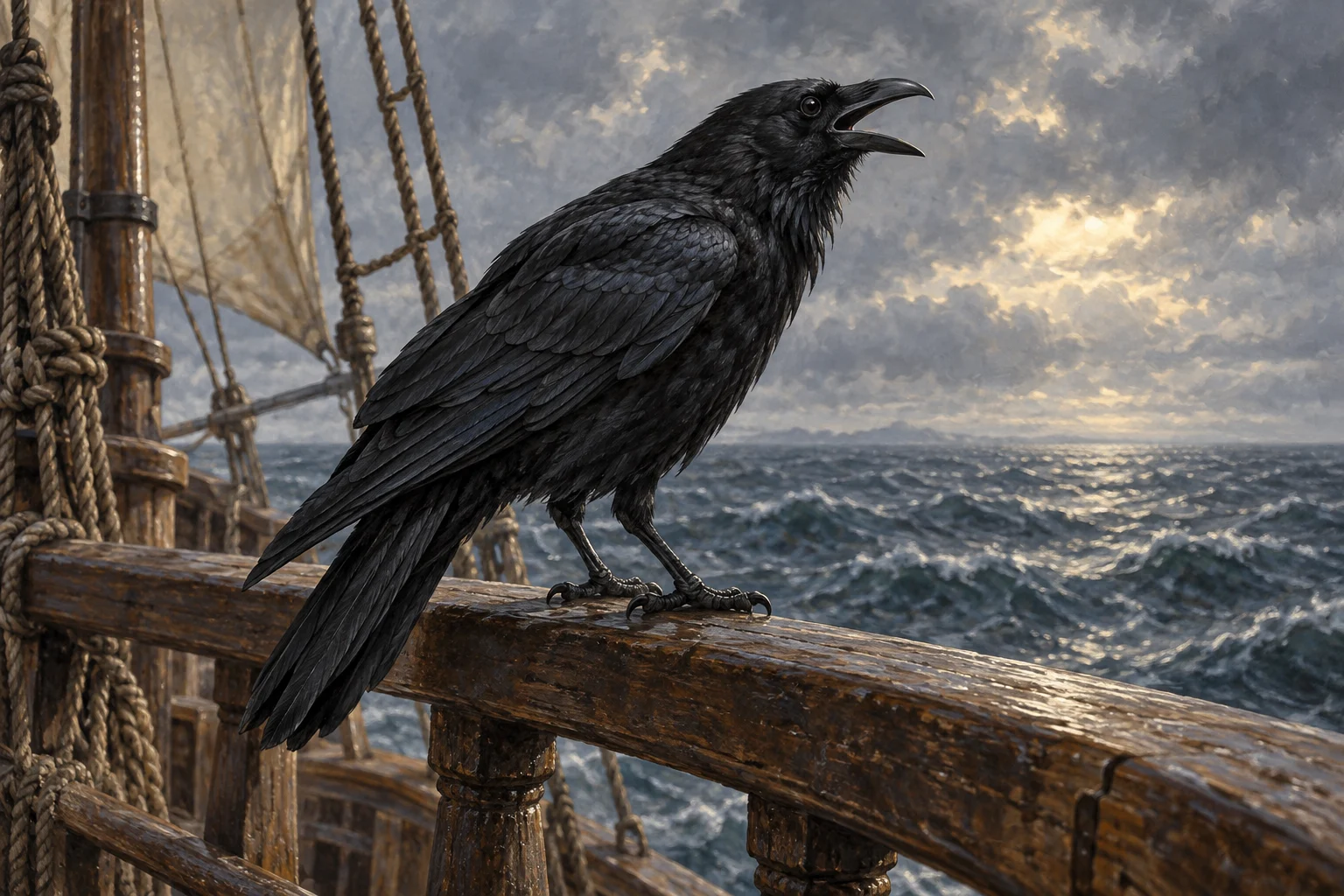
A large black bird with open beak perches on a ship railing above the sea.
AI-generated interpretation of the large black bird whose warning is heard at sea in Crane's In Love with a Statue (1885). Large size, black colour, voice and sea setting are textual; visibility, species, pose, ship, weather and light are choices. Original composition from Crane's 1885 English prose under the retained US/UK source assessment; no worldwide clearance asserted. Not a historical image; no original illustration copied. Compressed for display.
Overview
A large black bird speaks over the sea while an elder prince carries a dancing mouse, a singing bird and an abducted woman home to his younger brother. Its three warnings connect each gift with the brother’s dangerous fascination and say that explaining the danger will turn the messenger into marble. The bird’s voice is heard during the voyage; no physical encounter or attack by it is described.
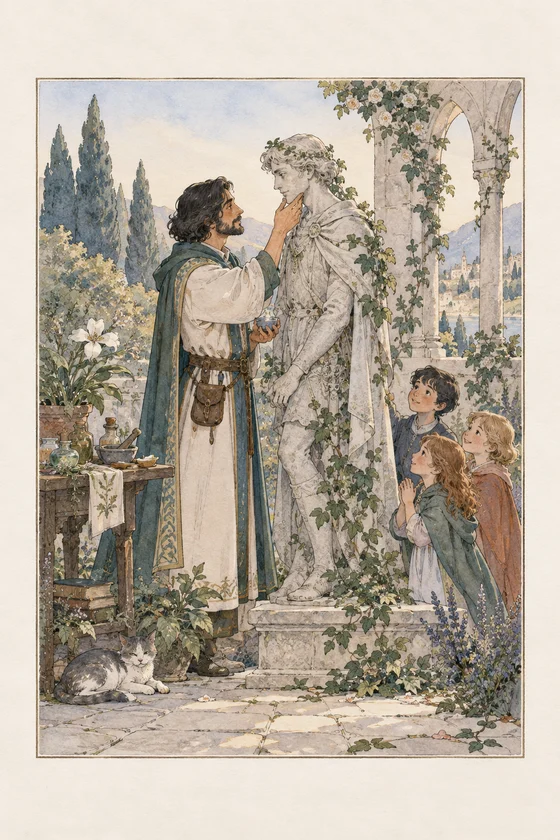
The elder brother kills the two animal gifts but presents the woman and remains silent. Imprisoned and condemned by his suspicious brother, he finally explains each warning and becomes stone progressively: first to his waist, then his breast, then completely. A physician restores him with the children’s blood and subsequently restores the children as well. That physician identifies himself as the woman’s magician father. The text does not explicitly identify the black bird as the father’s transformed body, so the two figures remain separate.
Origins & earliest records
Thomas Frederick Crane, Italian Popular Tales (1885), XVII, In Love with a Statue, pp. 85–88; identified source: Comparetti 29, L’Innamorato d’una Statua.
Records & interpretation
The creature is described in the specified historical English tale. Its actions belong to this account, rather than to a general species definition.
3D model
An original procedural model made for the Mythscribe World Builder. It is an interpretation based on this entry, not a historical source or a depiction from the records cited here.
Procedural folklore creature kit · 25,020 triangles · 1.4 MB
Opens mythscribe.cloud in a new tab. Sign-in is required.
Selected bibliography
Documented works and useful reading. This is not a list of every appearance.
- 01
Italian Popular Tales: XVII, In Love with a Statue, pp. 85–88
English witness; source attribution: Comparetti 29, L’Innamorato d’una Statua. Original-language collection not independently collated.
Family & connections
A source-supported family tree or inspiration record has not yet been compiled for this profile. Related reading below indicates a connection in subject matter, not a proven lineage or creative influence.
References
Sources supporting this profile. Linked pages have their own scope and editorial standards.
- Primary historical literary collectionCrane, Italian Popular Tales (1885): XVII, In Love with a Statue, pp. 85–88Research access: 2026-10-05
Image credits
AI-generated interpretationA large black bird with open beak perches on a ship railing above the sea.
AI-generated interpretation of the large black bird whose warning is heard at sea in Crane's In Love with a Statue (1885). Large size, black colour, voice and sea setting are textual; visibility, species, pose, ship, weather and light are choices. Original composition from Crane's 1885 English prose under the retained US/UK source assessment; no worldwide clearance asserted. Not a historical image; no original illustration copied. Compressed for display.