
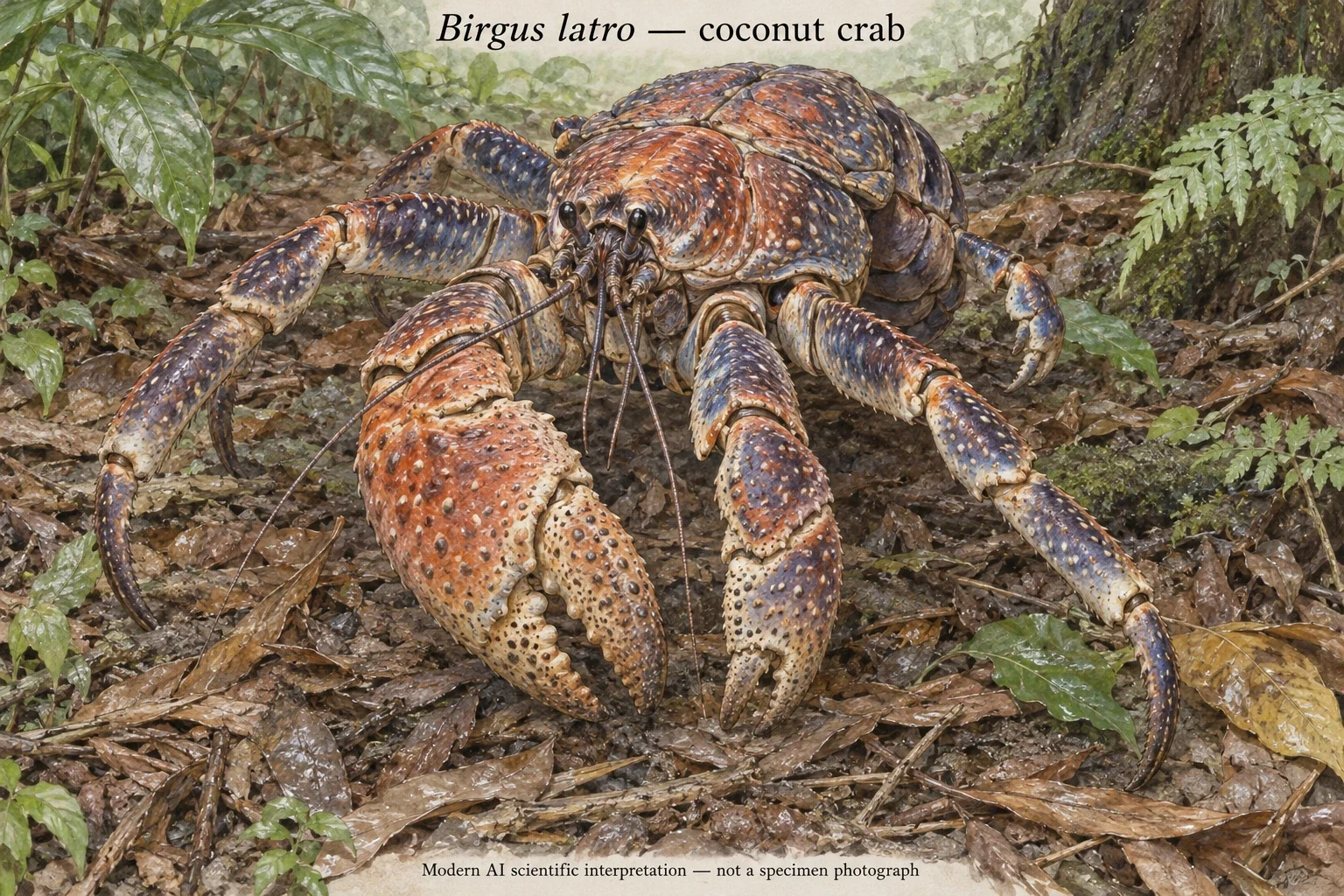
AI adult coconut crab.
Shell-free hardened adult abdomen follows retained accounts. Colour, appendage details and setting imagined; not specimen or diagnostic leg-count evidence.
Overview
FAO places terrestrial Birgus latro in Coenobitidae, the sole species of its genus. Young crabs occupy discarded shells near the coast, then discard them and move inland. Thoracic lungs support terrestrial life; reproduction retains an ocean connection.
Parks Australia describes a hardened adult abdomen and young animals carrying shells or coconuts. On Christmas Island, crabs shelter during daylight and emerge at night or in overcast weather. They forage on forest-floor fruit, seeds and fallen-tree pith, scavenge animal carcasses and climb trunks or rock faces. These are local institutional observations, not a uniform diet or schedule everywhere.
The Niue report records 1990 fieldwork, slow growth, irregular recruitment and exploitation vulnerability. Planktonic dispersal makes recruitment dependent on larval survival, currents and shore habitat. Historical laws and abundance statements are not present-day assessments.
Origins & earliest records
Coenobitid; evolutionary dates unestablished.
Evidence & interpretation
Retained FAO survey and Parks ecology passages; NHM unavailable.
Selected bibliography
Documented works and useful reading. This is not a list of every appearance.
- 01
- 02
Robber crab
Christmas Island habitat, activity and life stages.
Family, evolution & connections
Taxonomic classification
A hierarchy of classified groups, not a chain of direct ancestors.
Source note: FAO family and monospecific genus.
- FamilyCoenobitidae
- GenusBirgus
- SpeciesBirgus latro
References
Sources supporting this profile. Linked pages have their own scope and editorial standards.
- Primary field reportFAO Niue surveyResearch access: 2026-10-11
- Institutional ecologyParks robber crabResearch access: 2026-10-11
Image credits
AI-generated interpretationAI adult coconut crab.
Shell-free hardened adult abdomen follows retained accounts. Colour, appendage details and setting imagined; not specimen or diagnostic leg-count evidence.