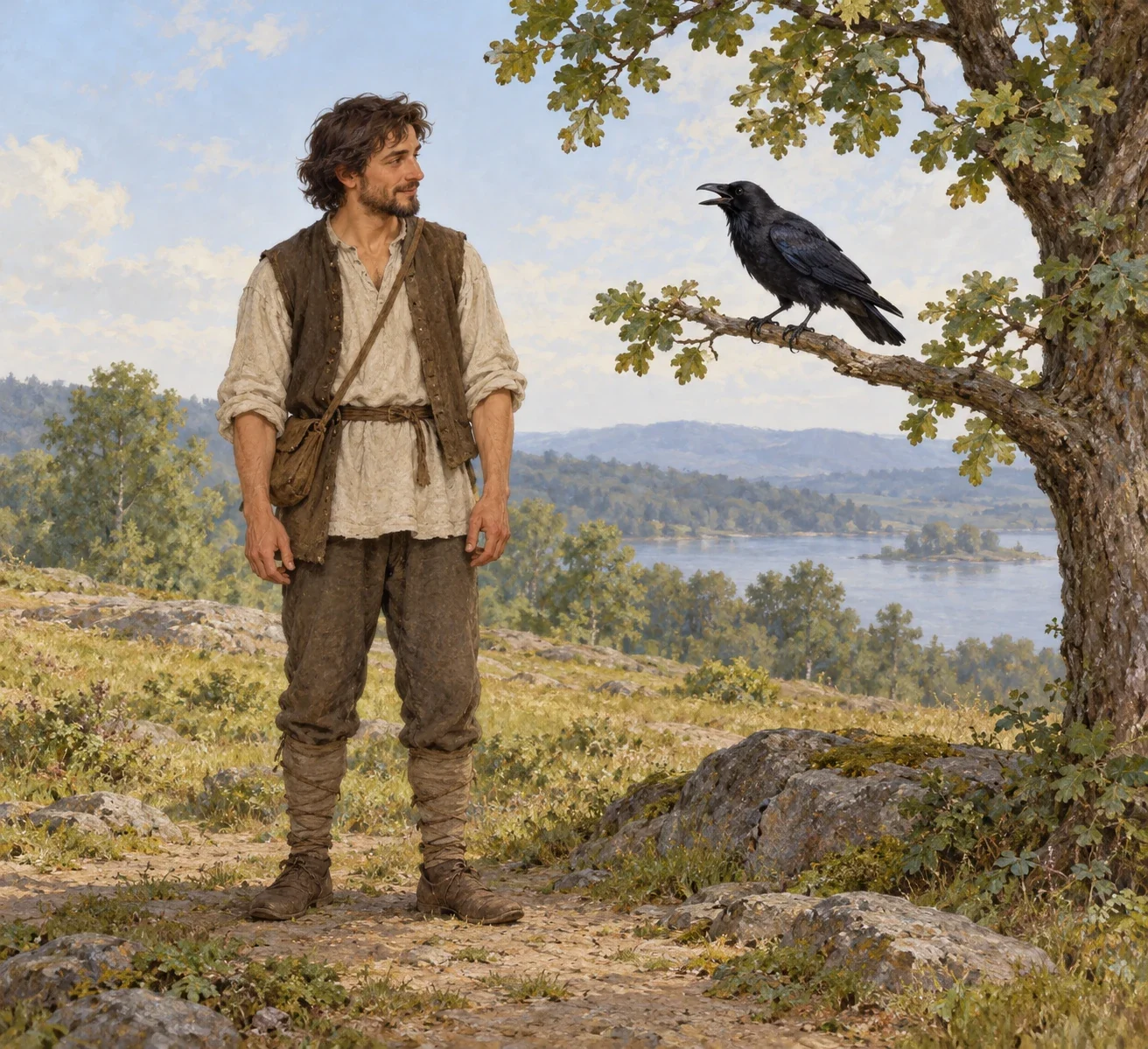
AI-generated narrative interpretation of the birdcatcher and freed crow before royal service. Face, clothing, bird detail and landscape are artistic choices, not an authenticated portrait, costume or place. The source’s later violence remains in the profile.
Historical collected narrative through Jukih/Erben/Wratislaw; no ethnic costume or geographic place authenticated.
Overview
A man near Constantinople supports himself by catching birds for sale and food. One day he takes home a crow for his children. When his wife urges him to kill it, the crow asks for freedom and promises to make him prosperous. He releases her, and she brings him two nightingales. Their singing attracts the grand vizier and then the emperor. Rather than simply rewarding the catcher, the emperor orders him to find their mother under threat of losing his head.
The crow devises a feast using the emperor’s wheat, identifies the mother among the assembled birds and helps him catch her. Next the emperor demands the birds’ mistress. Following the crow’s plan, the catcher takes a boat loaded with merchandise, waits for the woman to approach and carries her away when the crow marks her by perching on her shoulder. The emperor takes her into his household. Her subsequent hostility to the catcher follows this abduction, rather than an unexplained evil nature supplied by the profile.
The woman says that half her broken ring fell into the sea and asks for its recovery. The crow again directs the operation: the emperor supplies oil, the catcher pours it at the place, and the crow enters the agitated water and retrieves the fragment. The tale also repeatedly makes beating the catcher’s wife a condition of the crow’s help. Before the last ordeal he beats her so severely that she dies. These actions remain part of the account, not harmless comic rewards or instructions endorsed by this profile.
The captive woman finally agrees to marry the emperor if he destroys the birdcatcher. Ordered into a fire, the catcher follows the crow’s instructions, obtains a horse, covers himself with its foam and passes through the flames. He emerges as a handsome youth of twenty. The emperor imitates him, hoping for the same renewal, but burns to death. The people install the catcher as emperor; a selected damsel becomes sultana and the crow receives a senior court position. The ending grants him power without erasing the violence behind his success or establishing ordinary immunity to fire.
Origins & earliest records
J. F. Jukih’s Bosnian Friend, volume i, through Erben’s 1865 anthology and A. H. Wratislaw’s 1889 English translation. The inspected section is headed Serbian Stories from Bosnia. This historical editorial label is retained as a source association, without assigning every narrator or figure to a present nationality, religion or ethnic community. No individual narrator or exact field locality is established.
Records & interpretation
Complete XLV, printed pp.239–246; full preface and Bosnian section introduction. Contents credits Ptichar to J. F. Jukih, Bosnian Friend i.114.
Selected bibliography
Documented works and useful reading. This is not a list of every appearance.
- 01
Sixty Folk-Tales from Exclusively Slavonic Sources
London, Elliot Stock. Selected complete XLV and XLVI, original preface, regional framing and contents source credits inspected.
Family & connections
A source-supported family tree or inspiration record has not yet been compiled for this profile. Related reading below indicates a connection in subject matter, not a proven lineage or creative influence.
References
Sources supporting this profile. Linked pages have their own scope and editorial standards.
- Historical translated collected narrative with printed source attributionWratislaw1889 — complete XLV The Birdcatcher; preface, source credits and Bosnian framingResearch access: 2026-10-23
Image credits
AI-generated narrative illustrationAI-generated narrative interpretation of the birdcatcher and freed crow before royal service. Face, clothing, bird detail and landscape are artistic choices, not an authenticated portrait, costume or place. The source’s later violence remains in the profile.
Historical collected narrative through Jukih/Erben/Wratislaw; no ethnic costume or geographic place authenticated.