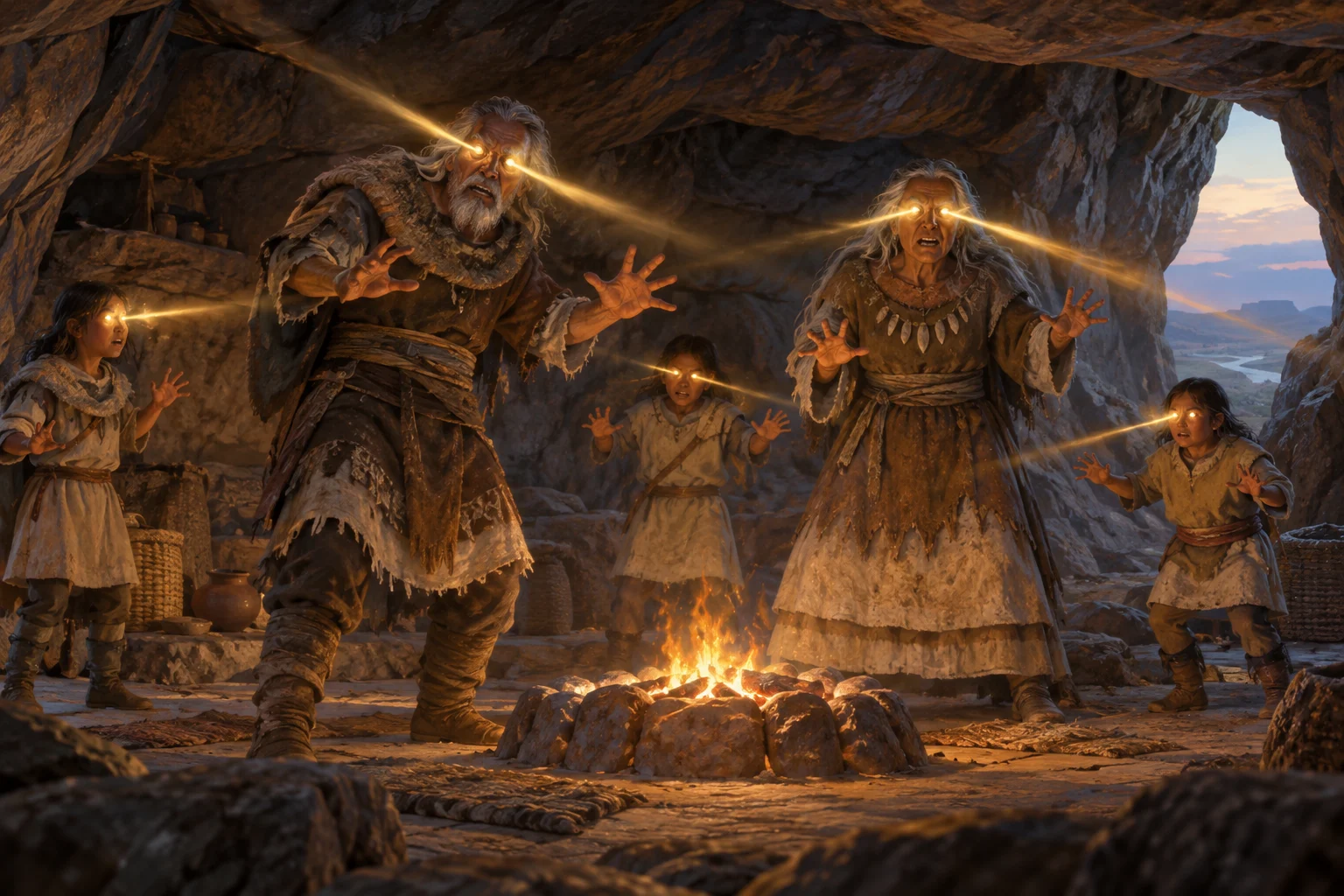
AI interpretation of Binaye Ahani. An imaginary older pair with several imaginary young figures inside a natural rock shelter, stylized lightning rays from their eyes. Generic invented garments, no injuries; neither living-community portraits nor authentic regalia. The number and visible appearance of the young are illustrative rather than a household census.
AI-generated unofficial original narrative interpretation. Selected scene: An imaginary older pair with several imaginary young figures inside a natural rock shelter, stylized lightning rays from their eyes. Generic invented garments, no injuries; neither living-community portraits nor authentic regalia. The number and visible appearance of the young are illustrative rather than a household census. Fine anatomy, garments, objects and setting are modern AI imagined visual details, not an historical reconstruction, community portrait, authentic artifact or evidence of living practice.
Overview
Abandoned twins in an earlier episode grow at Rock with Black Hole, a natural rock house. When the hero enters it later, an older pair and numerous children emit lightning from their eyes. His armour resists them, and their eyes protrude as they strain. Salt thrown into the central fire spatters and blinds them. He kills the adults and most children with his stone weapon.
One spared youngster becomes Tsidiltoi, a bird who reports what people cannot see and warns of enemies. The other becomes Hostodi, linked with night activity and making the earth beautiful. Their roles are distinct and no unverified modern species is assigned. Torlino's Version A supplies the salt through Salt Woman; Hatali Nez's principal version does not include her. This difference remains explicit rather than filling an apparent omission from another teller.
Origins & earliest records
Matthews published Navaho Legends in 1897. His introduction identifies Hatali Nez as the principal Origin Legend witness, Torlino as Version A and Jake the silversmith as Version B; supplementary matter is distinguished in notes. He used readable rather than strictly literal English and reports winter storytelling restrictions. This published narrative is not a complete ceremonial transcription or every Diné version.
Records & interpretation
Origin Legend paragraph 203 and paragraphs 343-346; notes 146-147. Complete selected episode, variant notes where cited, and the introduction on versions and translation read. No ritual formulas or practical ceremonial directions reproduced.
3D model
An original procedural model made for the Mythscribe World Builder. It is an interpretation based on this entry, not a historical source or a depiction from the records cited here.
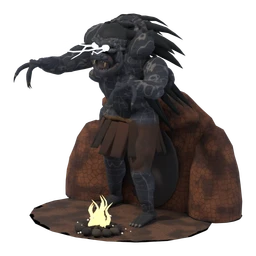
Procedural folklore creature kit · 29,068 triangles · 2.1 MB
Opens mythscribe.cloud in a new tab. Sign-in is required.
Selected bibliography
Documented works and useful reading. This is not a list of every appearance.
- 01
Navaho Legends: Origin Legend
Origin Legend paragraph 203 and paragraphs 343-346; notes 146-147.
Family & connections
A source-supported family tree or inspiration record has not yet been compiled for this profile. Related reading below indicates a connection in subject matter, not a proven lineage or creative influence.
References
Sources supporting this profile. Linked pages have their own scope and editorial standards.
- Primary textMatthews 1897: Origin Legend paragraph 203 and paragraphs 343-346; notes 146-147.Research access: 2026-10-05
Image credits
AI-generated interpretationAI interpretation of Binaye Ahani. An imaginary older pair with several imaginary young figures inside a natural rock shelter, stylized lightning rays from their eyes. Generic invented garments, no injuries; neither living-community portraits nor authentic regalia. The number and visible appearance of the young are illustrative rather than a household census.
AI-generated unofficial original narrative interpretation. Selected scene: An imaginary older pair with several imaginary young figures inside a natural rock shelter, stylized lightning rays from their eyes. Generic invented garments, no injuries; neither living-community portraits nor authentic regalia. The number and visible appearance of the young are illustrative rather than a household census. Fine anatomy, garments, objects and setting are modern AI imagined visual details, not an historical reconstruction, community portrait, authentic artifact or evidence of living practice.