
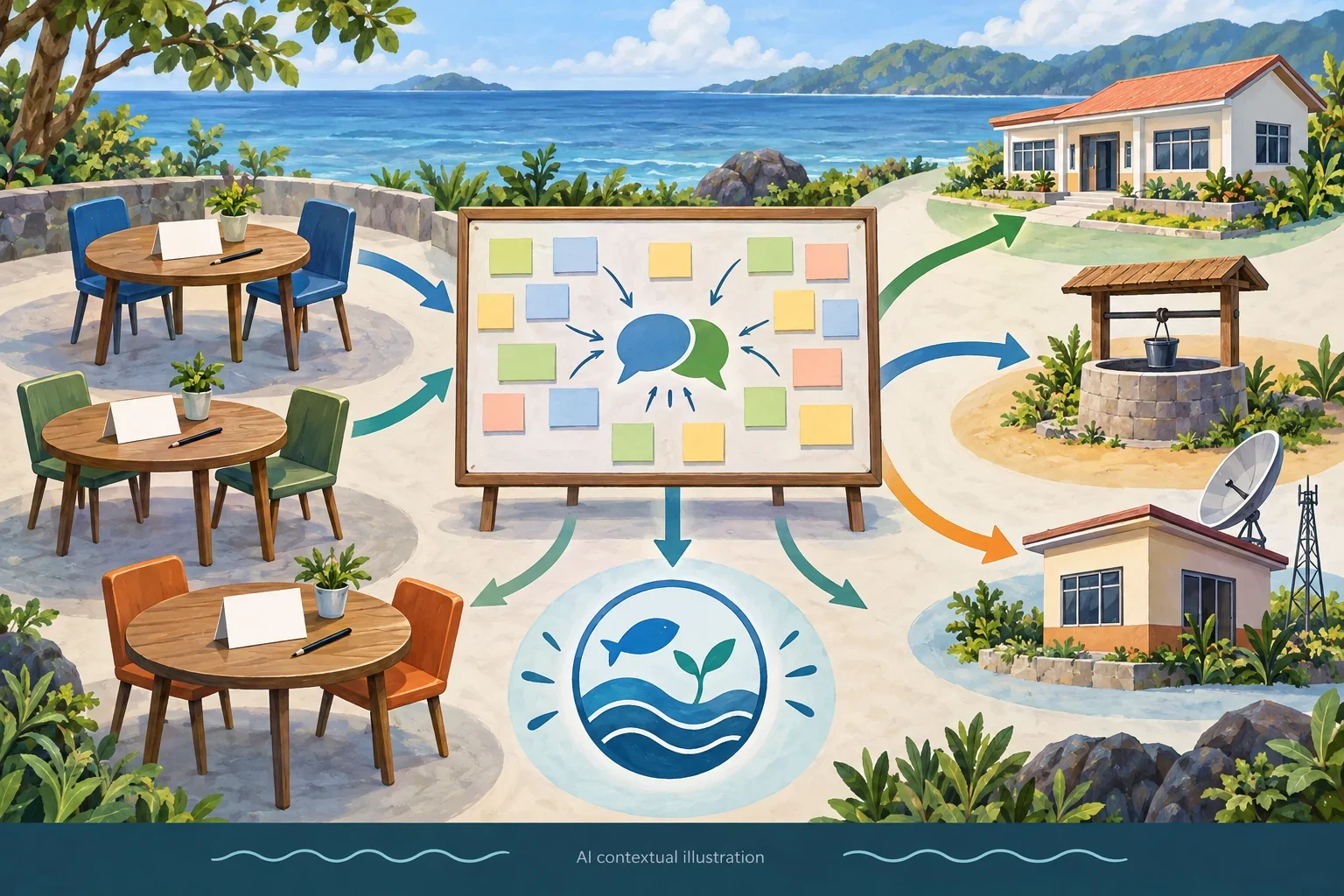
Imagined community deliberation linked with marine care and public services.
Setting, tools and layout imagined; not ethnographic evidence.
Overview
Tiniguena describes Urok’s community marine protected area as emerging from participatory development in the Bijagós archipelago. Resident communities tested resource-use rules incorporated into a management plan approved with the area’s creation in 2005. This selected local history concerns living Bijagó communities; it does not make all archipelago residents interchangeable or reproduce their restricted knowledge.
The community management council’s Equator Initiative account describes village committees, island assemblies and an Urok general assembly, alongside women’s and youth forums. It connects co-management with schools, community centres, water provision and radio. These reported arrangements show negotiated public institutions, rather than a timeless claim about every Bijagó community or permission to depict ceremonies.
History & identity
Living communities through selected Urok partnership accounts.
Sources & representation
Selected public institutional passages retained.
Selected bibliography
Documented works and useful reading. This is not a list of every appearance.
- 01
- 02
Language & cultural connections
Source-supported language and cultural connections have not yet been compiled for this profile.
References
Sources supporting this profile. Linked pages have their own scope and editorial standards.
- Local conservation partner accountGovernação ParticipativaResearch access: 2026-10-11
- Community governance case studyConseil de Gestion des îles UROKResearch access: 2026-10-11
Image credits
AI contextual interpretationImagined community deliberation linked with marine care and public services.
Setting, tools and layout imagined; not ethnographic evidence.