
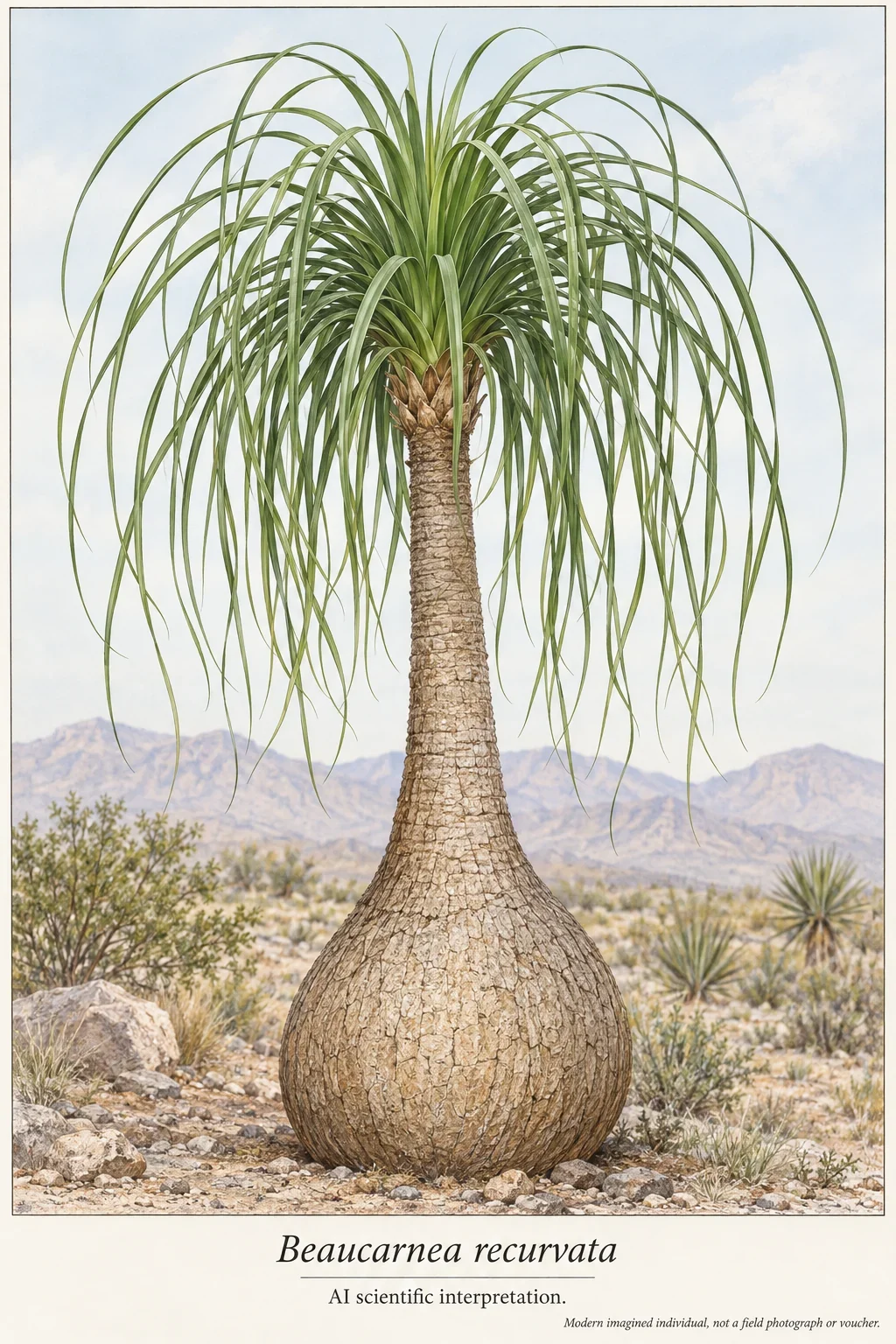
AI scientific interpretation of Beaucarnea recurvata.
AI scientific interpretation of an imagined Beaucarnea recurvata.
Overview
NParks describes a tree with a massively swollen base, usually unbranched when young and sometimes branching with maturity. Narrow green leaves emerge in dense spiral tufts at the branch tips, arching upward before drooping. Small cream-white flowers appear in large clusters.
Missouri Botanical Garden explains the swollen caudex as a water-storage structure associated with Mexico’s semi-desert conditions. Its houseplant guidance specifies full sun and dry to medium watering, with a cultivated height of six to eight feet. These indoor dimensions do not define the species’ wild maximum.
NParks lists southeastern Mexico as the native range and records slow growth, seed propagation and a preference for well-drained soil. Its account assigns the species to Asparagaceae under APG III, while noting older family placements. The palm-like appearance is a growth-form comparison rather than membership of the true palm family.
Origins & earliest records
Institutional botany and cultivation accounts connect the distinctive caudex with water storage.
Evidence & interpretation
Leaf-margin descriptions within the NParks page differ; no precise margin diagnosis is adopted.
Selected bibliography
Documented works and useful reading. This is not a list of every appearance.
- 01
- 02
Family, evolution & connections
Taxonomic classification
A hierarchy of classified groups, not a chain of direct ancestors.
Source note: Family placement follows the explicitly cited APG III treatment.
- FamilyAsparagaceae
References
Sources supporting this profile. Linked pages have their own scope and editorial standards.
- Institutional floraBeaucarnea recurvataResearch access: 2026-10-11
- Institutional horticultureHouseplantsResearch access: 2026-10-11
Image credits
AI-generated interpretationAI scientific interpretation of Beaucarnea recurvata.
AI scientific interpretation of an imagined Beaucarnea recurvata.