
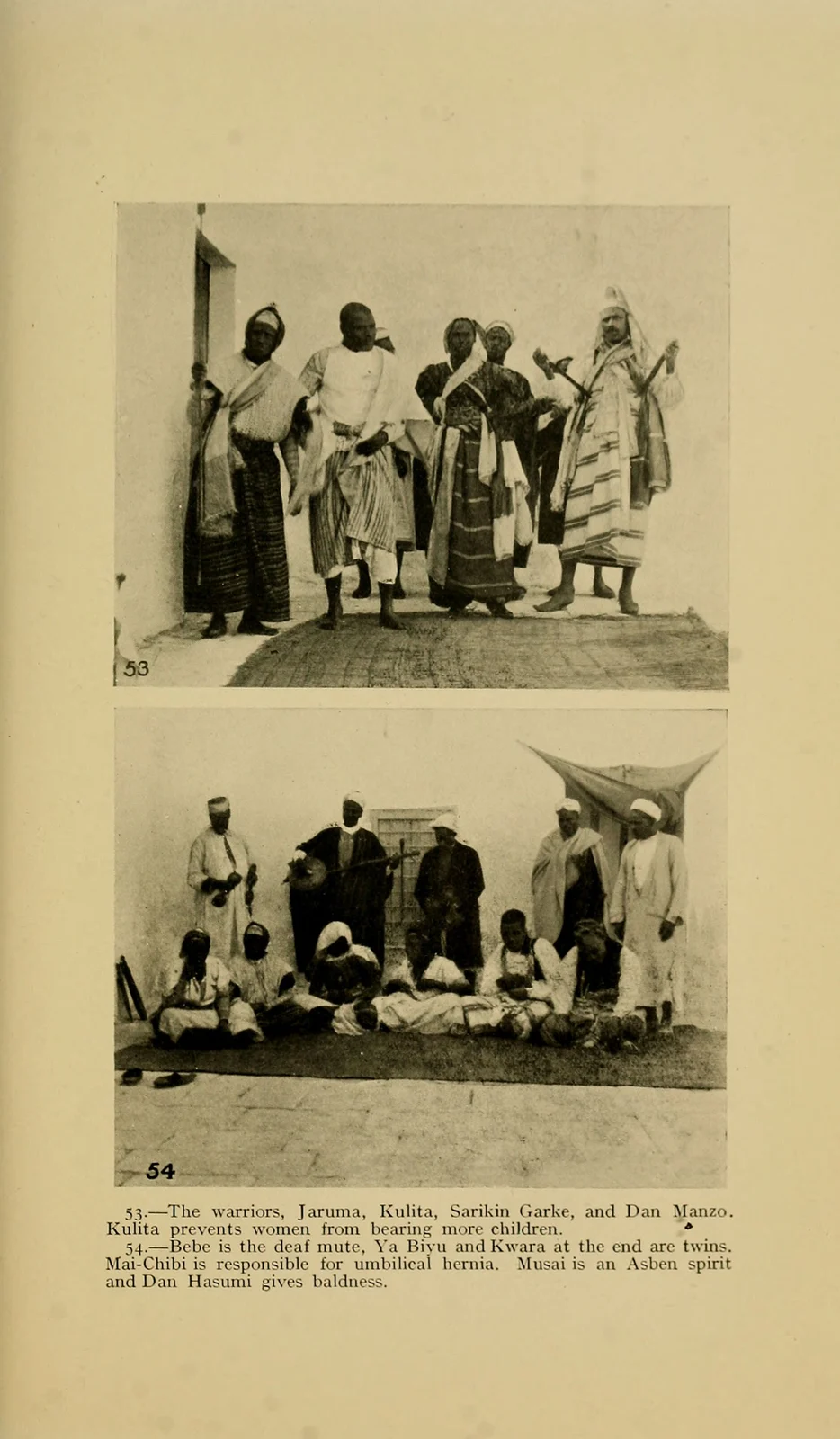
Human representatives of Sarikin Garke and other named warrior spirits in photograph53, 1914
The upper photograph53 names Sarikin Garke alongside Jaruma, Kulita and Dan Manzo. The source’s uncertain relationship between Baraje and Sarikin Garke is retained in the profile. This is a named group representation, not proof that every account treats those names as identical.
Overview
Baraje is identified with Sarikin Garke, Chief of the Shield-Wearers, by some informants and distinguished by others. His representation plants a spear in the ground, crosses the right foot over the left and back three times, then turns and repeats with the left foot. The song tells him to gird his loose clothing for action and connects him with Yar-Maso, the butcher’s daughter. The uncertain identity remains within one profile of these linked notices.
The account also describes a consultation concerning the outcome of a venture. After offerings and incense summon him, further incense is used. An appearance in white clothing on a white horse is taken to promise help and success, while black clothing and a black horse indicate failure. These are the recorded contrasting visions and their interpretation within the practice, rather than a demonstrated method of predicting events.
Origins & earliest records
A. J. N. Tremearne combines interviews and descriptions of bori performances with comparative interpretation. These selected notices do not consistently name individual speakers; printed attributes are distinguished from his conjectures.
Records & interpretation
Complete selected notice in chapter XXV, printed pp. 357–358; full chapter read.
Selected bibliography
Documented works and useful reading. This is not a list of every appearance.
- 01
The Ban of the Bori: Demons and Demon-Dancing in West and North Africa
Chapter XXV, printed pp. 357–358; complete spirit notice, song and attributed relationships.
Family & connections
A source-supported family tree or inspiration record has not yet been compiled for this profile. Related reading below indicates a connection in subject matter, not a proven lineage or creative influence.
References
Sources supporting this profile. Linked pages have their own scope and editorial standards.
- Digitized historical ethnographic accountTremearne — Baraje (Sarikin Garke)Research access: 2026-10-05
Image credits
Historical ritual performance photographHuman representatives of Sarikin Garke and other named warrior spirits in photograph53, 1914
The upper photograph53 names Sarikin Garke alongside Jaruma, Kulita and Dan Manzo. The source’s uncertain relationship between Baraje and Sarikin Garke is retained in the profile. This is a named group representation, not proof that every account treats those names as identical.